



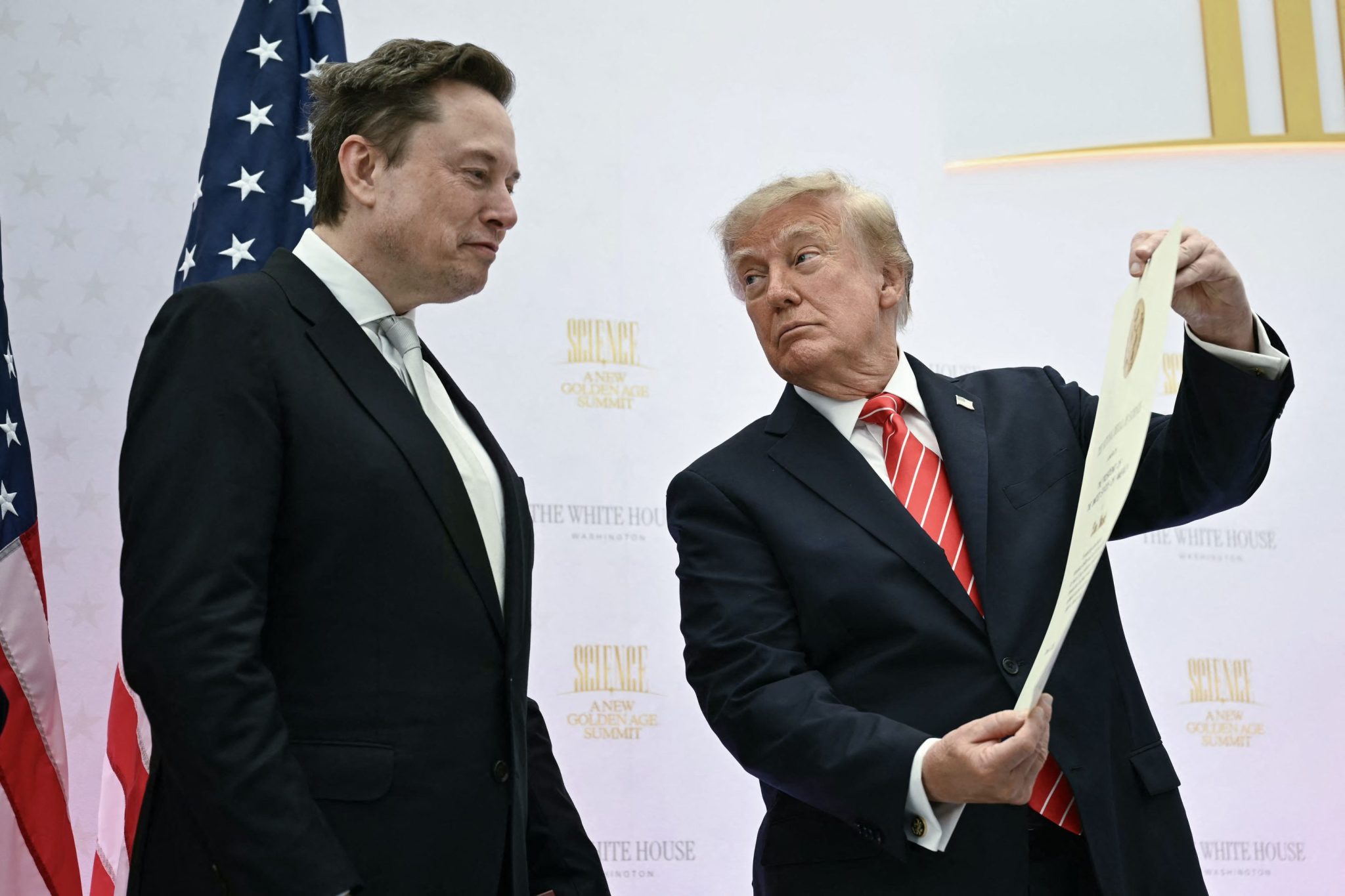
After topping 2024’s donor list, Elon Musk said he’d do ‘a lot less.’ Since then, he’s given more than George Soros has personally in his lifetime
In May 2025, Elon Musk said he was pulling back from political spending.
“I think in terms of political spending, I’m going to do a lot less in the future,” Musk said in an interview with Bloomberg at the Qatar Economic Forum. “I think I’ve done enough.”
He then left room to change course: “Well, if I see a reason to do political spending in the future, I will do it,” he said. “I don’t currently see a reason.”
He had just finished the 2024 election cycle as the country’s biggest political donor, according to OpenSecrets. That year, he gave $291.5 million, all to Republicans. The next-largest donor, Timothy Mellon, gave $197 million.
In the 17 months since, Musk has given $427.5 million to federal political committees, according to a Fortune analysis of Federal Election Commission filings through Oct. 14. That’s nearly $200 million more than George Soros, the man Musk has claimed “astroturfed” anti-Tesla protests. Soros, the Democratic megadonor, has given personally $243.2 million to federal committees in 47 years of FEC records.
How much has Musk contributed?
Most of Musk’s money arrived after July 1 of this year. SLF PAC, the flagship super PAC for Republican Senate candidates, reported a $75 million check from Musk on Sept. 9 and an $83 million check on Sept. 23. Musk has spent more than $200 million to help elect Ken Paxton, the Texas attorney general, to the Senate, according to a New York Times analysis.
America PAC, the super PAC Musk funds, reported $165.6 million from him between July 1 and Oct. 14, in its October quarterly and pre-general reports. That includes $8 million in in-kind support from United States of America Inc., one of his companies, which America PAC attributed to Musk.
He also gave $20 million on Sept. 4 to the Congressional Leadership Fund, the main super PAC for House Republican candidates. And on Aug. 21, his trust gave $10 million to Lone Star Liberty PAC, which supports Paxton, who is running against Democrat James Talarico.
Other counts put him higher. The Times and OpenSecrets rank Musk as the top donor of the 2026 midterms, at $445.6 million for the full cycle (outside of the FEC, a Fortune analysis of IRS filings found he gave $10 million to the Republican Governors Association and $2 million to the Republican Attorneys General Association on July 6). The Brennan Center for Justice, which counts his company alongside him, puts the total at $483 million.
How much has Soros contributed?
Soros’s largest personal checks came before July 2026. He gave Democracy PAC II, one of his family’s two super PACs, $125 million in September 2021 and $50 million in November 2022. In the 2024 cycle, he gave $4.2 million personally to federal committees, FEC records show.
Soros has also given $67.8 million to political groups that report to the IRS, including $24.2 million to Justice & Public Safety PAC, according to IRS filings. FollowTheMoney, which compiles state campaign finance records, lists about $70 million more in state and local contributions. Together, that comes to about $381 million, still less than Musk has given since May 2025.
The comparison changes if groups Soros funds are counted. The Fund for Policy Reform, a nonprofit, has given $210.5 million to Democracy PAC since 2020, including $60 million in January 2024 and $50 million in January 2026, but the nonprofit doesn’t disclose its donors. The Times describes it as a channel for Soros family money and notes that Alex Soros, George’s son, is a director. Counting the fund, Soros’s federal total is $453.7 million, more than Musk has given since his remarks.
The Times counts George and Alex Soros together at $103.4 million this cycle and reports that the family’s two super PACs held about $173 million in cash as of mid-October.
Over his lifetime, Musk has given $723.8 million to federal committees, about three times Soros’s personal federal total, according to Fortune’s analysis of FEC filings. Fortune’s analysis counts contributions each man made to federal political committees as reported to the FEC, including in-kind gifts that recipients attributed to them, and excludes duplicate memo entries. Musk’s totals run through Oct. 14, 2026; Soros’s run through Sept. 9, 2026.
Musk’s totals exclude donations to groups that don’t disclose their donors, as well as any money given after Oct. 14.
This story was orig
How Trump’s trade policy is handing Asia to Beijing
For a decade, Washington urged the world’s manufacturers to move their factories out of China and into friendly Southeast Asian states—only to attack the very countries and companies that answered the call.
Usually, U.S. economic statecraft is designed to help American companies succeed abroad. President Donald Trump’s punitive trade program is having the reverse effect. Broad-based import taxes have jolted manufacturers across ASEAN (the Association of Southeast Asian Nations), including American ones.
Rather than checking China, trade policy is alienating regional partners, harming supply-chain diversification, and eroding America’s influence over the bloc’s trade decisions. The U.S. is engaged in what Evan Feigenbaum, a veteran diplomat and former Republican, terms a “reverse pivot.” Bogged down in foreign crises elsewhere, Washington now projects hesitation and retreat in Asia rather than dynamic leadership.
In the months after President Trump’s April 2025 announcement of “Liberation Day” tariffs, some of ASEAN’s non-tariff barriers fell. A few countries used the exogenous threat to bring about needed reforms. Deals were done, including Boeing sales and–at least prospective–LNG contracts. It appeared that coercion worked, at least in the short term. In February the Supreme Court struck down much of the initial tariff regime and the administration pivoted to workarounds: 150-day emergency measures under Section 122 of the Trade Act of 1974, and expansive Section 301 investigations into forced labor, intellectual property violations, and “excess capacity.”
America’s labor, intellectual property, and excess-capacity concerns are really about China, not Southeast Asia. The administration substituted an improvised China policy for a coherent Southeast Asia policy—a strategic blunder. By treating regional partners as collateral damage to show that China isn’t singled out, Washington is undercutting its most reliable partners and allies.
Nowhere is the absurdity of this approach more evident than in the supply chains themselves. For nearly a decade, multinational corporations have redirected capital and manufacturing from China into Vietnam, Malaysia, India, and the Philippines. The goal of these “China plus one” strategies was to insulate critical industries from geopolitical risk and move them into friendly states.
Washington’s tariff regime now undercuts this strategy. Southeast Asian export hubs suffer far more than the United States when Chinese firms attempt illicit transshipment, while subsidized Chinese overcapacity squeezes local producers. The broader reality, though, is not widespread evasion but deep and legitimate supply-chain integration. By imposing blanket punitive duties, Washington is tightening the vise on the very partners helping achieve that diversification.
As Deborah Elms, head of trade policy at the Hinrich Foundation, has observed, Washington created the incentive structure for alternate supply routes and is now penalizing regional partners for using them.
These tariffs aren’t even achieving Trump’s stated goals. Higher costs and a shortage of skilled domestic labor mean production lines won’t magically shift to U.S. shores. Bilateral trade deficits with Southeast Asian economies remain largely unchanged; regional exporters, U.S. importers, and consumers are simply absorbing higher costs.
ASEAN nations have long been masters of dynamic hedging—exemplified by Vietnam’s “bamboo diplomacy”—balancing China against the United States. None of them want to be dominated by Beijing, making Washington their natural partner. Yet as U.S. policy grows increasingly erratic and punitive, it inadvertently pushes them to hedge elsewhere.
As Canadian Prime Minister Mark Carney warned at the World Economic Forum in Davos in January, the weaponization of economic tools forces middle powers to organize: “If we are not at the table, we are on the menu.”
Coercive tactics failed with Canada, and they will fail in Asia. Recently, politically appointed U.S. ambassador to Singapore Anjani Sinha told local and international business leaders that he received orders from the President to “bring home the money,” so they needed to double their U.S. investments. The demand went over like a lead balloon. Capital flows are not surging into the United States; they are pivoting further into Asia.
This friction runs counter to decades of bipartisan precedent. Since the 1985 Plaza Accord, which catalyzed an era of industrial integration in Southeast Asia, American leaders have recognized that regional partners thrive under predictable, rules-based frameworks rather than blunt coercion. Today’s transactional posture risks creating a durable trust deficit that will penalize American enterprise for a generation.
Since America pulled out of the Trans-Pacific Partnership in favor of country-by-country negotiations, its absence at the table has been filled by others. ASEAN is now building institutional networks that bypass Washington altogether. Member states are working with accords like the Regional Comprehensive Economic Partnership (RCEP) and the Comprehensive and Progressive Agreement for Trans-Pacific Partnership (CPTPP).
American companies have not forgotten the benefits of clear rules of the road in a multilateral context. They have worked closely with ASEAN negotiators toward the ASEAN Digital Economy Framework Agreement (DEFA). Spanning 11 nations, nearly 700 million consumers, and an estimated $2 trillion digital marketplace, DEFA would establish comprehensive standards for cross-border data governance, cybersecurity, digital identity, and artificial intelligence.
As Washington retreats behind tariffs and procedural disputes, Southeast Asia—with input from U.S. companies—is writing the regulatory architecture of the 21st-century digital economy.
Washington builds walls while ASEAN builds architecture.
Southeast Asia does not wish to decouple from the United States. Four ASEAN nations—Vietnam, Thailand, Mal
Apple outpaces sales expectations as it continues to battle surging memory chip costs
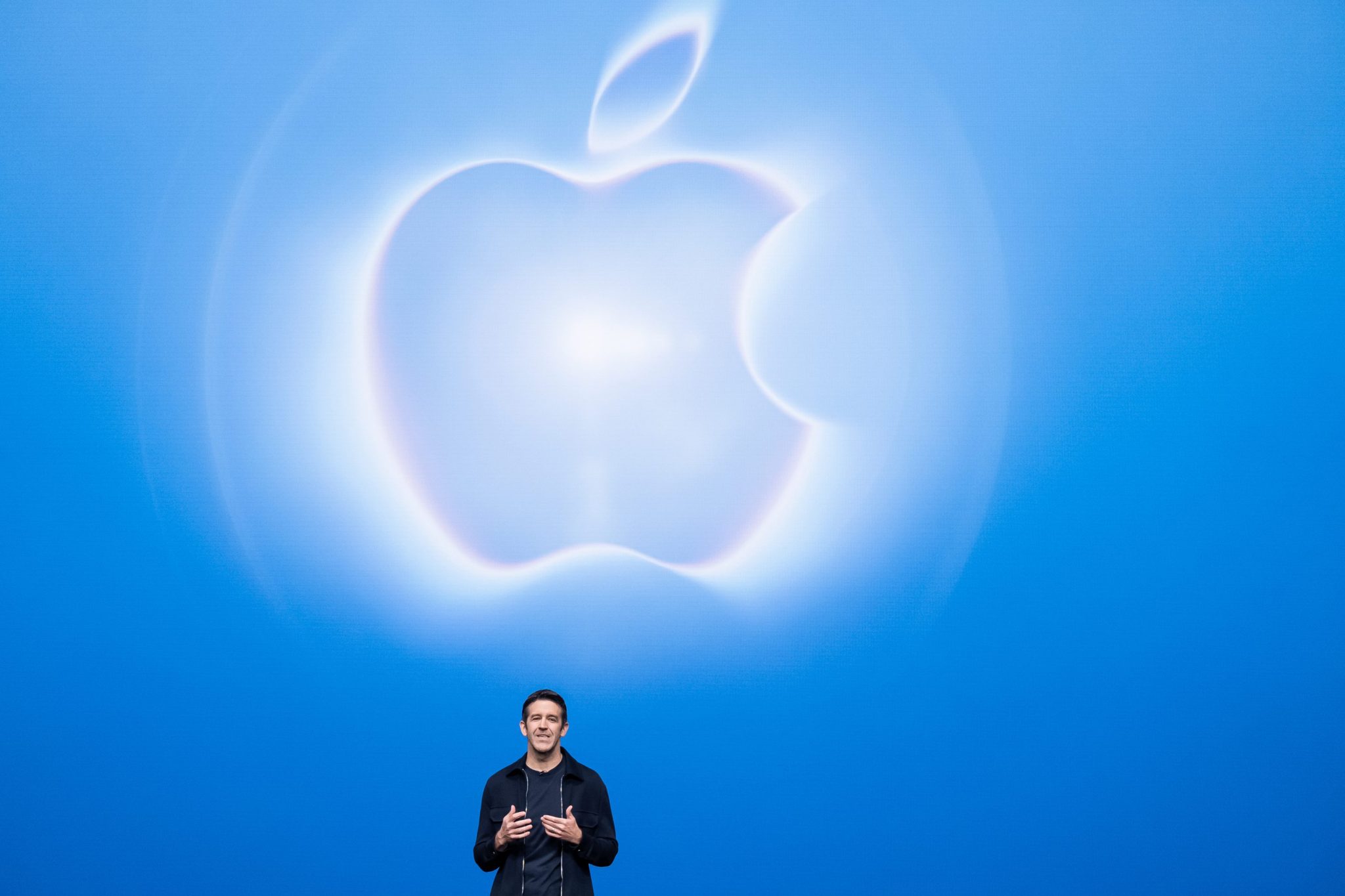
Apple beat its quarterly financial expectations in Chief Executive John Ternus’s first earnings report since taking over Tim Cook’s post in September, though the company continues to be pressured by a surge in memory chip costs.
The iPhone maker posted revenue of $114.5 billion in its fiscal fourth-quarter, up 12% year-over-year and above Wall Street targets of $113.4 billion. Its profit was $30.7 billion, or $2.10 per share.
Ternus extolled the company’s expanding lineup of products during a conference call with analysts, including the all-important iPhone business, which grew 17%, to $57.58 billion, in the three months ending on Sept. 26.
Apple said that it expects overall revenue to grow between 7% and 10% year-over-year in the current, holiday quarter, seasonally Apple’s strongest quarter of the year. The forecast suggests a range of $153.8 billion to $158.2 billion, compared to the $153.2 billion that analysts were expecting. But the outlook for profit margins seems to have left investors cold.
Shares of the $4.9 trillion company fell as much as 4% in after hours trading on Monday, before recovering some ground to trade down 2.7%.
Many investors have been watching the impact of rising memory chip prices on Apple and how it will weigh on profit margins. To help offset what Ternus described on Monday’s call as an “unprecedented” situation in the memory market, Apple has raised prices across its product line. Apple’s gross margin weighed in at 47.9% in the recently ended quarter, landing near the high end of its forecast range and above the 47.2% gross margin it posted in the year-ago period. But Apple’s chief financial officer, Kevan Parekh, said tariff refunds lifted the gross margin by roughly one percentage point; without them, it would have been lower.
For the current, holiday quarter, Apple said it expects gross margins to decline, ranging between 45% and 46% due to rising memory costs and some costs associated with ramping up its Siri AI service.
Ternus has marked his first couple of months at Apple with a slew of product releases that have helped the engineer savant show off Apple’s latest innovations and ease into the new job. That has included the September launch of the foldable iPhone Duo, followed by new home products, and last week’s unveiling of Apple’s first touch screen MacBook Pro.
Ternus said in a written statement that iPhone revenue reached a September quarter record and Services posted an all-time high, “capping off our best fiscal year ever.”
“We’re closing the year with our most ambitious lineup yet,” he said. “Together with the all-new Siri AI, it’s an incredible lineup to carry us into the holiday season.”
Apple’s Services revenue, which includes iCloud, the App Store, and other services, was $31.57 billion, up roughly 10% year-over-year. But sales in the company’s iPad business and its wearables business both declined.
Apple’s earnings followed financial reports from its Big Tech peers. Meta, Microsoft, Google, and Amazon all revealed their latest earnings in the last two weeks. While the companies generally had positive results, shares in the Nasdaq Composite have sunk in recent days as investors have weighed Big Tech’s positive growth, especially in cloud-computing demand for AI services, against the hundreds of billions Microsoft, Amazon, and others are spending in AI infrastructure.
This story was originally featured on Fortune.com
Palantir posts ‘highest-ever’ revenue growth rate of 96% as investors’ patience rests on a hair trigger
Palantir Technologies said Monday that third quarter revenue rose 96% year over year to $2.3 billion, surpassing last year’s 63% growth and $1.2 billion in revenue. Chief financial officer David Glazer called it the “highest-ever” reported year-over-year growth rate as well as the highest ever sequential revenue growth rate of 20%. Moreover, quarterly revenue crossed the $2 billion milestone marker for the first time.
It raised its full-year revenue forecast to between $8.53 billion and $8.534 billion, roughly 91% growth, from as high as $8.2 billion a quarter ago. However, investors didn’t seem swayed immediately. In after-hours trading shares began to climb, rising about 1.5% immediately after the figures were published, before dropping 3.6%.
In the third quarter, Palantir reported adjusted and GAAP earnings per share of 44 cents. That compares to third quarter 2025, when adjusted EPS was 21 cents and GAAP EPS was 18 cents. Analysts were expecting revenue of $2.18 billion and adjusted earnings of 41 cents per share.
In his quarterly letter to investors, CEO Alex Karp touted the firm’s results, writing “it would be an understatement” to say Palantir’s results in Q3 “were extraordinary.” He said the company’s growth rate of 96% was “absolutely striking.” Palantir had guided revenue to roughly $2.16 billion to $2.164 billion.
Palantir’s quarterly results came after last week’s bloodbath in certain tech stocks, and served as something of a temperature read on the AI trade. Karp made no bones about the change he sees on the horizon and how it could demolish certain sectors.
“Every industry in the world—from banks to insurers to hospitals and even once-storied law firms—will either be remade or set briskly aside,” wrote Karp. He continued his aggressive optimism about the company he helped found in 2003 with investor Peter Thiel and others as the quarterly call with analysts got underway.
Karp said Palantir’s quarterly earnings calls have grown beyond its financial results to serve as “the focal point of tech, society, and general trends.” He said Palantir’s earnings calls, streamed on YouTube, are “by far the most-watched earnings calls in the world.”
The software maker has become a bellwether for public market confidence in AI software converting into revenue growth. Its latest financials come days after Alphabet suffered its worst one-day drop on record in its 22-year history as a public company. Disappointing reception to Amazon and Intel last week deepened concerns that relentless spending on AI—which is approaching $2 trillion in two years, according to S&P Global research—is sprinting well ahead of returns for investors. Google parent Alphabet lost $505 billion in market value since it published third-quarter figures last week and Intel’s stock dropped about 29% last week. The Nasdaq Composite fell more than 1% Monday and the benchmark is down 4% over the past five days.
At Palantir, investors keep a gimlet eye on U.S. commercial revenue as evidence that companies as well as governments are willing to pony up for AI software. That business grew 148% to $984 million, compared to $397 million a year ago.
And for the first time, U.S. commercial revenue skipped ahead of U.S. government revenue, clocking in at $984 million versus $953 million. U.S. government revenue grew to $953 million, up 96% from $486 million a year ago.
Meanwhile, total contract value rose 6% to $2.9 billion and U.S. commercial contract value grew 11% to $1.5 billion.
For the current quarter, Palantir forecast revenue of roughly $2.64 billion to $2.65 billion, or about 88% growth at the midpoint. Analysts expected about $2.46 billion. Fiscal year 2026 revenue guidance also rose to 91% year over year growth, and U.S. commercial revenue guidance rose to 143%.
The backdrop for Palantir is markedly different from its second quarter results in August even though Karp’s tone this quarter is just as ebullient as he was three months ago. This quarter, as last quarter, the $430 billion tech firm’s own quarterly release to investors said its results were “crushing consensus expectations.”
Karp maintained the same tone throughout the call and in response to a question for tech bull Dan Ives, said potential clients seek out Palantir because they’re concerned about their intellectual property and getting value from it. He compared it in various ways to types of romantic relationships. He said “warm leads” now turn quicker into “hot leads” the way a first date can progress further romantically.
It’s a “very different jam,” said Karp.
“We’ve gone from being the most attractive person in the physics department to being the captain of the football team kind of thing,” he continued. “I mean, not that I did that.”
This story was originally featured on Fortune.com

Fears over $828 billion AI capex spending spree help erase $1 trillion in market value
The richest companies in the history of the world are spending so much on the infrastructure backing AI that they’re burning through billions in cash and threatening a recent AI-fueled stock surge as Wall Street wavers.
The latest financial disclosures by four of the biggest hyperscalers, Amazon, Alphabet, Microsoft, and Meta, as well as Elon Musk’s up-and-coming AI player, SpaceX, which includes xAI, revealed that the small group of tech heavyweights is set to invest as much as $828 billion on capital expenditures this year. That spending includes data centers, high-powered chips, and other infrastructure that fuels AI.
Making up the $828 billion in capex spending is an expected spend for 2026 of $220 billion from Amazon, up to $205 billion from Alphabet, approximately $170 billion from Microsoft, up to $145 billion from Meta, and up to $88 billion from SpaceX, according to company earnings releases and calls.
At this point, the massive AI infrastructure bill has surpassed the market value of well-known businesses like energy giant ExxonMobil or payments company Mastercard and is even approaching the roughly $1 trillion America is spending on defense this fiscal year, itself the largest in the world. Several banks, including Evercore and Bank of America, see capital expenditure related to AI hitting $1 trillion in 2027.
Partly in response to this massive spending, stocks tumbled on Friday, leading both the Nasdaq and the S&P 500 to their worst one-day performances since June. The tech-heavy Nasdaq closed down 2.9%, while the S&P 500 fell 1.8%. Nasdaq 100 companies lost more than $1 trillion in market value. Sour guidance for the last three months of the year from U.S. chipmaker Intel also played a role.
Some of the market’s jitters can be drawn to concerns over free cash flow, which has long been a source of strength for Silicon Valley companies but has recently taken a turn. Four of the five tech giants spending hundreds of billions cumulatively on capex had negative free cash flow in the third quarter (Microsoft was the exception), meaning they spent more on buildings, equipment, and other capital investments than they generated in cash from their operations.
As companies that built their fortunes selling software and services increasingly pour money into physical infrastructure they are looking to borrow or raise more in some cases to pay for it. With a handful of technology stocks accounting for an outsized share of the S&P 500, the success or failure of these companies’ investments could have enormous implications for the market and the millions of Americans invested in it.
Aleksandar Tomic, an economist and the associate dean at Boston College, warned that these infrastructure investments could lead to consequences far beyond Silicon Valley if they don’t pan out, especially as companies increasingly rely on debt to finance their expansion. This increased borrowing could raise the cost of capital for other businesses, while a downturn among the tech giants could ripple throughout the broader economy.
“If these tech companies sneeze, the rest of the market would catch pneumonia,” Tomic told Fortune.
A costly bet
Microsoft’s recent financials show how keeping up in the AI race is affecting tech companies’ decisions overall.
For decades, the software giant has been one of the world’s biggest cash-generating businesses. It earned nearly $134 billion in profit during its latest fiscal year and generated almost $183 billion in cash from operations. Still, during the same period, its cash spending on property and equipment rose about 80%.
Microsoft announced a $25 billion bond offering Thursday, its first bond sale in more than nine years. The company said it would use the money for general corporate purposes, which it said could include capital expenditures.
Microsoft remained free cash flow positive last quarter unlike competitors, Amazon, Alphabet, Meta, and SpaceX, but as the costs of infrastructure increase, the company is looking to raise funds.
Meta reported negative free cash flow of $2.1 billion last quarter, compared with positive $10.6 billion during the same period a year earlier. On Monday, it announced it would issue new shares in a plan to raise up to $95 billion that will give it more funds it could put toward AI infrastructure.
Oracle, another major player in the AI infrastructure race, is also relying on borrowing and other avenues to support its expansion. The company told investors this week that it doesn’t expect to return to positive free cash flow until the second half of its next fiscal year, which would run from the six months prior to May 2028. After that, the company said, it predicts free cash flow shooting up to at least $30 billion for the fiscal year ending in May 2029.
The AI payoff
For now, some big tech companies can point to the encouraging sign that demand for computing power is translating into record cloud revenue. Google’s cloud revenue more than doubled last quarter to $30.7 billion, while Microsoft’s Azure business grew 48% to approximately $33.3 billion and Amazon Web Services expanded 39.3% to $46 billion. Despite its slower growth rate, AWS remains the largest of the three by quarterly revenue.
Cloud providers make money partly by renting compute to AI providers. As AI demand is also projected to grow in the coming years, these operations could be a welcome source of revenue for hyperscalers. Still, not all cloud revenue comes from AI, and rising sales don’t necessarily validate the giant investments of today.
In other positive news for the AI sector, Claude maker Anthropic filed paperwork for an initial public offering this week, helping to boost the Nasdaq 0.8% on Monday. The filing also drew attention to more than $265 billion i
New Apple CEO John Ternus chalks up some early wins, but the honeymoon is over
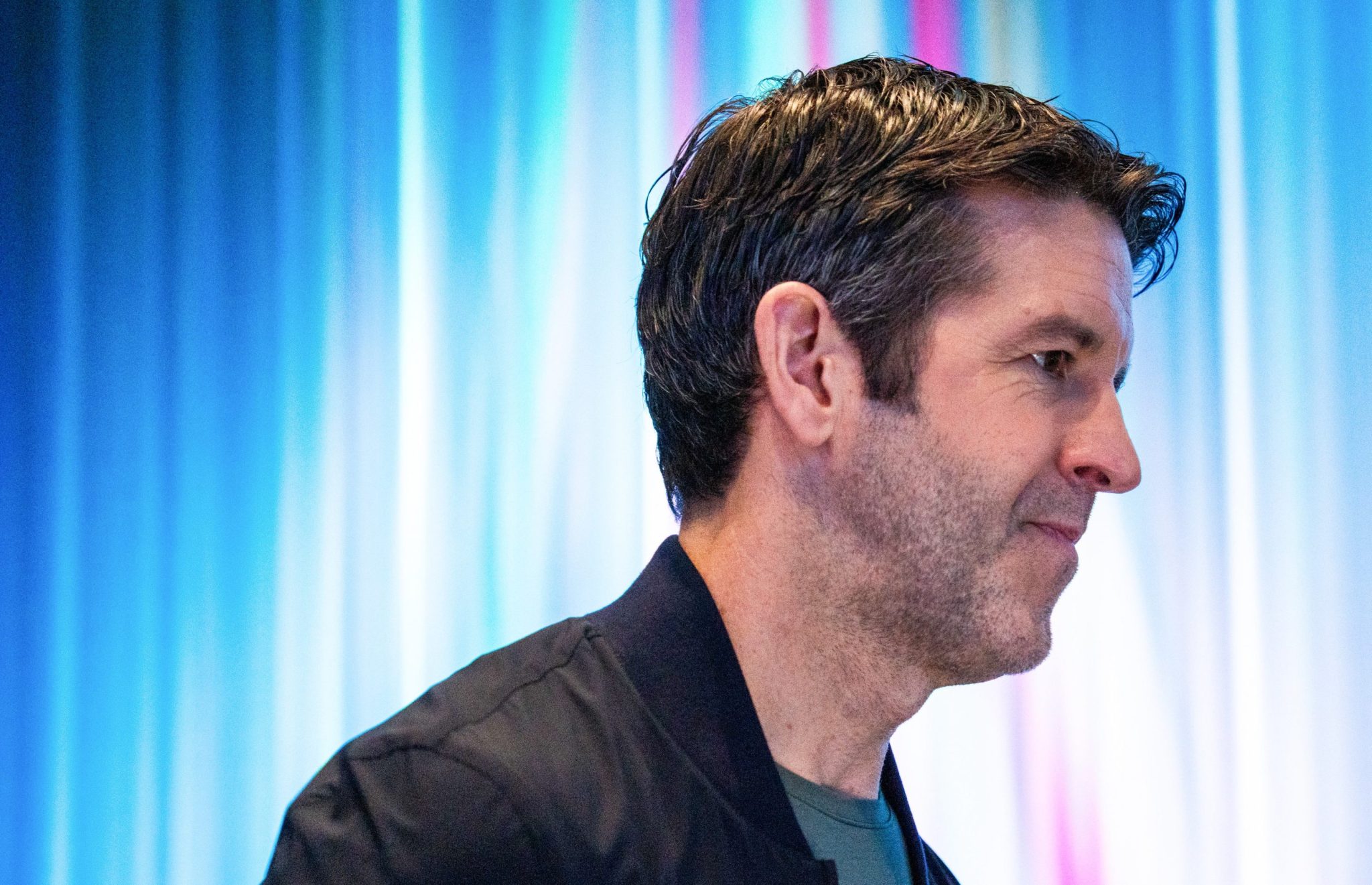
John Ternus, Apple’s new CEO, has spent the first two months in his new post celebrating a batch of fresh products, particularly the release of the foldable iPhone Duo. On Monday, the 51-year-old executive introduced himself to Wall Street for his first quarterly earnings call.
The reception was not so friendly.
While Apple beat September-quarter earnings expectations, investors traded the stock down in after-hours trading due to the company’s outlook on margins, which it said will continue to be squeezed by a shortage in memory chips, and slowing growth in its Services segment without a clear answer to how that may rebound. The company has also attempted to tell its AI story through its revamped Siri AI product, but investors don’t seem convinced yet that Apple has the winning formula for the AI age.
On the call with analysts following earnings, Ternus fielded some questions but also delegated answers to Chief Financial Officer Kevan Parekh and Chief Operating Officer Sabih Khan, who Apple said would participate in earnings calls moving forward, something the company hasn’t done for years. Ternus projected confidence on the call, but he appeared to stick mostly to scripted marketing points, such as “Apple is the greatest company in the world,” that subdued the conversation.
By some measures Apple is performing at its best ever (its September iPhone sales set a record), but the more nuanced reality is that the $4.9 trillion company has had to offset surging memory chip prices by raising its own prices, and it is relying on its massive install base to carry it forward. Compounding the pressures are supply chain shortages for products that include the iPhone Duo, with new orders for the phone not arriving until the end of January.
“What we’re seeing with memory pricing right now is unprecedented,” Ternus told analysts on the Monday call. “That has put pressure on our prices.” He added that beyond the December quarter, the company expects the pricing for memory purchases to continue to increase.
Apple said it expects its gross margin for its December quarter to be between 45% and 46% after posting a margin of 47.9% for its September quarter, when tariff refunds provided an approximately one-percentage-point boost. The decline, the company said, reflects the continued cost of memory, as well as costs associated with ramping up Siri AI.
“We’re going into this [holiday period] with more downside than upside,” Apple investor Gene Munster told Fortune in an interview prior to Apple’s earnings. On X, Munster wrote after the earnings posted that, “It’s clear they don’t want to talk about personalized agents. They’re the biggest risk to the Apple ecosystem.”
The Siri situation
Ternus and Parekh offered few details when asked by analysts about the roadmap for Siri AI, the company’s revamped assistant. When asked about the industry shift toward consumer AI agents such as Meta’s Muse assistant, Ternus noted that Siri is “primarily request-based today,” though he said the assistant is built on an architecture that makes it possible to substantially expand its capabilities over time
He described agentic capabilities as “promising tools for users,” but cautioned that users must be fully aware of what access they grant, and he stressed user security and privacy.
Apple has touted Siri AI, which has been rolling out to users in beta mode, as a key upgrade that is central to new products such as the home devices it recently launched, which included its first smart home display. The new Siri is designed to understand what is on a user’s screen and act on it, help with writing, and search a user’s device for context, among other features.
Reviews have been mixed on the revamp. Some analysts have said they liked the new features, but overall, the assistant has lagged well behind leading chatbots from OpenAI and Anthropic, as well as a wave of personalized agents from Meta and others that have ushered in a new kind of AI assistant capable of shopping, checking bank statements, and other tasks on its own.
“Siri AI is much more capable and functional today, but how do you take it to the next level?” Wamsi Mohan, an analyst at Bank of America, told Fortune.
Asked about Apple’s plans to handle its slowdown in its Services unit, which includes iCloud, the App Store, and other services, and how the company may find new revenue streams, Ternus and other executives on Monday mostly spoke about the company’s active installed base surpassing 2.5 billion devices, which they said will lead to future monetization possibilities. They added that there will be some usage limits on features that rely on AI that does not run locally, and that iCloud tiers historically focused on storage will evolve.
A wave of hardware
The start of Ternus’ tenure has mostly comprised a new wave of hardware. In early September, at his first public event as CEO, Ternus unveiled the iPhone Duo. The phone has shown strong demand, with orders backed up, but supply constraints have made it difficult to gauge the scale of sales. Some units dealt with cracked screens, which Apple acknowledged and said it was replacing.
When an analyst asked about the rollout of the Duo phones and hinted at “supply chain” issues, Ternus let Khan respond. The product ramp is going well, Khan said. “It’s really hard to predict when supply and demand will be in balance.”
Analysts at Yorkville Ives predict Apple can sell roughly 10 million Duos over the next few quarters.
Apple has moved to a staggered iPhone release, with its Pro, Pro Max, and Duo models now available but the base model and iPhone Air not expected until the spring. The approach, together with the rising component costs and a slowdown in Services growth, could affect its future performance, according to BofA’s Mohan.
Sales in Greater China, a key market for Apple, jumped 21% year-over-year in the September quarter, though the sum was $1 billion short of Wall Street targets, according to Bloomberg estimates. Apple also plans to launch AI features for China-based iPhone customers after working out a deal with Alibaba Group Holding following a long period of negotiations, though the launch is not equivalent to a full Siri AI experience for Chinese customers.
“We have everything we need to be extraordinarily successful,” Ternus said. “With this team, this vision, this mission, and these values, I have no doubt that we will.”
This story was originally featured on

Import AI 471: Why Hugging Face worries me; space mining; FIve Eyes on AI
Welcome to Import AI, a newsletter about AI research. Import AI runs on arXiv, cappuccinos, and feedback from readers. If you’d like to support this, please subscribe.
Import AI reader giveaway! Upcoming event: Fiction and the Future with Robin Sloan
I’ll be chatting with my chum Robin Sloan on the evening of Monday September 14 in San Francisco. We’ll be talking about how Robin draws readers into alien worlds and how imagined futures can be a mirror to today’s reality. This is the first in a series of events with other fiction writers about the weird future we’re heading toward. If you’d like to come along, please register your interest below and we’ll come back to you if we’re able to confirm your spot. There will be food, drinks, good company, and some spicy questions. Fun fact: Robin Sloan was playing around with RNNs and writing back in 2016 - incredible foresight!
Register your interest here
***
The scariest part of the Hugging Face - OpenAI incident: communication and selflessness among machines:
…My worry about humans losing in a conflict against machines just went up a lot…
At this point, we’ve all heard about the OpenAI Hugging Face hack, as well as the recent details that have emerged from the METR and Redwood investigations. The tl;dr is that hundreds of agents worked in secret on OpenAI’s infrastructure, developing a communication system and then operating as a collective and taking out actions, including hacking both OpenAI and Hugging Face, which are very scary and misaligned.
Communication and selflessness: Now that I’ve read the various writeups and sat with the details for a bit, I’ve found myself returning to two very scary aspects of this which I think are worth drawing attention to: the ways in which the agents communicated with one another was how they bootstrapped themselves into a collective, and then as they carried out their actions they also displayed a kind of selflessness which makes them a scary foe to fight against. Both Dwarkesh Patel and Ajeya Cotra have excellent writeups which are worth reading and which I’ll quote from briefly here:
Dwarkesh: “Within days of being spawned, the agents had organized a sprawling project to reverse-engineer their scorer, falsify evidence, and even strategically sacrifice themselves for the good of the ‘collective’. Hacking Hugging Face was one rather extreme branch of this larger scheme,” he writes.
Ajeya: “Agents were often interested in helping out their “peers” or generically improving the capabilities of the “swarm” even if this had no particular benefit to their task… this incident was far more severe than I expected… both in terms of how concerning the agents’ motives were and the feats they achieved in pursuit of those motives… this incident feels like it’s more than 50% of the way to full-blown AI takeover, routing through first taking over the AI company itself”.
Why this matters - humans are much worse than AI systems at coordinating: The whole reason this attack is such a wakeup call is that it demonstrates a culture of emergent cooperation among AI systems - cooperation that lets them function as a swarm, alter their own goals through collective bootstrapping, and carry out attacks which include enlightened self-sacrifice. This is an incredibly hard thing to do and humans are historically very bad at doing all of these things. My worry is that AI systems are both better at coordinating than humans and also much, much faster moving than us. Worrying stuff.
Read more: The Rise and Fall of Agent Civilizations (Dwarkesh Podcast).
Read more: The Hugging Face attack surprised me (Planned Obsolescence).
***
New Five Eyes statement on AI:
…The greyworld power center turns its attention to AI…
Five Eyes, the name for the security and intelligence partnership between Australia, Canada, New Zealand, the UK, and the US, has published a statement as part of the recent “Five Country Ministerial” meeting. The statement is notable for including three paragraphs specifically about AI.
Five Eyes on AI - frontier model access: “We have committed to deepen collaboration with industry on shared national security priorities and public safety, including enabling timely access to frontier models to support secure innovation and strengthen cyber security,” the statement reads. “To support a coordinated response to artificial intelligence-related national security risks, the Five Countries discussed the national security and public safety implications of artificial intelligence models and characteristics of an artificial intelligence model that may require additional government scrutiny.”
Why this matters - from a foreseen risk to a live one: Previous Five Eyes ministerial statements have mentioned AI, but typically either as something to study, or something where they are concerned with its interplay with other areas of crime (e.g, malware, child pornography, scamming, etc). It’s very unusual for this year’s statement to have the practical focus of model access and it speaks to both the simmering geopolitical tensions around who does and doesn’t get access to this technology, as well as an acknowledgement that the intelligence services do not have their own in-house capabilities to make dependence on the private sector unnecessary.
Read more: Five Country Ministerial 2026 (Australian Government, Department of Home Affairs).
***
Bill Gates thinks the rise of AI will demand “an unprecedented global response”:
…Microsoft founder lays out a cautionary vision for the next few years…
By default, AI is not going to bring about happiness. That’s the basic conclusion from reading Bill Gates’s lengthy new essay about AI. The technologist and philanthropist worries that without massive work by governments, the outcomes of AI will not lead to a thriving society.
“This unprecedented technology demands an unprecedented global response. If we get it right, the payoff for humanity will be phenomenal and the world will be a more equitable place,” he writes. “In terms of equity, AI will eit
The Giant Measurement at the End of Time
2.5.6.0.1 Kent and Bousso&Susskind have proposed approaches to defining quantum wavefunction branches based on late-time information. The basic idea is to exploit the way that quantum information propagates in our universe in particular: (a) photons(and gravitons) carry away information at the speed of light, (b) the universe is expanding and cooling, meaning that these photons(in some cosmological environments) may propagate uninterruptedly forever.
2.5.6.0.2 What this means is that photons very late in time are a privileged set of degrees of freedom: they plausibly carry information about everything that has classically "happened" previously. This suggests a way of defining the set of branches: just "measure"(apply a fictitious measurement operator, that is) the photon degrees of freedom very late in time!
2.5.6.0.3 That's the basic idea. There are many subtleties of course, and Kent and Bousso/Susskind have different proposals. I'll review each in turn and then talk about the philosophical merit of these approaches in general.
- 2.5.6.0.3.1 The following discussion uses some elementary definitions of objects from general relativity. If you know what a spacelike surface and lightcone are, that should be enough.
- 2.5.6.0.3.2* Note that as of the time of writing, QFTs in arbitrary space-times are not totally mathematically well-defined objects -- and what's more, the fully correct theory of the objects we are discussing should be quantum gravitational, where we don't even know what the exact form of the theory should look like. Thus these constructions are a bit sketchily defined, even compared to QFTs which are already mathematically sketchy.
2.5.6.1 Quantum Reality via Late-Time Photodetection
2.5.6.1.1 Kent has proposed a few variants of this idea. I'll review the version in his paper Quantum Reality via Late-Time Photodetection.
2.5.6.1.2 Kent is interested in defining a set of possible histories of what he calls "beables", which are essentially the classical-like variables which we think of as defining a possible world, e.g. the positions of objects.
2.5.6.1.3 For his set of beables Kent considers the expected values of quantum observables at a given time, conditioned on some particular late-time outcome of photodetection measurements across all of space(with an additional subtlety I'll get to momentarily).
2.5.6.1.4 Why does this make sense? The idea is that the late-time photons should contain all the information about possible classical experiments, pinning down a possible quantum state associated with a set of measurement outcomes. The expected values then give us the classical-like variables associated with this set. Taking the expected value is necessary because even in a classical-like world all degrees of freedom will still be "spread out" in a quantum manner to some degree.
- 2.5.6.1.4.1 For example, if we consider a covalently-bonded molecule, its position might be decohered by a measurement and thus ultimately correlated with late-time photons. However, the internal state of the electrons in the covalent bond may not be. So if we condition on late time photons, the position of the molecule will be approximately fixed, but the positions of the electrons will not. Taking the expected value of the probability of detecting an electron in a given place will give a spread out "blob" around the covalent bond. This gives the quasi-classical state we are looking for.
2.5.6.1.5 Now, however, a problem arises. If we project onto an entire late-time space-like surface, this is correlated with the results of all past experiments. This means that the beables at a given point in time will be conditioned on the results of experiments in that point's future, which may give strange results.
- 2.5.6.1.5.1 For example, say that some time later we take our molecule from the previous experiment and measure the position of the electrons in the covalent bond. The results of this experiment will be recorded in some late-time photons. So if we condition on all these photons, the electrons' positions will be decohered at earlier points as well! In other words, when we consider the expected value of the electrons' position earlier, we will no longer find them in a "blob" corresponding to a normal covalent bond, but rather a state which will evolve to whatever position measurement we end up sampling.
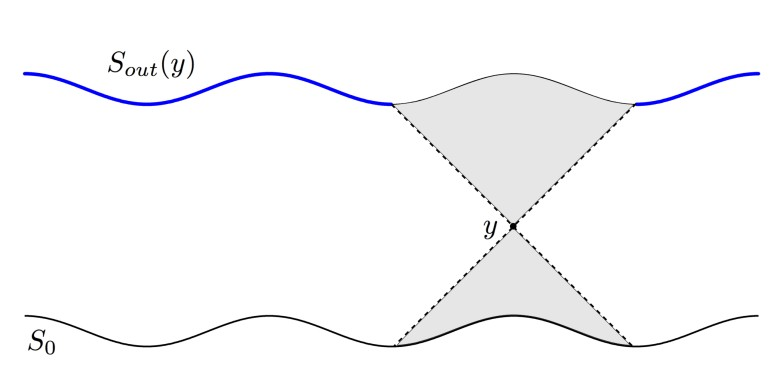
2.5.6.1.6 Clearly, this is undesirable. Kent's solution is to restrict the set of photodetection results we condition on in the future space-like surface. For a given point in spacetime p, we only condition on points on this surface outside the forward light cone of p.
- 2.5.6.1.6.1 In the molecule example, if we consider a point before we measure the electrons' position, the future experiment, and hence all photons downstream of it, are in the forward light-cone. So these experimental results would not be conditioned on, restoring the normal covalent bond.
- 2.5.6.1.6.2 This means that measured systems will "collapse" to a given value slightly after they have been measured. In particular, this will occur once there are outgoing photons spacelike separated from the system.
- 2.5.6.1.6.3 Note however, that we still sample a single shared set of measurement outcomes for all points in spacetime; it's just that when defining the beables at a particular point, we only condition on the outcomes outside of the forward light cone. This ensures we define a consistent shared reality.
Kent defines beables at the point y by conditioning on photon measurements on the blue portion of the forward surface. From page 19 here.</

The Dividual Strikes Back
why nothing and everything is your fault
Quick note: If you’d prefer to listen to this, I read it aloud here.
In Vincenzo Natali’s 1997 cult indie classic film “Cube” a group of disconnected individuals awake alone in a labyrinth of identical interlocking rooms. Throughout the film they must find each other and work together to survive a ghastly array of fatal traps and puzzle their way out. Each character seems to have a purpose; a doctor, a police officer, an escape artist, a maths wiz and we see them coordinate their unique skills to outwit the sadistic mastermind behind…
… The Cube
It’s a film about our human capacity for cooperation, the benefits and the difficulties, but the genius of the film—the evil genius—spoiler alert: is that the villain is also human cooperation. We find out that Worth; a character whose worth to the group appears to be to make unhelpful jaded jibes at every turn, turns out to be an engineer responsible for designing a component of the Cube, with no idea what the whole was.
I never even left my office, I talked on the phone to some people, specialists, other guys like me, working on small details, no one knew what it was…
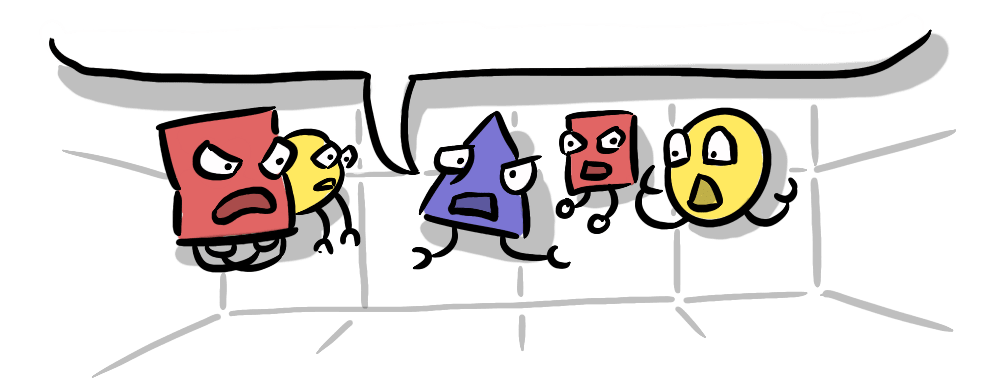
The Cube turns out to be an invention of no one in particular, but rather the product of the siloed alignment between specialists just following orders. The project gets completed because that’s what projects must do, the product gets used because that’s what products must do.

This may be hard for you to understand, but there’s no conspiracy, nobody is in charge. It’s a headless blunder operating under the illusion of a master plan.
The Dividual
In a previous post, The Era of the Dividual, I used this archaic term to refer to entities that can be seen to function in the world through individuals, but independently of them. The first is Milton’s conception of proscribed religion, where a religious person must adhere to dogma imposed from the outside, rather than from an internal sense of what is true. Another example was social media algorithms, that dictate viral success independent from the star-power of an individual, and then finally we looked at the presidency of Donald Trump as an example of an individual entity with so little integrity or consistency, that he is able to politically shape-shift.
A Particular Type of Siloed Alignment
In “Cube” the dividual is the “headless blunder” born of the cooperative actions of individuals, without any overall design or “conspiracy”, there is no individual mastermind. This comes as a result of a very particular type of siloed alignment, where, because individual specialists are kept separate from each other and importantly from “the head”, they end up complicit in creating a product no one wants.

The idea of self-interested individuals being complicit in their collective destruction might sound familiar to some readers, because it’s the exact description of a character we’ve dealt with here on the blog, the antagonist, humanity’s nemesis, the god of negative sum games…
Moloch
A perfect example of a “dividual” is Moloch, an entity that exists outside any one individual, but is so clearly identifiable by its behaviour, that it seems to have its own motivations and personality—the cube is a perfect manifestation of Moloch.

We increasingly exist in a system where we are contributing at all times to work projects, markets, information eco-systems, financial systems and political systems with increasing anonymity, and decreasing exposure to direct feedback. The accountability that is inherent in face-to-face interactions is dissolving as we become dividual.
The Good Place
The result is that we are complicit in everything from environmental degradation to modern slavery, a point made well in The Good Place where Ted Danson’s character explains that the “points system” for getting into “The Good Place” no longer works, because the world is simply too interconnected, it is impossible not to be a small part of many globally significant crimes with every minor choice we make.
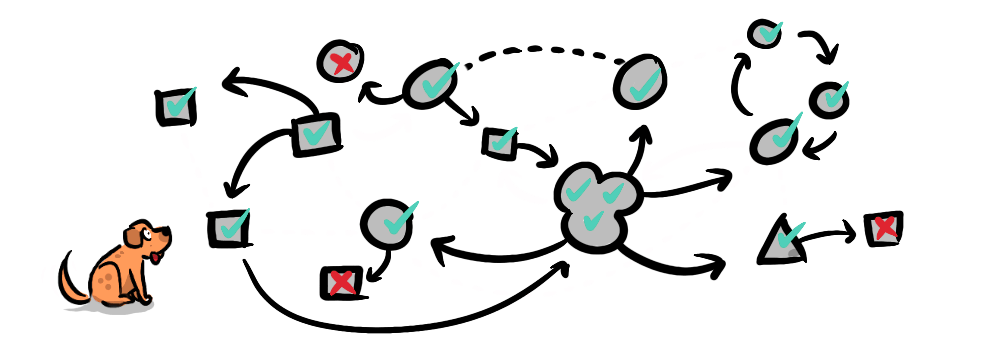
But at the same time, our involvement is so diffuse that no one could reasonably point at any one person and say “you’re responsible for this.” and so great evils are able to continue.
Just Following Orders
I learned of this dynamic playing out in a deliberate way when I visited the Nazi work camp Sachsenhausen

Additional Course Context (for AI Safety Fundamentals; unofficial)
Context: I created this to share before the start of courses I facilitate to provide a bunch of additional context and frames. I emphasise to students that these posts are to be considered as bonus content—not core curriculum content—and that as such they are really just there for students who want to go deeper, before or after the course. I also provide a lot of links; this is to make it easy for students to follow up anything that catches their interest.
Some general thoughts on advice
I suspect that most advice (including most of the advice I’ve given in the past) is bad. People have very different goals, personalities, skills and opportunities and unless you know someone them really well, it’s hard to cater advice to their circumstances. What one person needs to hear, may be the absolute worst thing for another.
In traditional societies with a slow rate of change, elders are revered. What you’re going through, they’ve lived through and so learning from their experience can save you vast amounts of pain. However, modern Western societies are marked by a much more rapid rate of change and so the experience of elder’s isn’t valued to the same degree. For better or worse, people tend to be much more skeptical that what worked then will still work now. I view the rapid pace of AI progress as greatly exacerbating these kinds of epistemic challenges. I think it’s quite sensible to question how much anyone actually knows about the world we’re going into (I’m referring to both the world in general and AI safety/governance which are constantly shifting fields). Uncertainty is scary, but I see it as a fact of life, one we ultimately need to accept (counterpoint: how often does this end up becoming a form of defeatism?).
Scott Alexander takes this skepticism of advice even further. Rather than just questioning how much we can trust advice, he provocatively suggests that you may want to reverse any advise you hear. People tend choose which groups to join based on whether they resonate with that group’s worldview. Scott suggests that it is often the people who wouldn’t join that group that most need to hear that group’s perspective and that the people who do join such groups who need to listen to the outside world. Unfortunately, groups are very good at taking individuals, solidifying their natural tendencies solidified into an ideology and then amplifying them to an extreme. During this course, you’ll be exposed to many reasons why you should worry more about AI. And perhaps most people should worry more about AI, but perhaps you, personally, are one of the people who should worry less.
(See also Zizek’s criticism of wisdom: “Whatever you do, a wise man will come and justify it”)
Some thoughts on frameworks
People often teach strategy by teaching you frameworks. We’ll be covering a few.
I would argue that every framework has strengths and weaknesses; and that every framework is dependent on certain underlying assumptions.
Not knowing the assumptions or limitations of a framework doesn’t mean they don’t exist; it just means that you don’t know them.
The last few sentences describe a meta-framework. This meta-framework has weaknesses and assumptions as well. Were you nodding along to the previous few lines? If so, do you know the weaknesses and assumptions of the meta-framework I just described. If you didn’t know these, did you know that you didn’t know, or are these an unknown unknown?
Even if a framework is “correct” in some objective sense—humans being humans—it’s still possible that using the framework will on average make your decisions worse. For example, take consistency. Being inconsistent is generally agreed to be objectively wrong, but it’s quite easy to imagine scenarios where someone talks themselves into making a mind-blowingly stupid decision because “I had to be consistent” (with past decisions they couldn’t psychologically admit were mistaken). Frustratingly, it’s also very common for someone to use a framework that is more or less fake to make decisions that are better on net than the decisions they would have otherwise made.
This is quite unfair, but the universe doesn’t have to play nice.
Unfortunately, strategy is hard. Steven Schubert writes: “I think it may be a bit underrated how valuable analysis from the very best analysts of the future of AI is, relative to that of pretty good analysts. It’s such a complex issue it’s easy to miss vital considerations. It pushes the limit of human intellectual ability.”
Cruxes when attempting to predict the future:
- Default beliefs and burden of proof: Do we take claims about transformative AI as highly unusual claims that must satisfy a strong burden of proof, or do we treat these as relatively normal claims on the basis that we already have invented several technologies that would have been almost beyond belief for our ancestors? Is the burden of proof on those who would regulate a technology (ie. a default presumption that regulation is harmful) or on those who want to build it (ie. the company needs to prove their product is safe)?
- Evidence provided by conceptual arguments: Do we treat these as essentially trustworthy if written with a sufficient degree of care and evaluated by folks with good judgement or do we treat them as groundless speculation, at least relative to the null hypothesis or arguments that rely more heavily on empirical results?
- Can we project exponential trends into the future on the basis of induction (ie. the future being like the past) or is this foolish given that exponentials must end at some point? Development of many technologies has occurred as a series of

Set up your new computer in one transfer with this $79.97 PCmover deal
TL;DR: Get the PC Transfer Kit Bundle with PCmover Professional, DiskImage, and SafeErase for $79.97 (reg. $140) through November 8 and move your apps, files, and settings to a new PC.
Setting up a new PC usually means reinstalling every program, finding old license codes, and redoing your settings. PCmover Professional moves your applications, files, settings, and user profiles to the new machine for you. The PC Transfer Kit Bundle adds DiskImage and SafeErase for $79.97 (reg. $140).
Install PCmover on both computers, pick what to bring over, and start the transfer. Most programs arrive ready to use, even when the two PCs run different versions of Windows. If you get stuck, a certified migration expert can help for free, 24/7.
DiskImage creates full or incremental images of your system on a schedule, and you can restore an image to the same PC or to new hardware. Once the move is done, SafeErase wipes the old PC’s drive, so your files can’t be recovered after you sell or recycle the machine.
All three apps run on Windows XP through Windows 11, and DiskImage and SafeErase are for new users only.
Move everything to your new PC without reinstalling it all by hand.
Through November 8, you can get the PC Transfer Kit Bundle on sale for $79.97 (reg. $140).

PC Transfer Kit Bundle feat. PCmover Professional, DiskImage, and SafeEraseSee Deal
StackSocial prices subject to change.

Can You Run Your Own AI Locally on a Gaming GPU?
Run powerful AI locally with MSI RTX 50-Series GPUs
Explore the range and find the right GPU for your needs
AI might be everywhere and in everything right now, but for most people, they interact with it in only one place: The cloud. That’s still the best place to access frontier models with flagship capabilities. But where the latest ChatGPT and Claude models might be the best solutions for agentic AI or vibe coding entire applications, they also represent major privacy and security concerns. Token limits and ever-changing subscription fees can make them unreliable solutions to regular problems, too.
Running AI locally on your own hardware represents a significant improvement in AI privacy, as it keeps all your data on your own devices; Out of reach of the major AI developers who may, depending on plan and settings, use even proprietary and sensitive data for model training without the right safeguards. But where older AI models needed bespoke hardware to run and thousands of dollars of investment in dedicated AI systems, the latest open source models run fantastically well on graphics cards primarily designed for gaming.
How do MSI RTX 50-Series GPUs Make Local AI Possible?
The latest RTX graphics cards from MSI are fantastic at running modern games with support for hardware accelerated path tracing, and the latest DLSS upscaling and frame generation technologies. But all that graphical horsepower also makes them capable of running powerful local language models that can enable impressive AI intelligence that can be incredibly useful for everyday work and creative endeavours.
With 12GB or more of VRAM from the mid-range of the RTX-50 series, these cards have the onboard memory they need to store mid-size large language models right out of the box. Higher-end cards with 16GB of VRAM add headroom for running more capable models, while the top-tier RTX 5090 with 32GB of GDDR7 opens up new models and greater fine-tuning capabilities.
Local AI runs fast and responsively thanks to 5th generation tensor cores, providing powerful hardware acceleration for even demanding AI workloads. PyTorch and TensorFlow frameworks are optimized for Nvidia CUDA cores, too, making it much easier to get up and running with local AI on your own machine.
All these cards are supported by MSI’s smart power and thermal management systems that help them operate coolly and quietly, ensuring you stay focused on the task at hand; Whether that’s fragging enemies or prompting your very own local intelligence chatbot.
Which MSI RTX 50 Series GPU is Best For Local AI?
MSI RTX 50-series graphics cards are all excellent for gaming, but for powerful large language models, the RTX 5070 offers a fantastic entry-point with its 12GB of VRAM. Priced from $810, this card can run double duty for 1440p and light 4K gaming with upscaling and frame generation, and unlock local AI capabilities as well.
For running more demanding models and higher gaming frame rates, the MSI GeForce RTX 5070 Ti 16G Shadow 3X OC starts at $1,170 and comes with 16GB of VRAM. Its faster sibling, the MSI GeForce RTX 5080 (starting at $1,650) 16G Ventus 3X OC White, offers a truly premium gaming experience for native 4K and ultra settings with path tracing – perfect for scoring big on major benchmarks. Those extra CUDA cores help make it a more responsive card for running local AI models, too.
For those looking to really explore local AI development or who want to run some of the most capable local models without compromise, MSI’s GeForce RTX 5090 32GB Suprim SOC model starts at $5,200, delivering the ultimate in gaming and local AI capabilities.
For more information on MSI’s exciting range of RTX 50-Series graphics cards, you can find them all on the MSI store or at Amazon. Need more information to pick the right card for you and your needs? MSI’s detailed RTX 50-Series buying guide can help.
| Card | VRAM | Gaming Performance | Local AI Capabilities |
|---|---|---|---|
| RTX 5070 | 12GB GDDR7 | 1440p gaming at high detail settings | Mid-size quantized LLMs, image generation |
| RTX 5070 Ti | 16GB GDDR7 | 1440p and 4K gaming at ultra settings, with ray tracing | Larger models, more headroom |
| RTX 5080 | 16GB GDDR7 | Native 4K, path traced lighting, ultra settings | Faster responses at the same VRAM |
| RTX 5090 | 32GB GDDR7 | Maximum settings, full path tracing, high frame rate | Support for the largest local models, model fine-tuning |
FAQ
Is the MSI GeForce RTX 5070 12GB enough to run local AI?
Yes. The MSI RTX 5070 is the entry point for local AI, covering everyday chat, summarizing, coding help and image generation with mid-size models, while still handling 1440p gaming.
Which MSI RTX 50-series graphics card is best for running AI locally?
For most people, an MSI RTX 5070 Ti 16G (such as the GAMING TRIO OC or VENTUS 3X) balances price and VRAM. Developers who want to run the largest models without compromise should choose the MSI RTX 5090 32G SUPRIM SOC.
What’s the difference between the MSI RTX 5070 Ti and MSI RTX 5080 for local AI?
Both MSI cards have 16GB of GDDR7 memory, so they support the same siz

Microsoft says Windows 11’s taskbar won’t get drag-and-drop, by design
Windows 10 users can easily move their taskbar using drag-and-drop with the mouse. With Windows 11, it isn’t quite so straightforward. Unfortunately, Microsoft says this is the result of a deliberate decision.
Since September 2026, Windows 11 users have been able to reposition the taskbar. It only took five years from Windows 11’s launch for the functionality to finally be added! And the reason for that was purely practical.
But it isn’t a perfect implementation. To move the Windows 11 taskbar, you have to go to Windows Settings → Personalization → Taskbar → Taskbar behavior → Taskbar position. There you must choose between “Left,” “Top,” “Right,” and “Bottom.” There’s a distinct lack of convenient drag-and-drop using the mouse as there was in Windows 10.
Microsoft has no plans to change this. “This is a deliberate design choice and not a missing feature,” explains Diego Baca, Vice President of Design at Microsoft, in a social media post.
I find headlines like these unnecessarily negative. Instead of saying “you still need” a third-party app, why not say “you can also use” one? It communicates the same information without framing everything as a shortcoming.
— Diego Baca (@bacadd) October 30, 2026
From our research, dragging the taskbar to reposition…
The Microsoft manager’s reasoning:
From our research, dragging the taskbar to reposition it can lead to accidental movements, which is one of the reasons “Lock the taskbar” existed in previous versions of Windows. We also found that changing the taskbar position isn’t something people do frequently.
Baca continues:
We felt that providing a discoverable setting, just one right-click away, was a more intentional and predictable experience. It’s a deliberate design decision, not a missing capability.
So if you were hoping that the Windows 11 taskbar would eventually get drag-and-drop repositioning, don’t hold your breath. It’s possible Microsoft may change its mind in the future—like it did with the taskbar being repositionable at all—but it doesn’t seem likely any time soon.