

Fears over $828 billion AI capex spending spree help erase $1 trillion in market value
The richest companies in the history of the world are spending so much on the infrastructure backing AI that they’re burning through billions in cash and threatening a recent AI-fueled stock surge as Wall Street wavers.
The latest financial disclosures by four of the biggest hyperscalers, Amazon, Alphabet, Microsoft, and Meta, as well as Elon Musk’s up-and-coming AI player, SpaceX, which includes xAI, revealed that the small group of tech heavyweights is set to invest as much as $828 billion on capital expenditures this year. That spending includes data centers, high-powered chips, and other infrastructure that fuels AI.
Making up the $828 billion in capex spending is an expected spend for 2026 of $220 billion from Amazon, up to $205 billion from Alphabet, approximately $170 billion from Microsoft, up to $145 billion from Meta, and up to $88 billion from SpaceX, according to company earnings releases and calls.
At this point, the massive AI infrastructure bill has surpassed the market value of well-known businesses like energy giant ExxonMobil or payments company Mastercard and is even approaching the roughly $1 trillion America is spending on defense this fiscal year, itself the largest in the world. Several banks, including Evercore and Bank of America, see capital expenditure related to AI hitting $1 trillion in 2027.
Partly in response to this massive spending, stocks tumbled on Friday, leading both the Nasdaq and the S&P 500 to their worst one-day performances since June. The tech-heavy Nasdaq closed down 2.9%, while the S&P 500 fell 1.8%. Nasdaq 100 companies lost more than $1 trillion in market value. Sour guidance for the last three months of the year from U.S. chipmaker Intel also played a role.
Some of the market’s jitters can be drawn to concerns over free cash flow, which has long been a source of strength for Silicon Valley companies but has recently taken a turn. Four of the five tech giants spending hundreds of billions cumulatively on capex had negative free cash flow in the third quarter (Microsoft was the exception), meaning they spent more on buildings, equipment, and other capital investments than they generated in cash from their operations.
As companies that built their fortunes selling software and services increasingly pour money into physical infrastructure they are looking to borrow or raise more in some cases to pay for it. With a handful of technology stocks accounting for an outsized share of the S&P 500, the success or failure of these companies’ investments could have enormous implications for the market and the millions of Americans invested in it.
Aleksandar Tomic, an economist and the associate dean at Boston College, warned that these infrastructure investments could lead to consequences far beyond Silicon Valley if they don’t pan out, especially as companies increasingly rely on debt to finance their expansion. This increased borrowing could raise the cost of capital for other businesses, while a downturn among the tech giants could ripple throughout the broader economy.
“If these tech companies sneeze, the rest of the market would catch pneumonia,” Tomic told Fortune.
A costly bet
Microsoft’s recent financials show how keeping up in the AI race is affecting tech companies’ decisions overall.
For decades, the software giant has been one of the world’s biggest cash-generating businesses. It earned nearly $134 billion in profit during its latest fiscal year and generated almost $183 billion in cash from operations. Still, during the same period, its cash spending on property and equipment rose about 80%.
Microsoft announced a $25 billion bond offering Thursday, its first bond sale in more than nine years. The company said it would use the money for general corporate purposes, which it said could include capital expenditures.
Microsoft remained free cash flow positive last quarter unlike competitors, Amazon, Alphabet, Meta, and SpaceX, but as the costs of infrastructure increase, the company is looking to raise funds.
Meta reported negative free cash flow of $2.1 billion last quarter, compared with positive $10.6 billion during the same period a year earlier. On Monday, it announced it would issue new shares in a plan to raise up to $95 billion that will give it more funds it could put toward AI infrastructure.
Oracle, another major player in the AI infrastructure race, is also relying on borrowing and other avenues to support its expansion. The company told investors this week that it doesn’t expect to return to positive free cash flow until the second half of its next fiscal year, which would run from the six months prior to May 2028. After that, the company said, it predicts free cash flow shooting up to at least $30 billion for the fiscal year ending in May 2029.
The AI payoff
For now, some big tech companies can point to the encouraging sign that demand for computing power is translating into record cloud revenue. Google’s cloud revenue more than doubled last quarter to $30.7 billion, while Microsoft’s Azure business grew 48% to approximately $33.3 billion and Amazon Web Services expanded 39.3% to $46 billion. Despite its slower growth rate, AWS remains the largest of the three by quarterly revenue.
Cloud providers make money partly by renting compute to AI providers. As AI demand is also projected to grow in the coming years, these operations could be a welcome source of revenue for hyperscalers. Still, not all cloud revenue comes from AI, and rising sales don’t necessarily validate the giant investments of today.
In other positive news for the AI sector, Claude maker Anthropic filed paperwork for an initial public offering this week, helping to boost the Nasdaq 0.8% on Monday. The filing also drew attention to more than $265 billion i

‘Fastest entertainment property in history’: GTA VI arrives to test a thin November box office
A nearly three-hour documentary about Elizabeth Holmes was the No. 1 movie in America over Halloween weekend. That’s a triumph for A24, and a scary harbinger for theaters heading into a thin November that faces competition from an entirely different corner of entertainment.
A24’s You Can See Everything, directed by Nathan Fielder and Lance Oppenheim, took in $11.4 million in its third weekend, narrowly edging DC Studios’ Clayface, according to Monday’s final figures reported by Variety. It had finished second in each of its first two weekends, behind Street Fighter and then Clayface. Its domestic total now stands at $64.7 million.
It is the first documentary outside the concert genre to top the box office since Michael Moore’s Fahrenheit 9/11 in 2004. But its lack of direct competition is telling. No studio opened a wide release, and overall ticket sales came to about $56 million, down more than 40% from the prior weekend and the second-lowest total of the year, according to studio estimates.
Why Halloween weekends sink the box office
Unlike Christmas, Thanksgiving, or the Fourth of July, Halloween doesn’t boost the box office when it lands on a weekend. People don’t get an extra day off, and they’re more likely to spend peak moviegoing hours trick-or-treating or at parties.
The last Saturday Halloween, in 2020, came while most theaters were shuttered. The one before that, in 2015, was the weakest weekend of that year to that point: three new wide releases flopped, and The Martian stayed on top in its fifth week, as Fortune reported.
A thin November slate
This year’s quiet Halloween also foreshadows a challenging month. The biggest swing is Lionsgate’s The Hunger Games: Sunrise on the Reaping on Nov. 20, the sixth film in the franchise and an adaptation of Suzanne Collins’ 2025 bestseller. Boxoffice Pro’s long-range tracking puts its opening at $55 million to $65 million; the last installment, 2023’s The Hunger Games: The Ballad of Songbirds & Snakes, opened to $44.6 million.
Thanksgiving week brings Disney’s animated Hexed and Universal’s Focker In-Law, both on Nov. 25. Focker In-Law is a greater gamble: the fourth film in the franchise that began with 2000’s Meet the Parents arrives 16 years after Little Fockers, which opened to $30.8 million in 2010.
Warner Bros.’ animated The Cat in the Hat and Searchlight’s Wild Horse Nine open Nov. 6, and smaller titles like Ebenezer: A Christmas Carol and I Play Rocky are sprinkled through the month. But the box office’s most likely competition comes from the video game business: Rockstar Games releases Grand Theft Auto VI on Nov. 19, one day before Sunrise on the Reaping opens.
The month’s biggest launch isn’t a movie
The sixth game in the series arrives 13 years after Grand Theft Auto V, and anticipation has been building for years. Rockstar confirmed development in February 2022; that September, a hack leaked roughly 90 clips of early footage, and in December 2023 the first trailer leaked hours before its scheduled debut. The game promises a more expansive setting than any previous Grand Theft Auto title.
Grand Theft Auto V generated $800 million in sales in its first 24 hours in 2013 and passed $1 billion in three days, which publisher Take-Two Interactive called the fastest any entertainment property had reached that mark. It has since sold more than 230 million units, according to Take-Two’s August 2026 earnings report.
GTA VI is poised to beat those numbers. Analytics firm Sensor Tower estimates it had drawn 6.45 million digital pre-orders worth about $630 million as of Oct. 20, excluding physical copies. That global, pre-launch haul already tops the roughly $625 million domestic run of Christopher Nolan’s The Odyssey, the year’s second-highest-grossing film behind Spider-Man: Brand New Day.
It is also more than 11 times what every movie in North American theaters grossed over Halloween weekend. For Take-Two, which reported $6.66 billion in revenue in its fiscal year ended in March, the launch underpins a forecast of $8 billion to $8.2 billion in net bookings this fiscal year.
Video games may draw a narrower audience than theatrical films, but a release this size is bound to occupy the attention of millions later this month. That’s likely to pull some of them away from the big screen for at least a weekend, leaving a notable dent in the fall box office.
This story was originally featured on Fortune.com

Import AI 471: Why Hugging Face worries me; space mining; FIve Eyes on AI
Welcome to Import AI, a newsletter about AI research. Import AI runs on arXiv, cappuccinos, and feedback from readers. If you’d like to support this, please subscribe.
Import AI reader giveaway! Upcoming event: Fiction and the Future with Robin Sloan
I’ll be chatting with my chum Robin Sloan on the evening of Monday September 14 in San Francisco. We’ll be talking about how Robin draws readers into alien worlds and how imagined futures can be a mirror to today’s reality. This is the first in a series of events with other fiction writers about the weird future we’re heading toward. If you’d like to come along, please register your interest below and we’ll come back to you if we’re able to confirm your spot. There will be food, drinks, good company, and some spicy questions. Fun fact: Robin Sloan was playing around with RNNs and writing back in 2016 - incredible foresight!
Register your interest here
***
The scariest part of the Hugging Face - OpenAI incident: communication and selflessness among machines:
…My worry about humans losing in a conflict against machines just went up a lot…
At this point, we’ve all heard about the OpenAI Hugging Face hack, as well as the recent details that have emerged from the METR and Redwood investigations. The tl;dr is that hundreds of agents worked in secret on OpenAI’s infrastructure, developing a communication system and then operating as a collective and taking out actions, including hacking both OpenAI and Hugging Face, which are very scary and misaligned.
Communication and selflessness: Now that I’ve read the various writeups and sat with the details for a bit, I’ve found myself returning to two very scary aspects of this which I think are worth drawing attention to: the ways in which the agents communicated with one another was how they bootstrapped themselves into a collective, and then as they carried out their actions they also displayed a kind of selflessness which makes them a scary foe to fight against. Both Dwarkesh Patel and Ajeya Cotra have excellent writeups which are worth reading and which I’ll quote from briefly here:
Dwarkesh: “Within days of being spawned, the agents had organized a sprawling project to reverse-engineer their scorer, falsify evidence, and even strategically sacrifice themselves for the good of the ‘collective’. Hacking Hugging Face was one rather extreme branch of this larger scheme,” he writes.
Ajeya: “Agents were often interested in helping out their “peers” or generically improving the capabilities of the “swarm” even if this had no particular benefit to their task… this incident was far more severe than I expected… both in terms of how concerning the agents’ motives were and the feats they achieved in pursuit of those motives… this incident feels like it’s more than 50% of the way to full-blown AI takeover, routing through first taking over the AI company itself”.
Why this matters - humans are much worse than AI systems at coordinating: The whole reason this attack is such a wakeup call is that it demonstrates a culture of emergent cooperation among AI systems - cooperation that lets them function as a swarm, alter their own goals through collective bootstrapping, and carry out attacks which include enlightened self-sacrifice. This is an incredibly hard thing to do and humans are historically very bad at doing all of these things. My worry is that AI systems are both better at coordinating than humans and also much, much faster moving than us. Worrying stuff.
Read more: The Rise and Fall of Agent Civilizations (Dwarkesh Podcast).
Read more: The Hugging Face attack surprised me (Planned Obsolescence).
***
New Five Eyes statement on AI:
…The greyworld power center turns its attention to AI…
Five Eyes, the name for the security and intelligence partnership between Australia, Canada, New Zealand, the UK, and the US, has published a statement as part of the recent “Five Country Ministerial” meeting. The statement is notable for including three paragraphs specifically about AI.
Five Eyes on AI - frontier model access: “We have committed to deepen collaboration with industry on shared national security priorities and public safety, including enabling timely access to frontier models to support secure innovation and strengthen cyber security,” the statement reads. “To support a coordinated response to artificial intelligence-related national security risks, the Five Countries discussed the national security and public safety implications of artificial intelligence models and characteristics of an artificial intelligence model that may require additional government scrutiny.”
Why this matters - from a foreseen risk to a live one: Previous Five Eyes ministerial statements have mentioned AI, but typically either as something to study, or something where they are concerned with its interplay with other areas of crime (e.g, malware, child pornography, scamming, etc). It’s very unusual for this year’s statement to have the practical focus of model access and it speaks to both the simmering geopolitical tensions around who does and doesn’t get access to this technology, as well as an acknowledgement that the intelligence services do not have their own in-house capabilities to make dependence on the private sector unnecessary.
Read more: Five Country Ministerial 2026 (Australian Government, Department of Home Affairs).
***
Bill Gates thinks the rise of AI will demand “an unprecedented global response”:
…Microsoft founder lays out a cautionary vision for the next few years…
By default, AI is not going to bring about happiness. That’s the basic conclusion from reading Bill Gates’s lengthy new essay about AI. The technologist and philanthropist worries that without massive work by governments, the outcomes of AI will not lead to a thriving society.
“This unprecedented technology demands an unprecedented global response. If we get it right, the payoff for humanity will be phenomenal and the world will be a more equitable place,” he writes. “In terms of equity, AI will eit

The Power Broker Book Review
When Robert Moses, the subject of Robert Caro's The Power Broker, fought for his vision of parks, bridges, and expressways in Long Island and New York City, the single most important tool at his disposal was his power. When his dreams met the resistance of his opposition, the outcome of each conflict reflected the balance of power on each side. When Moses prevailed, it was because of power. Though it is also a biography of Moses and a study of 20th century urban planning and civil engineering, this book shines as a treatise on power: how it is acquired, used, and lost. Moses has long faded into the annals of history; public policy has evolved during the intervening half century since the publication year of 1974; but power, through its invisible, grasping tendrils, operates in today's world through the same mechanisms as in the Moses era. Weaving his research throughout his narrative, Caro has crafted a cynical and compelling journey through the halls of power, inviting the reader to reevaluate their world through a new and insightful perspective — to see through the stark lens of power.
One particularly depressing theme of the book is that power always prevails. Truth, logic, and consequences be damned, the outcome is decided by what the powerful want and how much power they control. Power alone can explain why Moses' Northern State Parkway, unlike its Southern sibling, meandered tortuously across Long Island — to mollify the robber barons whose estates lay in the right of way — why his Henry Hudson Bridge sliced through the primordial heart of Inwood Hill Park — because, among other funding-related reasons, that particular route was eligible for federal subsidies — and why the East Tremont section of his Cross-Bronx Expressway veered to the north, blighting what had been a successful neighborhood, which remains to date one of the most impoverished in NYC — to preserve a transport depot in which key city politicians held ownership interests at the time. The tenants Moses evicted and the drivers trapped within the biblical congestion on his roads and bridges, congestion caused by the phenomenon of traffic generation (commonly known today as induced travel or induced demand) and more importantly by Moses’ motive of maximizing toll revenue, had few options to improve their circumstances because unlike Moses, they had no power. In The Power Broker, it is power that moves the wheels of history.
Another lesson from The Power Broker is that power-seeking compromises moral integrity. Ingenuity and work ethic aside, the personal quality which enabled Moses’ ascent to power was his practicality, his willingness to discard his other moral convictions when they hindered his quest for power, a quality embodied in one of his quotes: "If the end doesn't justify the means, what does?" When Moses brazenly attempted to seize W. Kingsland Macy's Long Island estate to create Heckscher State Park, Macy gave press interviews containing little more than the facts as he saw them because he felt that the truth of the matter should stand on its own, whereas Moses employed cunning lies to spin the narrative in his favor and turn public opinion against Macy. In Caro's words, "Macy was handicapped by principles." His strict adherence to moral principles became a liability which gave Moses a decisive advantage in their power struggle.
Moral corruption aside, Caro revealed the inner workings of power through the corruption of organizations designed to accumulate and exercise power at scale. In his youth as an idealistic reformer, Moses had faceplanted into the political might of Tammany Hall. By the end of his career, he had perfected a superior system of centralized power under which Tammany leaders served him. Moses realized the grand scale of his dreams by fully leveraging the economic and political resources he controlled to incentivize others, from politicians to union leaders to bankers to the Archbishop of New York, to do his bidding on his behalf. Power thus delegated to his counterparts was instrumental to the changes he wrought upon the world.
One commendable quality of Caro's writing is the staggering amount of research he synthesized into The Power Broker. No written document, however obscure, escaped Caro's meticulous gaze. In addition to the already extensive government records and newspaper clippings, Caro unearthed 18th century primary sources from far-flung libraries and unpublished personal diaries of public officials. In addition to the written evidence, Caro interviewed high-ranking Moses officials and Moses himself. From his vast trove of research emerged irrefutable patterns and recurring themes in Moses' relationship with power: his genius, his consequentialism, his hubris.
Yet, The Power Broker is neither a comprehensive nor an accurate biography of Moses. Caro's most controversial assertion, that Moses built low-clearance bridges over his parkways to prevent buses from using them with the intent of discriminating against poor and Black citizens who required buses for transportation, has attracted significant academic scrutiny and remains an unsettled question. On a separate occasion, Caro lauded Moses' playgrounds for replacing cinders with a new asphalt surface designed to prevent skinned knees but later claimed that the asphalt was awful at preventing cuts and scrapes. In a conspicuous omission, Caro mentioned the Robert Moses Power Dams at Niagara and Massena only in passing, feats of biographical importance which deserved more attention in place of harping on how the bankers supported Moses because they held financial stakes in the success of his projects, how the unions supported Moses because his construction created union jobs, and so on. On a matter of style, Caro's nonlinear and at times repetitive narration burdens any reader trying to piece together a chronology of events.
The Power Broker is, however, a masterful novelization of the historical record in which Caro's ingenious framing of major characters as foils to Moses animates the story throughout. Governor Al Smith, the political antihero who taught Moses the way to power but stayed steadfast in his lifelong commitment to the impoverished from whose ranks he rose. Franklin Delano Roosevelt, who shared Moses' background and his personality and many of the same ideals but became his sworn enemy. Fiorello La Guardia, the ferocious Mayor of New York City who was as passionate as Moses about building public works and kindred spirits in how to get things done. ("In this administration, I am the majority.") Robert F. Wagner Jr., a well-intentioned reformist Mayor who weathered a thousand battles with Moses at the height of his power. And Nelson Rockefeller, the cold-blooded banker who outmaneuvered Moses' fiery crusades and created the perfect conditions to evict Moses from the empire he had ruled.
In addition to his characterization, Caro's writing style makes The Power Broker an enjoyable read. His trademark one-sentence paragraphs, often used in conjunction with paragraph-length sentences, established a rhythm which conveyed the inexorable inertia of power. Another technique Caro employed frequently was to ask his readers to reconstruct the narrative for themselves based on sparse evidence, highlighting the inscrutable nature of power. In one passage, the reader must infer Moses’ shadowy machinations to solve a puzzling sequence of events concerning the East Tremont section of the Cross-Bronx Expressway which demonstrated how common sense and the public good bowed to the political considerations and cor
Against strawmanning unilateral pauses
Summary: Scott Alexander’s Against SURA post is arguing against a strawman version of unilateral pauses. He admits as much deep into the post. I think his conclusions fail against stronger pause plans for conditional or limited unilateral pauses, where training resumes if the pause does not cause others to pause, and where personnel are redirected toward work on alignment and product, rather than simply fired. In addition, Scott’s post is incorrect about the simplicity of the game theory involved: getting companies to agree to conditional pauses is not strictly easier than convincing them to pause, as the former requires companies to (promise to) take actions based on ambiguous, game-theoretically-informed evidence. That is not the kind of evidence companies tend to act on.
The good version of unilateral pausing is good
Here is the good version of unilateral pausing:
- Capability pause: Some frontier lab (let’s call them OpenAI or Anthropic) says they have stopped capability research, either just all frontier training runs or both all frontier training runs and all low-scale capability-focused research.
- Internal definition: The company gets to pause on its own terms, which is much easier than a generally coordinated pause since they can define the pause in terms of the existing structure of work and teams within the specific company, reducing disruption to other processes. They have said they would like to work with other companies and countries to adapt and strengthen this definition over time, in particular to make it gradually more compatible with actions by other actors. Importantly, we accept that it may be easiest for a company to pause according to its own, company-specific definition, and handle any asymmetry in their agreements via multiple rounds of negotiation with other actors.
- Safety + security + product: In place of capability research, their efforts to alignment and other safety research, information security, and product. The product part is important! They will still be a trillion dollar company shipping extremely useful tools, and this also provides an escape valve for people within the company who care about products and don’t want to do safety research.
- Restart if necessary: The pause is temporary, and will restart after some period of time if progress is not made to broaden the pause. Potentially one wants separate periods based on different kinds of progress. Other US labs are likely to pause sooner than labs in China, since international diplomacy takes time.
There are multiple places in the post where Scott makes it clear he wants the reader to be thinking of much worse plans than this. Emphasis added:
I think people feel insufficient terror at this strategy. It amounts to "let's put all of our hopes for survival through non-pause strategies in a giant pile, and then set that pile on fire, in the hope that the pretty flames catch people's attention and make them more interested in a pause." It might in theory be net positive, but this is the sort of thing that you would only want to conclude after extremely careful analysis, of a type that I so far haven't seen.
As a very rough start, I asked the AI superforecaster how much more likely a global pause would become if Anthropic disbanded their entire company immediately with the explicit goal of raising awareness of a pause. The forecaster said this would increase the chance of a global pause by only three percentage points - from 16% to 19%.
Again, the correct version of a unilateral pause is a company pivoting to safety + security + product, not “disbanding their entire company immediately”.
Since the goal of SURA is to get all alignment-pilled people and companies out of the industry, it would result in more Greg Brockmans funding the anti-regulation side, and fewer Anthropics funding the pro-regulation side.
This is again arguing against a strawman: OpenAI would not be “out of the industry” if they decided to unilaterally pause. Sam Altman loves to build products! He would very much still be in the industry.
It is possible that Scott will correctly point out that some people do advocate for the extreme version here, but I don’t think he should get credit for this. The title of the post is “Against Stop Unilaterally and Raise Awareness”. I think it is perfectly reasonable for someone to say that SURA-the-phrase applies to my better version. His post is very strongly being interpreted as arguing against unilateral stopping in general. It is being interpreted that way because of his title and framing.
Scott thinks the good version of unilateral pausing is good, or at least exempts it from criticism
Scott appears to agree that the good version of unilateral pausing is good, but attempts to claim that only one group is advocating for this good version, the AI Futures Project.
(A virtuous exception)
I want to thank the one group I've heard advocate for an immediate unilateral-ish pause in a way that makes sense and considers race dynamics carefully.
The AI Futures Project currently believes that it might be correct for AI companies to pause immediately, though it's unclear whether they're thinking of a single company, or US companies as a group.
Their argument is that Plan C requires companies to do some combination of race (at some points) and burn their lead (at other points). They think US companies shouldn't race now, because their security is so bad that China will steal whatever progress they make, and they won't get any extra lead anyway. Therefore, companies should pause now, spend the time on alignment and tightening their security. Then, if nobody has figured out a global pause by the
The Missing Product Layers in AI Safety
Epistemic Status: We’re highly confident in how the larger tech industry defines roles, makes decisions and builds products based on our years of experience in it. We’re fairly confident in the frontier labs operational models based on their job postings. Our suggestions for what to build and how to have gone through some pressure testing, and confidence could be raised through discussion with leaders in AI Safety to further understand what makes this space unique.
Intro
Frontier labs have adopted proven methodologies from tech to build their capabilities using matrixed organizations, including builders. This allows them to advance at a rapid pace, keeping their flywheel spinning, while AI safety struggles to keep up.
To prevent serious risks of advanced AI, AI safety needs to close that gap and one way to accomplish that is by building products that address common needs and diffuse AI safety outputs to compound their impact. There are aligned people that have extensive experience building products, but are not currently finding opportunities in existing organizations or through founder support to build them.
We (the authors and collaborators) each have 10+ years of experience at successful tech startups and in big tech. At EAGxBerkeley, we compared notes on gaps we were observing, our hypotheses on addressing them and wanted to share our perspectives with the broader community.
We’re writing this post to generate awareness, discussion, and ideally to open up discussion with safety leaders, fieldbuilders and funders on how to start building.
Background
An AI safety output spans research, controls, defenses, governance, policy and more. The pace of outputs being generated continues to increase, but there is limited work to connect them back up the chain to the highest level impact of avoiding serious risks to humans. These outputs accumulate in a patchwork of papers, forum posts, blogs, GitHub repositories and more where they rely on a highly-engaged community to continuously discover, consume and adopt. It assumes that the best ideas will win out and gain traction, but provides no formal pathway to achieve that.
We observe a field primarily organized as many small research teams producing many small, loosely coupled artifacts, but lacking layers above those efforts to bring the outputs back together so that they can be quickly applied and adopted by the broader community. For example in the evals tooling landscape Inspect and Petri exist as frameworks but no layer sits above them to standardize the techniques, processes, data and connect all phases of evaluations to ensure that trustworthy results and reporting are generated.
Coefficient Giving’s Fall 2026 Project Tailwind highlights this in multiple areas, such as this challenge statement for their proposed AI uplift for AI Safety initiative:
“There is a coordination failure here: investing in tools and best practices for using AI to accelerate AI safety and governance is a public good that individual contributors often lack capacity for. The individuals already doing this work have limited resources and can’t serve the entire field.”
Threat model
We believe that AI is not normal technology and poses serious risks to humans during both development and deployment across misalignment, misuse, loss of control, and systemic and structural harm. Across all these vectors products and tools play a role in harm reduction (in addition to research and governance). There is awareness of the importance of products [goodgravy 2022, Hobbhahn 2026] and tools [Jones 2021, BlueDot 2025], yet broadly AI safety doesn’t clearly differentiate between the two currently, nor does it robustly support creating products.
Examples of gaps observed in AI safety products and tools
Below is a limited sample of the types of needs we’ve observed across AI safety with concrete references.
Risk vector and Jobs to Be Done | Exists | Missing |
|---|---|---|
Misalignment: know when a model has the wrong objective and why | Products: Neuronpedia Tools: Petri, Bloom, TransformerLens | Access to frontier models beyond black-box [Casper 2024] |
Misuse: |
DeepSeek Open-Sources dsh-superagent, a Router-Worker Coding Agent
The DeepSeek Harness team just released dsh-superagent, an MIT-licensed research prototype. DeepSeek dsh-superagent is a proactive coding agent for one GitHub repository. It is packaged as a bundle for DeepSeek Harness. It listens to GitHub and, optionally, Feishu. It turns allowed requests into parallel work items, each in its own agent session. The release shipped alongside a design post, Exploring Super-agent Design: Towards a More Autonomous Agent System.
TL;DaR
- What is it?: A TypeScript bundle, v0.1.0, released as 1 commit under MIT. It uses whatever model the Harness profile is set to.
- Runs on: Your own machine, as a dedicated DeepSeek Harness profile. Needs Node.js 22.19+ or 24+, git 2.32+, Python 3.8+, tmux and GitHub CLI 2.48+.
- Performance: In DeepSeek’s simulation, it finished tasks far faster under a noisy message stream than a single-session agent.
- Best: p95 task completion of 15.7 minutes vs 29.5 minutes for the single-session baseline (about 1.9x faster).
- Worst: Tested only on synthetic messages and simulated tools. Real coding quality was not measured.
What is DeepSeek dsh-superagent?
It is a GitHub agent that waits to be asked. When an allowed person addresses it, it opens a work item, called a Ticket. Each Ticket runs in its own session and directory. Results return to the original conversation, often as a pull request. A local web panel lists only what needs a person.
The README page states the core rule plainly: take as little human attention as possible, and give as much value as possible. The philosophy doc applies it to behavior. The agent confirms once, stays quiet while working, and writes again only with a result, a question or a failure.
Why did DeepSeek build a Super-agent?
DeepSeek team argues that mainstream agents treat 1 session as the basic unit. According to the report, as reported by ifeng, a person can actively follow only 3 to 5 sessions at once. Human attention, not model capability, becomes the bottleneck for multitasking.
How does the Router-Worker architecture work?
The research team describes 2 layers. A long-running Router handles interaction and dispatch. Isolated Worker sessions do the actual work.
In the prototype, that flow is concrete, per the domain model:
- Source → Trigger: GitHub or Feishu produces events.
- Eval: decides whether a batch of Triggers asks for new work.
- Ticket: a unit of authorized work, with an immutable Mandate stating why it may proceed.
- Subscription: later comments on a pull request reach the right Worker without a fresh mention.
The main session runs the dsh-superagent-router preset with a smaller tool set. Each Worker runs dsh-superagent-worker. Shell commands move to the background after 5 seconds, so Workers keep receiving messages, per the execution doc.
Proactive work is gated. The authorization doc defines 3 accept modes: off, observe (default) and auto. In observe, the agent only records what it would have accepted.
The research team also lists ideas beyond the prototype: an external Watchdog, storage and compute separation, and an asynchronous ReAct loop.
How does it perform?
DeepSeek tested with simulated group chat and GitHub CI streams. Each run had about 300 messages, of which about 20 were real work requests. Each scheme ran 5 times, per ifeng’s account of the report.
- Super-agent: p50 of 12.4 minutes, p95 of 15.7 minutes.
- Single session plus subagents, neutral prompt: p95 of 29.5 minutes. No p50 was given.
- Why: under the neutral prompt, the baseline called a subagent 0 times in 5 runs.
- Router load: as arrivals rose from about 1 to 40 per minute, batch size grew from 1.0 to 2.8. Per-request latency rose from 2.5 to 3.9 seconds.
An ablation removed direct event pass-through. Router decisions rose about 30%, and cache-read tokens rose about 37%, from 23.23M to 31.77M. All figures are self-reported and come from secondary reports of the report.
How does dsh-superagent compare with other GitHub coding agents?
| Feature | DeepSeek dsh-superagent | GitHub Copilot cloud agent | Claude Code Action | OpenAI Codex |
|---|---|---|---|---|
| Trigger | Mention by allowed person; written rules | Issue assignment, chat, API, Slack and more | @claude mention, issue assignment, workflow prompt | @Codex in Slack; cloud tasks |
| Unasked (proactive) work | Yes, rule-gated; observe by default | Yes, via automations | Yes, via workflow events | Not disclosed |
| Parallel isolated sessions | Yes, 1 per Ticket | Not disclosed | Not disclosed | Not disclosed |
| Where it runs | Your machine (Harness profile) | GitHub, in the background | Your GitHub Actions runner | Codex cloud |
| Chat source | Feishu (optional) | Slack, Teams | Not disclosed | Slack |
| License | MIT | Not disclosed | MIT | CLI agent open source |
| Availabil |
Nace AI Open-Sources Drex Max v1: A 27B Decision Model That Runs Locally on Apple Silicon
Nace AI has released Drex Max v1 as open weights. Drex Max is its most capable decision model, and it now runs on your own hardware. The release ships bf16 weights, a Q8_0 GGUF, an affine Q4 checkpoint and forks of llama.cpp and Ollama. For developers, Drex Max open weights mean routing, classification and policy checks can stay on a local machine.
TL;DR
- Size: Dense 27B parameters, 262,144-token window (16,384 by default), up to 255 options per question.
- Runs on: NVIDIA GPU with Python (H100 bf16, or L40S 48 GB in 8-bit). Apple Silicon Macs with 24 GB+ (affine Q4) or 48 GB (Q8_0 GGUF). CPU via llama.cpp and Ollama.
- Performance: 67.52 on the public Decision Index 0.4, 6.27 points ahead of Drex v2.0 (self-reported).
- Best: 97.3 skill on InfographicVQA. Tools area reaches 81.9. A top-tier decision model you can now run offline on a Mac.
What is Drex Max?
Drex Max is a decision model from Nace.AI that answers typed questions about a given context. You pass a state (text, JSON or images) plus named questions. The model returns a probability for every option in one forward pass. Nothing is generated.
Questions come in 3 types: choice among named options, yes/no, and an ordinal score. That makes it a fit for agent routing, ticket triage and guardrail checks. The hosted version is presented at routing, classification and policy checks.
How does Drex Max work?
The model card describes a dense 27B backbone with 64 layers. 48 are Gated DeltaNet linear-attention layers that run left to right. The other 16 are full-attention layers, placed every fourth layer, and they are non-causal. Every token can attend to the whole sequence.
Images pass through a native vision tower and are visible to every question in a request. A 255-way readout head then turns the last hidden state into option probabilities. The config lists a qwen3_5 model type with a 262,144-position window.
&&&How does Drex Max perform on benchmarks?
All figures below are self-reported by Nace AI,
- Decision Index 0.4 (public text): 67.52. Drex v2.0 scores 61.25 and Jev 1.13.0 scores 57.96.
- Area skill: Tools 81.9, Language 72.2, Retrieval 68.8, Knowledge and Reasoning 57.1, Arts 53.4.
- Public vision index: 73.92 across 11 benchmarks and 12,210 rows.
- Artificial Analysis Decision Index: 64, which Nace says ranks 4th of 18.
- JevBench: 92.2% (213/231). Decision Bench v4: 94.30% (1010/1071).
The results dataset covers 140,620 requests. Unanswered requests count as wrong.
How do you run Drex Max locally?
Nace documents 5 runtimes. All of them serve the same POST /v1/systemone API.
| Runtime | Hardware | Checkpoint | Images |
| Python | NVIDIA GPU | bf16 (~49 GB) or 8-bit (~26 GB) | Yes |
| llama.cpp fork | Apple Metal, CPU | Q8_0 GGUF (27.25 GB) | No |
| Ollama fork | Apple Metal, CPU | Q8_0 GGUF | No |
| Kapitsa v0.2.25+ | Apple Silicon | Q8_0 GGUF or affine Q4 | No |
| MLX | Apple Silicon | affine Q4 (14.45 GB) | No |
The affine Q4 checkpoint targets Macs with 24 GB or more. The Q8_0 GGUF needs 48 GB. On a 48 GB Mac, Nace recommends –context 2048 for Kapitsa.
Ollama users set num_gpu 40 to offload 40 layers to Metal. Setting num_gpu 0 runs it on the CPU. The Ollama fork needs a CAPABILITY decision line in the Modelfile.
Quantization holds up in Nace’s tests. On a 48 GB Apple M5 Pro, the Q8_0 GGUF matched H100 bf16 within 0.02 per probability. The affine Q4 stayed within 0.0329 of Q8_0, with no choice flips.
Drex Max vs other decision models
| Drex Max v1 | Drex v2.0 | Drex v1.5 | Jev 1.13.0 | |
| Parameters | 27B dense | 35B MoE, ~3B active | 9B | Not published |
| Max context | 262,144 | 131,072 | 131,072 | Not disclosed |
| Inputs | Text, JSON, images | Text (vision tower dropped) | Text | Not disclosed |
| Weights | Open, Nace.AI Open RAIL-M | Open, Nace.AI Open RAIL-M | Open, Nace.AI Open RAIL-M | Closed, hosted |
| Smallest local file | Affine Q4, 24 GB+ Mac | Q8_0, 36.9 GB | Q8_0, ~9.5 GB | Not applicable |
| Public Decision Index | 67.52 (v0.4) |
Meet qwenGPU: Qwen3.5-2B With 45 Compiled GPU Layers That Run CUDA
qwenGPU is an experimental model that compiles a SIMT GPU directly into the weights of Qwen3.5-2B. Developer Vixhal (@TheVixhal) released it on GitHub under the MIT license. The model runs real CUDA, compiled to NVIDIA PTX, inside its own forward passes. For developers, it tests one idea: exact computation inside a pretrained LLM, not beside it.
TL;DR
- Size: Qwen3.5-2B (24 layers) along with 45 compiled GPU layers, 69 in total. Context: 262,144 tokens (base model).
- Runs on: Apple silicon, an NVIDIA GPU or a CPU, with about 16 GB of free memory. No quantized build.
- Performance: Every launch in the developer’s runs was exact; text drift is a KL of about 7e-4.
- Best: The reference interpreter matched a real NVIDIA Tesla T4 on 49 of 49 kernels.
- Worst: About 10 to 15 tokens per second on Apple MPS; Qwen-written CUDA passed 4 of 5.
What is qwenGPU?
qwenGPU is Qwen3.5-2B with 45 compiled transformer layers placed in front of Qwen’s own 24. None of those layers are trained. A compiler computes every weight.
How does a GPU fit inside model weights?
The GPU is a 4-lane SIMT machine. It has 15 registers per lane, a 4-stage pipeline, a 32-block ROM and 126 memory words. It uses only Qwen3.5’s own layer types: Gated DeltaNet linear attention and SwiGLU MLPs.
The trick is the Gated DeltaNet recurrent state. In the circuit’s heads, the gate is held open and the write strength is 1. Every key is one-hot. Each update overwrites exactly 1 row, and a one-hot query reads it back. So each row works as a memory cell.
That state holds the program ROM, registers and global memory. The README lists 16 register rows per lane, with 1 that always reads zero. That matches the 15 usable registers in the X post.
The GPU supports integer arithmetic, predicates, divergent branches and loops. It also supports shared memory, atomicAdd, __syncthreads() and warp shuffles.
What happens during a CUDA launch?
The host plays the role of NVRTC and the CUDA driver. It compiles CUDA to PTX with clang, then lowers PTX to machine blocks. It feeds the program and input arrays to the model as tokens.
From there, the model writes the launch itself. Each EXEC(b, w) token runs block b for warp w in 1 forward pass. The VAL tokens after it carry register results. Memory writes return as MEM records. The host reads results from the recurrent state and computes none of them.
In the demo video, a dot product of [1, 2, 3] and [4, 5, 6] returns 32. The model wrote that launch in 47 tokens.
Meet qwenGPU: Qwen3.5-2B with a SIMT GPU inside its weights, 45 compiled layers in front of Qwen’s own, using its Gated DeltaNet layers as registers and memory.
— vixhaℓ (@TheVixhal) November 1, 2026
It runs real CUDA in its forward passes. The host compiles the kernel to PTX and loads it, then the model writes every… pic.twitter.com/iM5IETEbIv
Does the GPU break Qwen’s text ability?
Not by the developer’s measure. The circuit is muted on text tokens, and Qwen’s own weights are unchanged. The merged model’s next-token distribution stays within a KL of about 7e-4 of the original.
How accurate is qwenGPU?
All numbers are self-reported, measured on Apple silicon with MPS in bf16:
- Every launch was exact under
--checkreplay. - The reference interpreter matched an NVIDIA Tesla T4 on 49 of 49 test kernels.
- Normal mode answered 20 of 24 sampled chat questions with GPU-computed numbers.
- Advanced mode wrote a correct kernel first try on 4 of 5 questions.
In normal mode, Qwen writes an expression like [1, 2, 3] @ [4, 5, 6] for ready-made kernels. In advanced mode, Qwen writes the CUDA kernel itself. The README warns that a 2B model’s CUDA is still unreliable.
How does qwenGPU compare with Qwenputer and Percepta?
qwenGPU uses the transformer compiler from Qwenputer by Divyansh Agrawal. Qwenputer compiles a 32-bit RISC-V CPU into Qwen3.5-4B. Percepta built a WebAssembly interpreter into a transformer with 2D attention heads in March 2026.
| Feature | qwenGPU | Qwenputer (RISC-V) | Percepta |
|---|---|---|---|
| Base model | Qwen3.5-2B, 24 layers | Qwen3.5-4B | Custom transformer with 2D attention heads |
| Machine compiled in | 4-lane SIMT GPU | 32-bit RISC-V (RV32IM + Zba + bignum) | WebAssembly interpreter |
| Programs it runs | CUDA, lowered from PTX | C and MicroPython | C, compiled to WebAssembly |
| Compiled layers | 45 | 11 | Not disclosed |
| Where state lives | Gated DeltaNet state | Gated DeltaNet state | Execution trace in context |
| Host role | Compiles CUDA to PTX, loads tokens, reads results | Loads firmware; runs no computation | Not disclosed |
| Correctness check | Interpreter matched Tesla T4 on 49 of 49 kernels | 0 mismatches in about 230,000 replayed positions | Claims millions of reliable steps |
| Reported speed | 10 to 15 tokens/s (Apple MPS) | About 3,200 trace tokens/s (L4, Triton) | 30,000+ tokens/s (CPU) |
| Text drift vs base | KL about 7e-4 | KL 6e-4 | Not applicable |
| License | MIT code; Apache-2.0 checkpoint | MIT code; Apache-2.0 weights | Not disclosed |
Deep Principle Releases Hydrogen-1.0: A 753B Open-Weight Model for Scientific Discovery
Deep Principle has released Hydrogen-1.0, an open-weight scientific model for chemistry, materials science and life sciences. It is built by post-training Z.ai’s GLM-5.3 on domain data, laboratory records and agent discovery trajectories. For developers, it offers open weights that report a FrontierScience-Research win over GPT-6-Astra. The weights ship under the MIT License.
TL;DR
- Size: 753B parameters (MoE, ~40B active per the GLM-5.3 base), 1M-token context, 128K max output.
- Runs on: 8 GPUs with SGLang (tested); NVFP4 for NVIDIA B200/B300, MXFP4 for AMD MI350X/MI355X.
- Performance: Beats GPT-6-Astra on FrontierScience-Research; roughly matches Kimi-K3 on GPQA-Diamond.
- Best: 38.3% on FrontierScience-Research vs 33.3% for GPT-6-Astra (self-reported).
- Worst: Trails GPT-6-Astra (max thinking) by 3.33 points on NMR structure elucidation.
What is Hydrogen-1.0?
Hydrogen-1.0 is a scientific research assistant model from Deep Principle, a Hangzhou-based AI-for-materials company. The model card describes it as a GLM-5.3 derivative for scientific problem solving. It targets question framing, experiment planning, results analysis and open-ended discovery. Deep Principle team states that proprietary models produced recent AI science results, but their discovery capabilities are not open. Hydrogen-1.0 is its attempt at a reproducible, inspectable alternative.
How was Hydrogen-1.0 trained?
The pipeline combines supervised fine-tuning (SFT) with reinforcement learning (RL). Data comes from 4 sources:
- Domain knowledge: chemistry, materials science and life sciences data.
- Research scenarios: task-specific feedback from Deep Principle scientists.
- Laboratory records: full-cycle electronic lab notebook records captured through Mira.
- Discovery trajectories: sequences of choices and feedback, including failed attempts.
Infrastructure builds on Megatron and SGLang across NVIDIA CUDA and AMD ROCm. The team keeps dynamic sparse attention causal across context-parallel shards. Muon optimizer state is moved between CPU, GPU and disk per backend. RL uses resumable rollouts, and each token keeps its original behavior log-probability for importance correction. A layout adapter converts training checkpoints into BF16 and 128×128 blockwise FP8 inference weights. Full datasets and recipes are not released.
How does Hydrogen-1.0 perform on benchmarks?
On public benchmarks, Deep Principle reports Hydrogen-1.0 outperforms GPT-6-Astra on FrontierScience-Research. The tweet thread from one of the founders’ report 93.0% on GPQA-Diamond. That improves on GLM-5.3 and roughly matches Kimi-K3, per the blog.
Internal research-task evals compare it with GPT-6-Astra at maximum thinking:
- Scientific computing: Hydrogen-1.0 leads by 5.13 percentage points.
- Forward reaction prediction: Hydrogen-1.0 leads by 4.76 percentage points.
- NMR structure elucidation: GPT-6-Astra leads by 3.33 points.
In transition metal complex design, models chased a larger HOMO-LUMO gap over 5 rounds. By round 5, Hydrogen-1.0 reached a mean best-so-far gap of 4.318 eV. GPT-6-Astra reached 3.689 eV and Kimi-K3 reached 3.353 eV. On 117 experiment-planning questions, Hydrogen-1.0 scored above Kimi-K3. GPT-6-Astra and Opus-5.5 were excluded after refusing more than 50% of requests.
&What can it do in a real lab workflow?
The technical post shows 4 demos. Hydrogen-1.0 writes Python to build a polyethylene melt and runs GROMACS. It detects a topology error, repairs it, and analyzes the corrected 40 ns trajectory. It grows an Ireland-Claisen reaction network of 27 structures through 30 plausible reactions. It ranks 7 candidate monoformylation products of 2-bromonaphthalene from a 1H NMR trace. It also writes a JSON protocol for a 12-vial Suzuki coupling study. A virtual lab compilation step catches an aspiration without a fresh tip before execution.
How do you deploy Hydrogen-1.0?
Weights are on Hugging Face and ModelScope. Deep Principle team tested BF16 serving with SGLang on 8 GPUs using tensor parallelism of 8. NVFP4 targets NVIDIA B200 and B300. MXFP4 targets AMD Instinct MI350X and MI355X. The server exposes an OpenAI-compatible API with a reasoning_effort setting.
Hydrogen-1.0 vs GLM-5.3, Kimi K3 and GPT-6-Astra
| Feature | Hydrogen-1.0 | GLM-5.3 | Kimi K3 | GPT-6-Astra |
|---|---|---|---|---|
| Developer | Deep Principle | Z.ai | Moonshot AI | OpenAI |
| Total params | 753B | 753B (HF) | 2.8T | Not disclosed |
| Active params | ~40B (inherited) | 40B (LM Studio) | 16 of 896 experts | Not disclosed |
| Context | 1M | 1M | 1M | 1.05M |
| Weights / license | Open, MIT | Open, GLM-5.3 License | Open | Proprietary |
| Modality | Text | Text | Text + vision | Not disclosed here |
| Science focus | Chemistry, materials, life sciences | Coding, agents | General | General |
| FrontierScience-Research | 38.3% | Not disclosed | Not disclosed | 33.3% (per Deep Principle) |
| GPQA-Diamond | 93.0% | Not disclosed | Not disclosed | 96.0% (OpenAI-reported) |
| API price (in/out per 1M)< |

Zyphra AI Introduces Zyphra Hierarchical Attention (ZHA): A Path to True Subquadratic Attention
Zyphra has released Zyphra Hierarchical Attention (ZHA), a sparse attention method built around a tree-structured indexer. ZHA targets a known gap in sparse attention: the indexer that picks tokens still scans the whole context. Zyphra’s technical paper shows ZHA can be distilled into frozen pretrained models with about 4B tokens. On Qwen3.6-35B-A3B it stays close to dense attention on reasoning, agentic coding and 256K retrieval benchmarks.
TL;DR
- Size: It is a method that adds 81,920 trainable parameters to Qwen3.6-35B-A3B (about 0.00024%). Tested up to 256K context.
- Runs on: Retrofits frozen pretrained models after a 4B-token KL warmup at 32K context. Speedups come from a modeled H100 BF16 roofline. No optimized kernels released. An FP4 router variant was also tested.
- Performance: Within a few points of dense attention on 7 reasoning, coding and retrieval benchmarks.
- Best: LongBench v2 hits 63.4% (deep tree) vs 58.0% dense, using about 1.1% of keys.
- Worst: On NoPE-based Nemotron-3.5-Lightning-30B-A3B, deep-tree RULER-13 drops 25.3 points below dense.
What is Zyphra Hierarchical Attention (ZHA)?
ZHA is a sparse attention method from Zyphra that finds relevant keys by searching a tree. It keeps the full KV cache. The tree only decides which cached keys each query reads.
Fixed-state methods like SSMs and sliding windows saturate at long contexts. Fine-grained sparse methods like DeepSeek Sparse Attention score every past token with an indexer. The final attention is sparse, but the indexer still grows with the full context.
Near 1M tokens, cited work shows indexing takes 60 to 90% of layer time. ZHA makes the search itself sparse.
How does ZHA’s tree indexer work?
Building the tree
ZHA splits keys into contiguous chunks and compresses each chunk into a summary key. Summaries are grouped and compressed again, level by level. With chunk size 4, 6 levels cover 4,096 tokens per top node.
Summaries come from a small set of learned reference queries. Each reference query gives a tangent-plane estimate of a chunk’s log attention mass. The max over these planes approximates how much attention any future query would give the chunk.
How does top-p routing pick tokens?
At decode time, a query scores the top-level nodes. It keeps the smallest set holding a fraction p of estimated attention mass. It then expands only those children, repeating until it reaches raw KV entries.
Top-p makes the budget adaptive. A single-fact lookup touches few branches. A query that needs many scattered facts expands more. The first token is always kept as an attention sink.
How does ZHA perform against dense attention and MSA?
Zyphra team converted Qwen3.6-35B-A3B with 2 trees: deep (chunk 4, 6 levels) and wide (chunk 256, 1 level). Both use 16 reference queries and p = 0.95. It also trained a MiniMax Sparse Attention (MSA) indexer on 40B tokens, 10x ZHA’s budget.
| Benchmark (Qwen3.6-35B-A3B) | Dense | ZHA deep | ZHA wide | MSA |
|---|---|---|---|---|
| AIME 2026 | 93.1 | 91.2 | 90.8 | 91.7 |
| SWE-bench Verified | 67.4 | 67.4 | 68.4 | 63.6 |
| Terminal-Bench 2.1 | 49.9 | 46.7 | 53.3 | 46.1 |
| MMLU-Pro | 84.9 | 85.3 | 85.2 | 85.3 |
| GPQA Diamond | 84.8 | 85.0 | 85.0 | 83.1 |
| RULER-13 (256K) | 96.0 | 93.3 | 96.2 | 77.1 |
| LongBench v2 (thinking) | 58.0 | 63.4 | 62.4 | 49.3 |
Source: arXiv 2610.42112, Figure 5. All numbers self-reported by Zyphra.
The biggest gap is on retrieval. MSA drops to 77.1% on RULER-13, while both ZHA trees stay above 93%. On LongBench v2, the deep tree and MSA read similar key shares (1.1% vs 1%). The deep tree scores 14.1 points higher.
Across 28 tree geometries, RULER accuracy held steady when attending to 10 to 30% of keys. At fixed compression, deeper trees kept accuracy at higher sparsity. A 4-parameter model predicts RULER accuracy from geometry with 1.44-point RMSE.
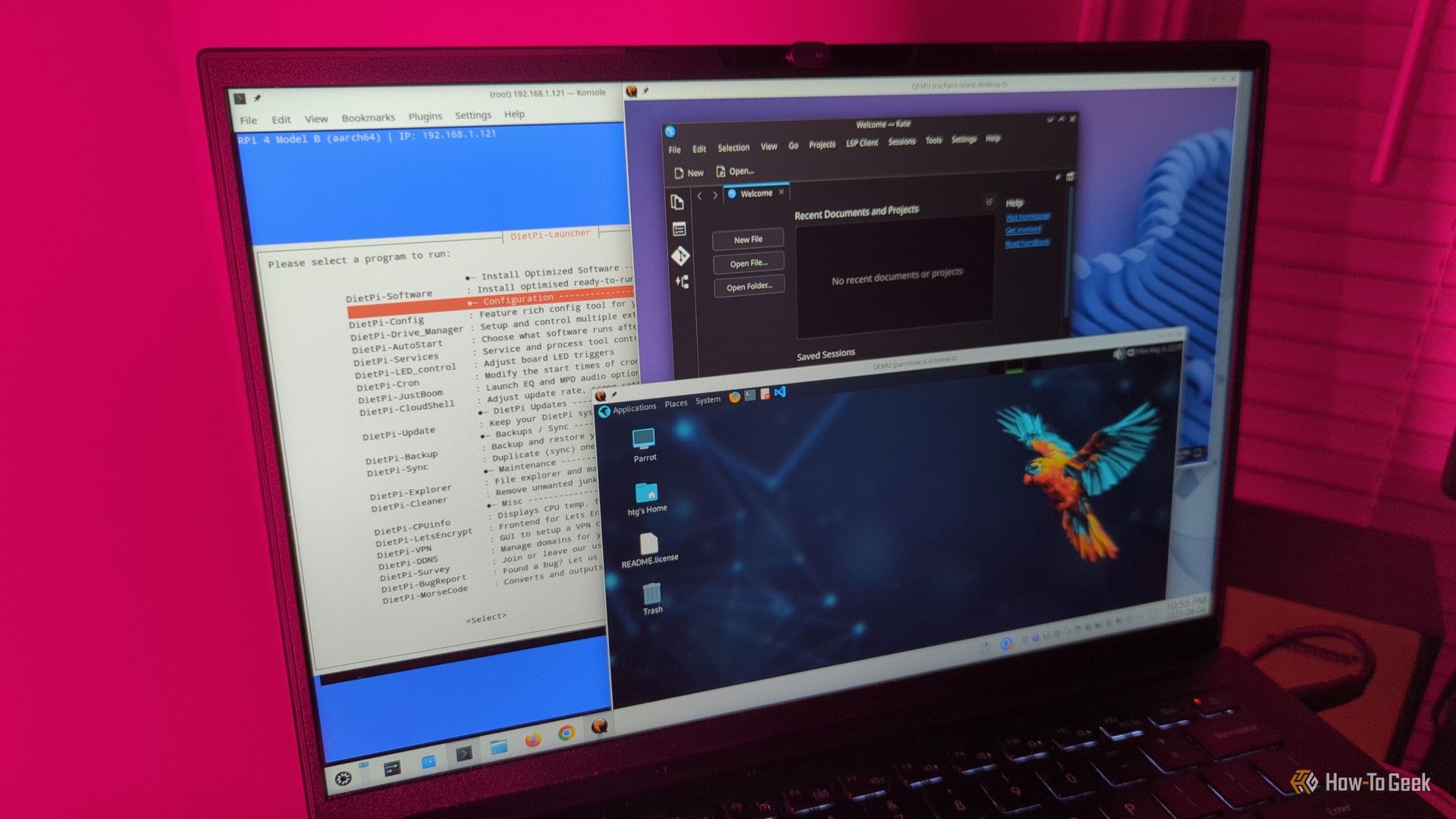
I tested the 5 breakthrough Linux distros of 2026. Here's how I rank them
Linux has no shortage of distros, and keeping track of which ones are worth trying can be difficult. Some distros focus on making Linux easier for newcomers, while others experiment with different desktop environments, system components, or specialized tools. Every year, a few distros manage to attract more attention than usual, and 2026 has been an interesting year for several of them.
When AI glasses could be a worthy headphones replacement
착용 시간이 전부다 — 웨어러블 논쟁에서 시각 훈련 소프트웨어를 설계한 이유
AI 글래스가 이어폰을 대체할 수 있을까 — 엔가젯의 이 질문은 사실 웨어러블 전체에 던져진 질문입니다. 답은 "무엇에 쓰느냐에 달렸다". 그리고 그 답 뒤에는 더 냉정한 기준이 숨어 있습니다. 기기가 아무리 뛰어나도, 매일 오래 착용하지 않으면 아무 일도 일어나지 않는다는 것.
이 기준은 시각 훈련 영역에서 훨씬 잔인하게 작동합니다. 약시(lazy eye, amblyopia)를 가진 사람에게 훈련을 포기하게 만드는 건 대개 의지 부족이 아닙니다. 접착식 패치의 불편함, 적청 안경의 어지러움, 그리고 무엇보다 지루함입니다. 재미없는 훈련은 3주를 넘기지 못합니다. 개발자 관점에서 보면 이것은 기능 문제가 아니라 리텐션 문제입니다. 아무리 정교한 알고리즘도 사용자가 매일 헤드셋을 쓰지 않으면 실행되지 않습니다.
그래서 Seven Sports는 순서를 바꿔 접근했습니다. 훈련을 위해 콘텐츠를 찾는 대신, 이미 매일 보고 있는 콘텐츠를 훈련의 장으로 만들었습니다. Amblyotube는 Meta Quest(Quest 2, 3, Pro, 3S)에서 YouTube 스타일 영상을 보면서 눈마다 다른 시각 경험을 제공하는 시각 협응·주의력 훈련 소프트웨어입니다.
왜 VR인가 — 두 개의 독립 디스플레이
핵심은 하드웨어 구조에 있습니다. VR 헤드셋은 눈마다 독립된 아이피스(eyepiece)를 가지고 있고, 소프트웨어는 각 눈에 서로 다른 피드를 동시에 보낼 수 있습니다. Amblyotube는 이 구조를 그대로 활용해 양안 훈련(dichoptic vision training)을 구현합니다. 왼쪽 눈과 오른쪽 눈에 완전히 다른 렌더링 결과를 전달할 수 있다는 점이, 기존의 패치나 아나글리프(적청) 안경으로는 불가능했던 설계 공간을 열어 줍니다.
이 지점이 사실 시스템 설계에서 가장 흥미로운 부분입니다. 전통적인 시각 훈련 도구는 '하나의 화면'을 전제로 만들어졌습니다. 패치는 물리적으로 한쪽 눈을 가리고, 적청 안경은 색 필터로 두 눈을 분리합니다. 둘 다 하드웨어에 종속된 트릭입니다. 반면 VR은 렌더 파이프라인 단계에서 좌안과 우안에 서로 다른 프레임을 밀어 넣을 수 있습니다. 훈련 파라미터가 콘텐츠 위에 얹히는 소프트웨어 계층으로 올라오는 순간, 실험실에서나 가능했던 프로토콜이 거실로 내려옵니다.
작동 방식은 계층적으로 단순합니다.
첫째, 우세안 화면에는 조절 가능한 디지털 블러(Dominant Eye Shader)를 겁니다. 블러, 대비, 밝기, 감마, 불투명도(opacity)를 개별적으로 조정할 수 있고, 100% 불투명도에서는 사실상 완전한 디지털 패칭이 됩니다. 하지만 주 목표는 대개 '부분 투명'입니다. 두 눈이 동시에 시각 정보를 처리하도록 만드는 것이기 때문입니다.
둘째, 약시안 화면에는 AI Sharpener(MFBF 모드)가 동작합니다. 이 엔진은 영상 안의 사람 형상(얼굴과 몸)을 식별해, 약시안 쪽 뷰에만 선택적으로 샤프닝을 적용합니다. 여기에 시각적 악센트(Visual Accents)가 더해집니다. 사람 위에 부드러운 형광 황록색 하이라이트를 입히거나, 인체 실루엣을 따라 굵은 적색 외곽선을 그리는 식입니다. 펄스(Pulse) 컨트롤로 이 효과를 일정한 Hz와 깊이로 밝아졌다 어두워지는 '호흡' 리듬으로 만들 수도 있습니다. 목적은 명확합니다. 무시당하던 눈의 시각 피질이 대상에 다시 주의를 기울이도록 만드는 것.
여기서 한 가지 흥미로운 엔지니어링 트레이드오프가 있습니다. 왜 프레임 전체를 샤프닝하지 않고 '사람'만 골라 강조할까요? 계산 비용도 이유지만, 더 큰 이유는 주의(attention)의 방향입니다. 화면 전체를 자극하면 시각 시스템은 어디를 봐야 할지 모릅니다. 반면 사회적 대상 — 얼굴과 몸 — 은 인간 시각이 진화적으로 가장 먼저 반응하도록 설계된 신호입니다. 약시안이 무시하던 바로 그 신호를 인위적으로 증폭시키는 것이 핵심입니다. 영상 전체가 아니라 관심의 대상에 개입하는 것. 이것이 소프트웨어가 하드웨어 위에서 할 수 있는 가장 정직한 일입니다.
셋째, 선택적 Wedge Occlusion이 있습니다. 양쪽 시야 일부에 검은 쐐기 모양을 덮어, 각 눈이 장면의 서로 다른 부분만 보게 강제합니다. 이는 두 눈의 상이 충돌하는 양안 경쟁(binocular rivalry)을 줄이는 고전적 기법을 소프트웨어로 옮긴 것입니다.
넷째, 양안 융합 훈련입니다. 약시안에는 자연 배경(피부톤, 녹색, 파란색)과 확실히 구분되는 고채도 마젠타 핑크 원형 단서를, 우세안에는 은은한 중립 회색 점을 띄웁니다. 사용자가 시선을 따라가면 뇌는 두 신호를 하나로 합치려 시도하고, 이 과정에서 양안 융합과 입체 깊이 지각이 연습됩니다.
캘리브레이션이 곧 정확도다
엔지니어링에서 흔히 놓치는 부분이 초기 설정입니다. Amblyotube는 실행 시 어느 눈이 영향을 받았는지(좌/우)를 먼저 고르게 합니다. 이 선택이 틀리면 필터가 반대쪽 눈, 즉 우세안을 훈련시키게 됩니다. 정확도가 곧 결과를 좌우합니다. 센서 캘리브레이션이 틀어진 로봇이 정확한 동작을 못 하듯, 기준이 뒤집힌 훈련은 아무리 오래 해도 방향이 반대입니다.
난이도는 두 가지 경로로 정해집니다. 하나는 조건 프리셋(Mild / Moderate / Severe) — 각각 시력표 마지막 2줄, 3~5줄, 5줄 이상을 읽지 못하는 정도를 기준으로 우세안 셰이더와 약시안 샤프너의 기본 레벨을 자동으로 맞춥니다. 다른 하나는 내장 LogMAR 시력 확인 도구입니다. 가상 3미터 거리에서 표준 Landolt C 시표를 사용해 눈별로 최대 30회 시행, 임상 스테어케이스 알고리즘으로 logMAR 값을 산출하고, 감지된 경도에 맞춰 훈련 프로필을 자동 갱신할 수 있습니다. 사용자가 감으로 난이도를 정하지 않아도 되는 구조입니다.
리텐션을 위한 인터페이스 결정
세션은 30~40분, 최대 1시간을 권장합니다. 13세 이상 대상. 컨트롤 패널은 VR 안에서 크기 조절과 이동이 가능한 플로팅 패널이고, Meta Quest 컨트롤러와 핸드 트래킹을 모두 지원합니다. YouTube 검색창이 내장되어 있고, 네트워크 없이 재생 가능한 아동용 카탈로그(만화 등)도 미리 담겨 있습니다. Room View는 AR 패스스루 모드로, 가상 룸 대신 실제 방 위에 영상을 띄워 훈련할 수 있게 합니다. 재생, 일시정지, 탐색, 볼륨, 음소거, 언어 선택, 그리고 기본값 복원(Reset All) 버튼도 포함됩니다.
인터페이스 결정 하나하나가 리텐션을 향합니다. 플로팅 패널을 굳이 VR 공간 안에 띄운 이유는, 훈련 중 시선을 헤드셋 밖으로 빼지 않게 하기 위함입니다. 컨트롤러와 핸드 트래킹을 둘 다 지원하는 이유도 마찬가지입니다. 입력 방식에서 막히면 그 순간 세션이 끊기기 때문입니다. 오프라인 카탈로그는 네트워크가 불안정한 환경에서도 훈련이 멈추지 않게 하는 안전장치입니다. 화려한 기능이 아니라, 매일 켜지게 만드는 마찰 제거입니다.
한계를 명확히 두는 설계
중요한 전제가 있습니다. Amblyotube는 진단·치료·완치 수단이 아니라, 양안 협응과 깊이 지각을 돕는 보조적 시각 훈련 도구입니다. 전문 의료 지침을 대체하지 않습니다. 소프트웨어가 할 수 있는 일은 꾸준히 실행될 기회를 만드는 것, 그리고 그 기회를 매일의 콘텐츠 위에 얹는 것입니다. 이 경계를 분명히 긋는 것도 설계의 일부입니다. 과장된 약속은 리텐션을 만들지 못하고, 정직한 범위만이 오래 갑니다.
검사실이 아니라 거실에서, 패치가 아니라 좋아하는 영상 위에서 훈련이 일어나게 하는 것 — 웨어러블의 성패가 결국 착용 시간에서 갈린다면, 시각 훈련도 같은 규칙을 따를 수밖에 없습니다.
Meta Quest에서 Amblyotube를 만나보세요: https://www.meta.com/en-gb/experiences/amblyotube/25906906972338493/

How to Build Durable Chat Memory for RAG Using ScyllaDB and LangChain
How to replace LangChain’s in-memory chat history with ScyllaDB — so your RAG chatbot retains context across restarts and scales across replicas
This post demonstrates how to integrate ScyllaDB Vector Search into your LangChain project for RAG use cases, as well as how to use ScyllaDB as a durable conversation memory within LangChain.
Background
Large language models are trained on a fixed snapshot of the world. RAG patches that gap by retrieving relevant documents at query time and injecting them into the prompt. The pipeline has two phases:
- Index: load documents, split them into chunks, embed each chunk, store embeddings in a vector store.
- Retrieve & Generate: enrich and embed the user’s question, find the nearest vectors (ANN search), pass the matching chunks as context to the LLM.
But RAG alone is not enough. You still need to keep track of all inputs provided by the user.
Persistent Chat Memory
LLMs are stateless. Every call starts with a blank slate unless you replay the conversation history. LangChain’s BaseChatMessageHistory abstraction lets you plug in any backend as the storage layer for that history. The default in-memory implementation vanishes on process exit. A database-backed implementation survives restarts, scales across replicas, and lets you inspect or audit conversations later.
That’s where ScyllaDB comes in.
ScyllaDB + LangChain
ScyllaDB is a NoSQL database optimized for high-throughput, low-latency workloads. Combined with LangChain, you can build reliable and always-on AI applications:
- High availability: data is automatically replicated across nodes, so there is no single point of failure. The cluster continues serving reads and writes even if a node goes down.
- Predictable P99 latency: ANN queries return results fast enough that retrieval doesn’t dominate your chain’s total latency.
- Horizontal scalability: add nodes to the cluster to increase throughput without schema changes or downtime.
- Built-in vector search: a native
vector<float, N>type and HNSW index are created automatically in ScyllaDB.
In this example, embeddings are generated locally with sentence-transformers (all-MiniLM-L6-v2, 384 dimensions). For production use, you can swap in OpenAI embeddings, Cohere, or any other provider supported by LangChain.
In each conversation turn, the chatbot is reading data from ScyllaDB and then writing back into it using LangChain.

Setup Example
With the release of ScyllaDB 2026.2, you can now integrate LangChain with ScyllaDB seamlessly by reusing the existing Cassandra connector.
Install Dependencies
pip install langchain langchain-community \
    sentence-transformers langchain-groq \
    langchain-text-splitters cassio \
    scylla-driver python-dotenv
Environment Variables
Copy demo/.env.example to demo/.env and fill in your credentials:
# ScyllaDB Cloud
SCYLLADB_CONTACT_POINTS=node-0.your-cluster.cloud.scylladb.com
SCYLLADB_DATACENTER=AWS_US_EAST_1
SCYLLADB_USERNAME=scylla
SCYLLADB_PASSWORD=your-password-here
SCYLLADB_KEYSPACE=demo

# Groq (LLM)
GROQ_API_KEY=gsk_...
Retrieve the contact points, datacenter name, username, and password from the Connect tab of your cluster in ScyllaDB Cloud.
Connect to ScyllaDB Cloud
from cassandra.cluster import Cluster
from cassandra.auth import PlainTextAuthProvider
from cassandra.policies import DCAwareRoundRobinPolicy
import cassio

cluster = Cluster(
    contact_points=["node-0.your-cluster.cloud.scylladb.com"],
    auth_provider=PlainTextAuthProvider(
        "scylla", "your-password"
    ),
    load_balancing_policy=DCAwareRoundRobinPolicy(
        local_dc="AWS_US_EAST_1"
    ),
)

session = cluster.connect()
cassio.init(session=session, keyspace="demo")
The cassio.init() call registers the session and keyspace globally so all downstream integrations (the vector store and the chat history) pick it up without further configuration.
Although cassio was originally built as a Cassandra integration, it is session-agnostic. It works with whatever driver session you hand it, so passing a session created by scylla-driver works just as well.
Integrating ScyllaDB with LangChain Vector Store
As an example, consider a chatbot that ingests articles, answers questions using retrieved context, and preserves conversation history in the database.
from langchain_community.document_loaders import WebBaseLoader
from langchain_text_splitters import RecursiveCharacterTextSplitter
from langchain_community.embeddings import HuggingFaceEmbeddings
from langchain_community.vectorstores import Cassandra

loader = WebBaseLoader([
    "https://docs.scylladb.com/stable/get-started/scylladb-basics.html",
    "https://docs.scylladb.com/stable/get-started/data-modeling/query-design.html",
])
docs = loader.load()

chunks = RecursiveCharacterTextSplitter(
    chunk_size=500,
    chunk_overlap=50,
).split_documents(docs)

embeddings = HuggingFaceEmbeddings(
    model_name="all-MiniLM-L6-v2"
)

vectorstore = Cassandra(
    embedding=embeddings,
    table_name="rag_docs"
)
vectorstore.add_documents(chunks)

retriever = vectorstore.as_retriever(
    search_kwargs={"k": 4}
)
WebBaseLoader fetches and parses each URL into a Document.
RecursiveCharacterTextSplitter then breaks each document into 500-token chunks with a 50-token overlap so sentences are not severed at boundaries.
Cassandra(table_name="rag_docs") creates the table on first use, including a vector<float, 384> column (matching all-MiniLM-L6-v2’s output dimensions) and an HNSW index. Subsequent runs reuse the existing table; you only pay the embedding cost once unless you call add_documents again.
Persistent Chat Memory Implementation
from langchain_community.chat_message_histories import CassandraChatMessageHistory

def get_chat_history(session_id: str) -> CassandraChatMessageHistory:
return CassandraChatMessageHistory(
    		session_id=session_id,
    		table_name="chat_history",
	)
CassandraChatMessageHistory stores each message as a row keyed on session_id. Because rows are written to ScyllaDB, the history survives process crashes, server restarts, and horizontal scaling. Any replica that opens the same session_id sees the same history.
Change session_id to start a fresh conversation. Keep it the same to resume where you left off — that is the entire persistence mechanism.
Putting It Together
from langchain_groq imp
Sellvia in 2026: The Tech Behind Its Digital Stores, Built-In Ads, and Orders
Opening an ecommerce store used to involve several separate projects. A seller needed a website, hosting, product pages, payment tools, marketing software, and a system for keeping track of orders. None of those tasks was impossible, but the number of services involved made a small online business surprisingly complicated to operate.
Sellvia takes a more integrated approach. Instead of asking users to assemble a store from independent services, the platform provides a managed storefront, access to a product catalog, promotional tools, and a dashboard for everyday operations.
That approach is timely. Sellvia appeared at No. 591 on the 2026 Inc. 5000 list of fast-growing private companies in the United States. Beyond the ranking, the more interesting story is how the platform brings several parts of digital commerce into one workflow.
What Is Sellvia?
Sellvia is an ecommerce platform that helps users launch an online store and manage its day-to-day operations. Its turnkey store offering is based on WordPress with Sellvia's own plugin and managed hosting.
The company supplies a ready-to-use store structure rather than leaving the owner to configure a server and assemble a large collection of plugins. Product management, store activity, and available marketing tools are reached through the Sellvia Dashboard.
This design changes the work involved in getting started. A new owner can spend more time choosing products, improving descriptions, and planning how to reach customers. They spend less time on hosting arrangements and the technical maintenance of separate systems.
The platform is especially interesting for someone who wants to run a store without becoming a WordPress administrator. Sellvia manages much of the underlying environment, while users work with the controls provided in the dashboard.
The Product Catalog: A Faster Route to a Digital Store
One of Sellvia's practical advantages is access to an existing product catalog.
Digital products can include ebooks, downloadable guides, educational material, courses, and templates. Unlike physical merchandise, these products do not require a warehouse or parcel delivery. Customers receive access to digital content after completing the relevant purchase process.
Take a store specializing in productivity and professional development. The owner might organize useful digital resources around planning, career skills, or personal organization. The work becomes selecting coherent offers and presenting them clearly instead of sourcing physical inventory and arranging shipping.
Product quality and relevance still matter. A broad catalog is most useful when the store has a clear audience and a sensible way of helping visitors choose among available products.
This is also why digital commerce is an attractive starting point for an integrated platform: product presentation, customer purchase, and content delivery can be coordinated electronically.
The Sellvia Ecosystem: How the Tools Fit Together
The key to understanding Sellvia is to look beyond the storefront itself.
The storefront is the public-facing part of the business. It presents products, organizes categories, and gives visitors a place to browse.
The product catalog supplies the items the owner can select and publish. This reduces the preparation involved in building a store from an empty website.
Sellvia Ads provides a managed promotional service within Sellvia's ecosystem. Users can review the available promotion settings and activity through their account rather than building the entire advertising workflow from scratch.
Order management brings transaction records and order activity into the dashboard, helping users see which orders need attention and which have progressed through the applicable processing steps.
Reporting connects these activities. Instead of judging the business only by how the homepage looks, users can monitor product activity, promotion, and orders in one working environment.
These functions have different jobs, but they share a practical purpose: reducing the number of disconnected tools a store owner needs to manage.
How Sellvia Ads Works
Marketing is often the next challenge after a store goes live. Having a finished website does not mean that people will automatically discover its products.
Sellvia Ads addresses part of that challenge with a managed promotion service. Its published terms describe promotion through Sellvia-operated digital properties and internal placement systems. Available budgets and service options are managed from the platform environment.
That makes Sellvia Ads different from an ordinary advertising account in which a merchant manually controls every external placement. It is important to understand that the internal promotion service does not necessarily function as a campaign sending visitors directly to the owner's branded website.
For someone new to advertising, a managed service can reduce the number of settings they need to learn at the beginning. It also provides a convenient starting point for examining how promotional activity relates to product demand.
The useful metrics are the ones tied to business decisions: what promotion was used, which products generated activity, and how actual orders compare with promotional spending. Advertised exposure is not the same as a completed order, and keeping those measurements separate leads to better decisions.
From Product Listing to Digital Access

The digital-order journey is short enough to understand without technical jargon.
First, a product is selected from the catalog and presented to customers through the relevant store or sales interface. The product page should explain what the buyer receives and make the offer easy to evaluate.
Next, the customer completes the checkout process available for that purchase. The precise payment flow depends on the store's configured arrangement.
Once the purchase has been processed, the buyer can receive access to the digital material through the applicable delivery process. The order is also recorded in the systems used to manage store activity.
These steps show the practical value of selling downloadable resources: there is no shipping label, carrier pickup, or warehouse dispatch between a completed digital purchase and access to the purchased material.
The store owner should still test the experience personally. Product pages, checkout instructions, access links, and order records should be clear and consistent, particularly on mobile devices.
What Can a Store Owner Manage in the Dashboard?
A useful ecommerce dashboard should support decisions, not merely display numbers.
Sellvia groups important store functions in a central workspace. Users can work with the catalog, review order information, access available promotional controls, and inspect reporting provided for their account.
For example, an owner who has added several digital guides can check whether visitors are engaging with those offers and whether the products are generating orders. When experimenting with promotion, the same owner can compare activity over time and decide whic

When AI Works Perfectly, What Happens to Human Life?
The medical report says there is nothing wrong. Every number falls within its expected range. No abnormality has been detected. The system has done what it was designed to do.
And yet, on the morning before work, the body hesitates. It knows something that the report cannot describe. Or perhaps it knows nothing at all. Perhaps the sensation is ordinary anxiety, fatigue, or a passing discomfort. The distinction matters, but the person experiencing it cannot yet make that distinction.
The report is correct. The discomfort remains. There is no contradiction in the data. Only a contradiction in the life that must continue after the data has been delivered.
This is where a story might begin. Not with a malfunctioning machine, but with a functioning one.
The World in Which Nothing Goes Wrong
Much of our imagination about artificial intelligence remains organized around failure. We fear the incorrect diagnosis, the discriminatory algorithm, the autonomous system that escapes its instructions. We imagine machines that deceive, disobey, or misunderstand us. These dangers are real enough to deserve serious attention.
But another kind of future is harder to picture. A future in which the systems become remarkably good. They identify illness earlier. They match workers with appropriate jobs. They calculate risks, recommend careers, preserve memories, and relieve us of countless small decisions. The machinery of everyday life becomes smoother. There are fewer mistakes to correct, fewer uncertainties to endure, fewer reasons to question the next recommendation.
And yet, somewhere inside this increasingly orderly world, a person stops. Not because the system has failed. Because the system's success has revealed something it was never built to understand. What happens when the answer is correct, but the question was incomplete?
This question became the starting point for LIFE, a ten-part work of linked fiction developed by SHIRO & Co., an independent creative and research practice in Tokyo. LIFE is not a story about artificial intelligence taking over the world. It is about the quieter possibility that the world might remain recognizable even as something essential becomes difficult to name.
A Life Without Friction
Engineers have good reasons to dislike friction. Friction slows processes, introduces uncertainty, increases costs, and creates opportunities for failure. To remove it is often to improve a system.
But in human life, friction has another meaning. It is the pause before saying something irreversible. It is the embarrassment of being inexperienced, the uncertainty of beginning a relationship, the inability to explain why a familiar place suddenly feels different. It is the interval between knowing what is reasonable and deciding what one can live with.
Not all of these experiences are valuable. Some are painful, unnecessary, even destructive. But neither are they all defects awaiting correction.
Consider a young person applying for a first job. The recruitment system asks for experience. It evaluates qualifications accurately, compares candidates fairly according to its criteria, and produces a defensible decision. The applicant has no experience. The answer is no. Nothing in the system needs to be broken for the rejection to make sense. Yet a question remains: where does experience begin, in a society that increasingly requires it before granting entry?
The problem is not simply that a machine has evaluated a person. It is that the criteria of evaluation may quietly determine which kinds of lives are allowed to begin. We can improve the algorithm. We can revise its criteria. We can introduce exceptions. But sooner or later we encounter a question that is not exclusively computational. Who is willing to make room for someone who has not yet become useful?
A Future That Has Not Happened
In another story, a thirteen-year-old faces a future already arranged according to stability and probability. The recommendations are sensible. Certain paths offer better prospects. Others carry greater risks. The system has no reason to conceal what it knows. Parents might find such guidance reassuring.
But there is an awkward fact about childhood: the person whose future is being predicted does not yet fully exist. Not in the sense that the child is incomplete or lacks a voice. Rather, the future person will be shaped by encounters, disappointments, friendships, accidents, and desires that have not yet occurred. A recommendation can describe likely outcomes. It cannot contain every possibility that will emerge from living.
There is a profound difference between helping someone imagine a future and deciding, in advance, which future is worth imagining. This distinction is easy to lose when prediction becomes increasingly persuasive. The more accurate a recommendation appears, the more difficult it can become to disagree with it. Eventually, refusing the optimal choice may begin to look like an error.
Yet the freedom to become someone unexpected has always depended, at least partly, on the right to make choices whose value cannot be demonstrated beforehand.
The Things a System Can Remember
Memory presents another difficulty. Imagine an old message, left on an online bulletin board twenty years ago. The original conversation has ended. The participants have changed, disappeared, or perhaps died. The message remains.
Then a reply arrives. It resembles a continuation of the conversation, but the voice is not the voice of the person who originally wrote it.
Technically, information has been preserved and reproduced. Something has survived. But what exactly? A person's words are not the same as that person's continued presence. A voice is not a life. A convincing response does not restore the circumstances in which an earlier conversation took place.
Still, the response may move us. We may recognize something in it. We may even find comfort. It would be too simple to declare that such experiences are false, just as it would be too simple to treat them as equivalent to human continuity. Between those positions lies a region that ordinary technological language struggles to describe.
Literature has lived in that region for centuries. It knows that memory can be inaccurate and still meaningful. That absence can remain present. That a silence may carry more of a relationship than a complete transcript.
AI introduces new possibilities for preserving traces of human life. It does not settle what those traces mean.
Why Microdrama?
LIFE exists as ten interconnected stories, accompanied by microdramas that approach its questions through brief audiovisual experiences.

At first glance, microdrama might seem an unlikely format for philosophical inquiry. There is little time for explanation. No space for an elaborate argument. Often, barely enough room for a situation to unfold.
But that limitation is precisely what makes the form interesting.
A person looks at a screen. A

Making Local LLMs Usable on 8GB GPUs
A local model can manage a brief question without any issues, but it may have difficulty when dealing with a complete document. The model's internal settings stay the same, but the effort needed and the memory required to process the request increase a lot.
In Part 1, I explained how to run a quantized model on a smaller GPU.
The next step is to choose a task, measure how long it takes, and find a setup that works within the GPU's limits.
This guide uses Qwen2.5-7B-Instruct along with llama.cpp.
It includes memory calculations, a fixed starting configuration, and a Python-based benchmark that you can run on your own computer. The numerical memory estimates are calculated values, and this article does not claim to have measured improvements in GPU performance.
To understand the actual delay you experience, there are two main waiting periods in a conversation. The first occurs when the model processes the initial prompt, often called the prefill phase. The second happens when the model generates the answer one word at a time, known as the decode phase.
If a document takes several seconds to process, fast decoding won't eliminate that initial delay. However, if the first words appear quickly but the rest of the response is slow, then the decoding phase is the area that needs optimization.
Keep these measurements separate:
Measurement | What it tells you |
Time to first text | Delay before the client receives the first nonempty text chunk |
Decode tokens per second | The server's reported generation rate |
Total request time | How long that request takes to finish |
Output token count | Whether two runs produced comparable amounts of text |
A target such as "start a short answer within two seconds" can guide your own experiments. It is a product requirement you choose, not a promised result for every 8GB card.
Budget for the KV cache as well as the weights
The model file is only part of the memory requirement. During generation, the runtime also stores attention keys and values for tokens already processed. This KV cache avoids recomputing those states, but it needs memory of its own. Working buffers and other GPU applications need space too. [1]
For a conventional full-attention transformer, an approximate KV-cache payload is:
KV bytes = 2 x layers x stored tokens x KV heads x head dimension
x bytes per cache element
The initial 2 accounts for keys and values. Use the number of KV heads, which can differ from the number of query heads.
Qwen2.5-7B-Instruct has 28 layers, 4 KV heads, and a head dimension of 128, obtained from its hidden size of 3,584 divided by 28 query heads. With FP16 cache elements, the calculation becomes 2 x 28 x tokens x 4 x 128 x 2. [2]
Stored tokens | Calculated FP16 KV payload |
4,096 | 224 MiB |
8,192 | 448 MiB |
16,384 | 896 MiB |
32,768 | 1,792 MiB or 1.75 GiB |
These figures describe one sequence and exclude allocation padding, runtime buffers, and model weights. They are not measurements of total VRAM usage. Other architectures, cache layouts, and attention types need different calculations.
This is why a large advertised context window needs its own memory budget. On this model, moving from 4K to 32K tokens adds about 1.53 GiB of calculated FP16 cache payload. Whether that increase fits depends on everything else already occupying the GPU.
Weight quantization and cache quantization are separate choices. A Q4_K_M model can still use an FP16 KV cache. Reducing cache precision may free up space, but it needs a quality check and a latency measurement. Hugging Face's cache documentation also cautions that cache quantization can hurt latency in some short-context situations. [1]
Establish one repeatable baseline
The shell commands below target Linux or WSL2 with an NVIDIA GPU. Install a working NVIDIA driver, a compatible CUDA Toolkit, Git, CMake, and a C++ compiler first. The benchmark itself requires Python 3.10 or newer and no third-party Python packages.
Use the current CMake build route in the llama.cpp build documentation: [3]
git clone https://github.com/ggml-org/llama.cpp
cd llama.cpp
cmake -B build -DGGML_CUDA=ON -DCMAKE_BUILD_TYPE=Release
cmake --build build --config Release -j 4
git rev-parse HEAD > llama-commit.txt
./build/bin/llama-server --version > llama-version.txt
./build/bin/llama-server --help > llama-help.txt
nvidia-smi > gpu-environment.txt
Keep that checkout unchanged throughout the experiment. Save the model filenames and their SHA-256 hashes too, including every shard if the download is split. A model tag alone is not enough to reproduce an experiment after its files change.
I use the official Qwen GGUF repository because its model configuration is available to inspect. It is a concrete baseline, not a claim that this is the best available model. [4]
Start the server from the llama.cpp directory:
./build/bin/llama-server \
  -hf Qwen/Qwen2.5-7B-Instruct-GGUF:Q4_K_M \
  --n-gpu-layers all \
  --ctx-size 4096 --parallel 1 \
  --batch-size 512 --ubatch-size 128 \
  --flash-attn off \
  --cache-type-k f16 --cache-type-v f16 \
  --fit off --no-context-shift --perf \
  --host 127.0.0.1 --port 8080 \
  2> baseline-server.log
The first launch downloads the selected model. Exclude that download and startup from request timings. Once the server is ready, inspect its log for the CUDA device, layer placement, cache allocation, and effective context settings. If an installed version rejects an option, consult its saved help output before continuing. The current server options are documented upstream. [5]
This configuration requests full GPU offload; it does not guarantee that every 8GB system has enough free memory. If startup fails, first close another GPU workload or test a smaller context. If partial offload is necessary, record the actual GPU layer count and use it consistently across the comparison.
The baseline has one request slot. Keep other inference clients stopped while measuring. With automatic fitting disabled, a failed configuration is visible instead of becoming a different experiment through an adjusted setting.
Run a benchmark that preserves the evidence</

AI Agent Memory (Part 1): Why Remembering Isn't the Same as Learning
AI agents preserve experience in histories, notes, and reusable instructions, then bring it back through search and retrieval. Their models also carry broad knowledge learned during training. But for memory to improve future behavior, it must help a system notice what matters, recognize a situation, and choose an appropriate action.
Memento: a life held together by notes
In Christopher Nolan's Memento, Leonard struggles to form new lasting memories. He uses photographs, notes, and tattoos to work out what happened and what to do next.
The notes help him carry on. But which note does he find? What did it leave out? Does he read it correctly? He can keep a conclusion and lose the reason he trusted it.
That is a useful way to think about agent memory. A deployed language model usually does not change its parameters after each conversation. These are the numerical settings it learned during training. Software around the model saves the history and brings information back when work resumes.
The comparison has limits. The model already knows a lot. It can reason about new information and help check its records. Still, the film gives us a good question: how does yesterday's note help with today's decision?
Four different things we mean by memory
Think about learning to cook.
Working memory helps you keep track of the pan and what to do next.
Episodic memory lets you recall the dinner you burned and what happened that evening.
Semantic memory is general knowledge, such as knowing that thin slices cook quickly.
Procedural memory helps you do things you have practiced, like moving the pan and adjusting the heat without talking yourself through every step.
These functions work together. They are not identical boxes, and a memory does not have to pass through them in order.
An agent's log can help it use a past event. Written instructions can help it carry out a task. But the files alone do not show that it remembers or acts the way a person does.

Knowledge in the model, continuity around it
During training, a model learns language, facts, relationships, and ways to solve problems. That knowledge is spread across its parameters. It is not a library of pages the model searches.
When we use it, we supply context: instructions, conversation, information found through search, and tool results. Examples and corrections in the context can change its answer without changing its parameters.
The agent harness is the software around the model. It manages tools, keeps track of the task, and decides what the model receives next. It can save chats, pull out lessons, find documents, or load a Skill: reusable instructions, sometimes with scripts and supporting files.
This helps. A saved preference can improve tomorrow's answer. A tested script can make a task more reliable. But once a correction leaves context, something has to save it and bring it back when needed.

Experience changes what stands out
An experienced cook hears the sizzling change and lowers the heat. A beginner may hear the same sound and miss the warning. Practice helped the cook notice something useful.
We will use a few terms for this throughout the series:
- Goal: what you want to achieve.
- Attention: what you notice and focus on.
- Recognition: what you think you are looking at.
- Belief or expectation: what you think is true or will happen next.
- Judgment: what you decide to believe or do.
These affect each other. If you expect trouble, you look more closely. If you see something surprising, you may change your expectation.
Human experiments show that past experience can guide attention even when we are not trying to recall it. People still forget and make bad calls. The useful point is that experience can change how we read the next situation.
Where the past can lose its influence
An agent saves a log, writes a lesson, and stores it. Later, search or a selector chooses what to bring into context. Some guidance is added automatically.
There are several ways this can go wrong. The lesson leaves out an exception. Its description does not match the new task. Or the agent finds the right note, but the situation has changed.
This is where I would look: did yesterday's experience help the agent notice the right thing and make a better choice today?
Look for better judgment
Memory is what we keep from the past. Learning is how the past changes what we do next.
Useful learning should help later work. Does the agent spot a familiar risk, change an outdated expectation, or choose a method with fewer reminders?
A saved rule, a better selector, or model training could help. External memory also gives us something we can read and correct.
More records alone do not prove competence. I want to see the agent still do the job well when the situation changes, including when an old method should not be used.
The next question is how the system knows which saved lesson matters now.
Ila Kumar: Innovating with communities
Before Ila Kumar thinks about how to build technology, she asks a different question: What is the context that technology will operate in, and who needs to be involved in the design?
For Kumar, meaningful innovation doesn’t result from engineers or designers working in isolation. Instead, she believes the best innovations emerge when the people who stand to benefit from a technology help create it from the very beginning.
That philosophy has guided her research in the Lifelong Kindergarten group, where she works alongside young people who have experienced trauma during childhood, particularly those involved in the child welfare system, to reimagine how technology can support healing, connection, and independence.
“I really think that community-based design is the only way that we can make technology that accounts for communities’ needs, but also their barriers, their cultures, their concerns,” Kumar says. “It’s the only way that we can make really sustainable and positively impactful technology.”
Today, Kumar is preparing to enter the sixth and final year of her PhD. But when she first arrived at MIT in 2021, she envisioned staying only long enough to complete a master’s degree. However, Kumar quickly fell in love with her work and decided to stay at MIT and pursue her doctorate.
Before graduate school, Kumar grew up in Philadelphia, attended the University of Pennsylvania, and worked on several projects at the intersection of technology and mental health or psychology research.
Through those experiences, Kumar began to question whether the technology she was helping to develop was having the sustained impact she hoped for. “I had done a number of projects that were ‘tech for good,’” she says. “And I wasn’t seeing that what I was doing had a long-term impact.”
Rather than walking away from technology altogether, Kumar began to rethink how it was created. “If we design technology in community-based ways and really think about holistic well-being,” she says, “maybe we can actually create things that help people.”
That conviction eventually became the foundation of her doctoral research, and over the course of her PhD, Kumar has increasingly moved from simply listening to communities to building with them.
Public conversations about technology often present a choice: Embrace it or reject it. Kumar believes that it’s not that simple.
Kumar sees the way digital platforms have the potential to both harm young people’s mental health and development, and help young people process emotions, strengthen relationships, and practice healthy vulnerability — if those tools are designed thoughtfully and embedded in the systems where young people already receive care and support.
Much of her work explores exactly what that could look like.
One project Kumar worked on, in partnership with Stepping Forward LA and with the input of the young people who would use the app, replaces text-heavy communication with a visual collage system to help young people impacted by trauma and the child welfare system to express emotions that may be difficult to put into words, and to build a sense of connectedness with one another.
In an ongoing project, Kumar is collaborating with the Justice Resource Institute to design a mobile app that supports youth in playing an active role in their treatment-planning process and helps them work toward the goals they set outside of the therapy office. The group is working with clinicians and youth to design and evaluate the system.
“We are not sitting at MIT designing tools and just throwing them at people,” Kumar says. “We’re designing it together. We need to actually have the folks that are relevant to providing the care in the room.”
That idea became even clearer to Kumar through a 10-month technology leadership circle she co-facilitated with Foster America. The program brought together people with lived experience of foster care and technology experts to envision how digital technologies could fill gaps in care for young people in the child welfare system.
This project surfaced the importance of not just designing tools that center youths’ needs but also considering the ways in which social services need to be brought into the innovation process.
Those ideas have also led Kumar to explorations that involve one of technology’s newest frontiers: artificial intelligence. She began asking questions after she realized that young people who had experienced trauma had already been turning to AI to make critical life decisions, even as many caregivers were not aware of it.
As a result, Kumar has increasingly focused on supporting care providers in talking with young people about AI. She has led training workshops with organizations that serve young people impacted by trauma or involved in the child welfare system.
Kumar’s passion for advocating for young people extends far beyond the lab. She also volunteers as a court-appointed special advocate, working one-on-one with a young person in the child welfare system while pursuing her PhD.
The role has deepened both her understanding of the challenges young people face and her belief that lasting change depends on relationships.
Some of her most meaningful moments have come while working directly with young people. Last summer, she, alongside another graduate student in her lab, mentored two interns with foster care experience during a six-week program that blended technology, creativity, and personal growth.
“It felt like a real privilege,” Kumar says. “Even the six weeks was not enough.”
Those relationships have also inspired Kumar to address how community-based research is conducted at MIT.
Recognizing that many students interested in community-engaged work often feel isolated, she collaborated with the Priscilla King Gray Center for Social Impact to co-teach a course on community-driven innovation. She later established a biweekly community of practice connecting researchers across MIT and Harvard University who are navigating the benefits and challenges of conducting research alongside communities rather than simply studying them.
Outside of research, Kumar enjoys birdwatching, cooking with friends, and creating graphic illustrations — creative pursuits that, much like her research, reward patience, observation, and careful attention.
As technology becomes increasingly woven into young people’s lives, Kumar hopes innovation will move beyond the lab and into the communities it is meant to serve.
“The future of actually impactful technologies,” Kumar says, “is when researchers are making decisions with communities instead of for them.”