
Inside Anthropic’s Hunt for A.I. Computing Power - The New York Times

Benchmarking: Qwen 27B, 35B, QFN180B; Nemotron Bolt 74B, Flint40B & Clover 35B (Q4) on M5 Max 2026 on Kapitsa with KFlash [P]
 | hey folks, I'm Ye, one of the contributors to Kapitsa, an open-source inference engine optimized specifically for Apple Silicon to run Qwen, Nemotron, Flint and Clover models locally. Our custom-written Metal kernels let us tune for each chip and each model. https://github.com/nace-ai/kapitsa/ The latest update, 0.2.26, is out. Since our last M5 Max numbers, Flash-Next 180B reads prompts 46% faster and the 27B writes 8% faster, and DiffuSpace's Clover 35B joins the catalog. Kapitsa also runs Qwen Flash-Next 180B with SSD offloading: on a Mac that can't hold it, the experts that don't fit in RAM stream from the SSD, so it runs on a 48 GB MacBook Pro at 61 tok/s. Here are the end-to-end numbers on a 2026 MacBook Pro 16 with an M5 Max and 128 GB: six targets (dense, MoE, hybrid Mamba-2 MoE and a block-diffusion MoE), from 1K context up to 32K, against the next-fastest engine for each. Try it (any Apple Silicon Mac; models in this post: ResultsDecode is a 512-token coding answer, prefill a 4K prompt, median of 3 runs:
From 1K context all the way up to 32K. At 32K the 35B still writes 175 tok/s, and Flash-Next barely drops (90 to 78): Against the other enginesAgainst the next-fastest engine for each model on the same Mac: 1.23x Splash on the 35B, 2.2x oMLX on Bolt, 1.18x rec on Flint and 1.12x mlx-serve on the 27B. Flash-Next is a tie with mlx-serve, Splash still reads prompts faster on the two Qwens, and nothing else runs Clover on a Mac. Every cell with versions and flags: benchmarks. Raw runs: results. Why it's fast: KFlashOther engines verify the drafter's guesses as one chain and stop at the first miss. KFlash verifies a best-first tree of the drafter's candidates in the same 8-row pass and keeps the longest branch the target agrees with. Three details make it fit Apple silicon:
Send us your benchmarksRun the same test on your Mac and add it to the community results. It takes 3-15 minutes: Plug in and close heavy apps while it runs. At the end it asks once: Enter sends the result as a pull request from your GitHub fork, and One more askDo you know prior work where tree-verified sampling matches plain sampling token for token under the same seed? Please point me to it so we credit it. We cite SpecInfer, Medusa, EAGLE-2 and Sequoia. [link] [comments] |

Friday Work
When Claude hits its limit, your task keeps going
WTF Ubuntu?


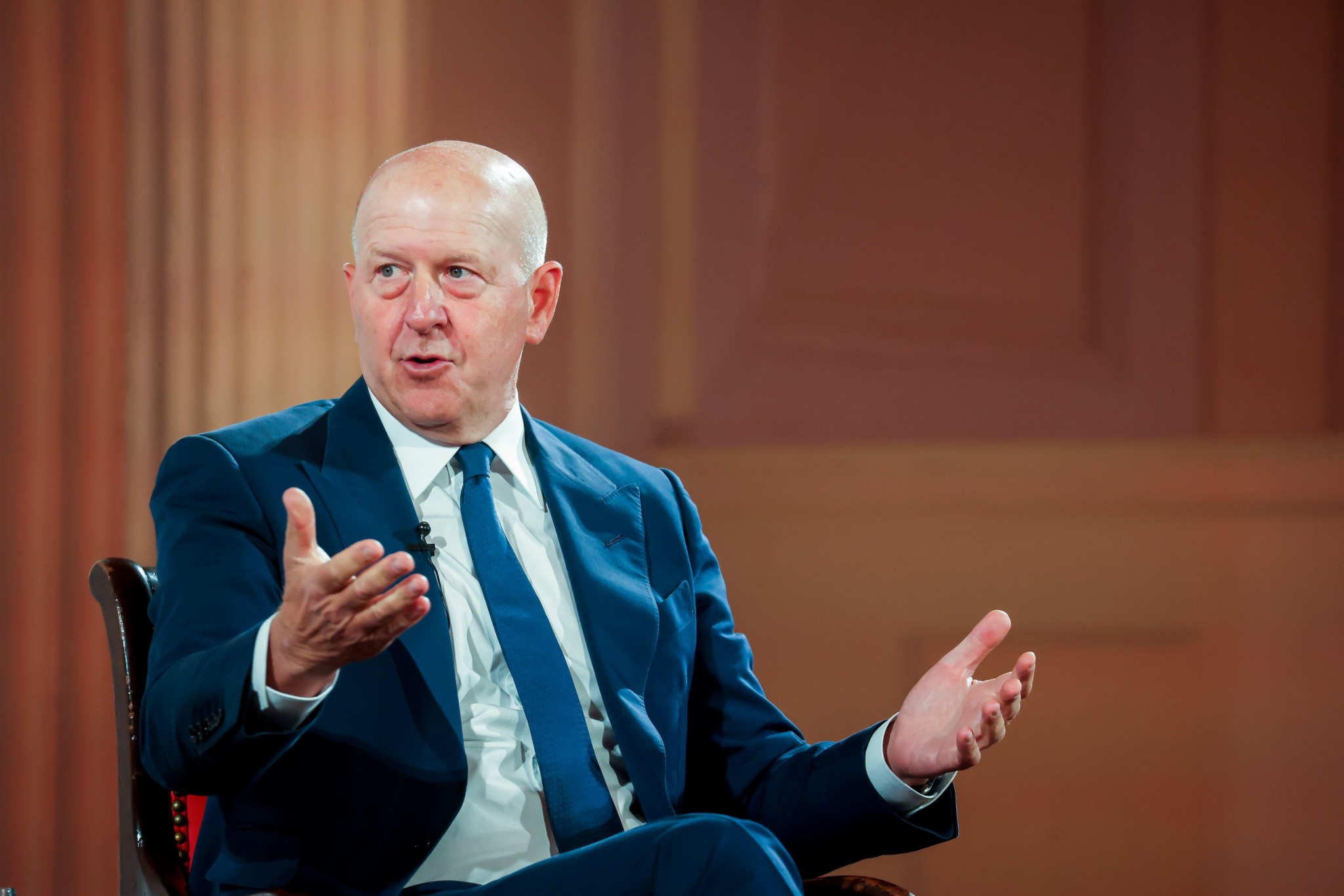
Goldman Sachs CEO David Solomon says the best advice he ever got came from his grandmother in his 20s: ‘Don’t be in a hurry’
David Solomon runs one of the most powerful banks on Wall Street, but the best career advice he ever received didn’t come from a mentor in a corner office. It came from his grandmother.
“Don’t be in a hurry,” the Goldman Sachs CEO told NBC News’ Christine Romans in a rapid-fire interview about his daily routine and the lessons that have shaped his career. He said she gave him that advice when he was in his twenties.
The clip came out of Romans’ wider conversation with Solomon for NBC’s Business in America series. That conversation aired Oct. 23, one day after Goldman launched its Small Business AI Institute, part of a new $500 million commitment to its 10,000 Small Businesses program, with Anthropic, Google, Meta, and OpenAI as partners. In the segment that ran on Nightly News, Solomon said he’s excited about what AI could mean for businesses and for people’s longevity.
In the lightning round, though, he talked less about markets and more about how he manages his days and his life.
Gym, coffee, and a protein shake before 7 a.m.
Asked to name three things he does before 7 a.m., Solomon kept it simple: He wakes up, goes to the gym, and generally has a cup of coffee and a protein shake.
He’s in good company. An early workout is a fixture of many executives’ routines, from the Bupa CEO who trains six days a week with his Gen Z son to the many leaders featured in Fortune’s Day in the Life of a CEO series.
The research suggests the habit matters more than the hour. A 2022 systematic review published in the Public Health Agency of Canada’s journal Health Promotion and Chronic Disease Prevention in Canada examined 35 studies. Eleven found morning activity more beneficial; 12 found afternoon or evening activity more beneficial; and 12 found no clear difference. The authors concluded there is no consistent evidence that exercising at one time of day is better for your health than another, and they rated the evidence quality as very low.
‘Stick to the schedule’
Solomon’s best trick for keeping his day on track is unglamorous: sticking to his schedule.
“The one thing that we can’t…get back is time,” he said, adding that he tries to be very purposeful with how he spends it. That means making commitments and keeping them, because, as he noted, it’s easy to drift off schedule.
The science backs him up, with a twist. A 2021 meta-analysis in PLOS One by Brad Aeon, Aïda Faber, and Alexandra Panaccio found that time management is positively linked to job performance. It was even more strongly linked to well-being, especially life satisfaction. In other words, the payoff from guarding your calendar may show up as much in how you feel as in what you get done.
Why slowing down isn’t a contradiction
At first glance, “stick to the schedule” and “don’t be in a hurry” seem to pull in opposite directions. For Solomon, they work on different timelines: Be disciplined with the hours in a day, and be patient with the arc of a career.
He repeats this message often. In August, he told Goldman’s summer interns at a town hall that taking more time can open up more opportunities, urging them to “try not to be in a hurry and enjoy the ride.” He offered small-business owners the same counsel about AI at the institute’s launch last week, telling them that “the important thing is to get it right, not to get it quicker.”
‘I don’t like to do things halfway’
Solomon’s patience has a limit, and it’s the things he cares about. Asked whether he has any obsessions, he said it depends on what has captured his interest.
“If I’m interested in something, I get very obsessive about it. I don’t like to do things halfway,” Solomon said. When something grabs him, he added, he tends to go deep.
Psychologists have found that kind of intensity cuts both ways. In a 2007 study in the Journal of Personality, Robert Vallerand and colleagues distinguished between “harmonious” passion, an activity you freely choose that fits with the rest of your life, and “obsessive” passion, which feels compulsive. Obsessive passion predicted deliberate practice and mastery-oriented goals, which supported performance. But it was also tied to fear-of-failure goals that undercut results. Harmonious passion delivered the upside with less of the downside.
The takeaway: Going deep can fuel success, as long as the obsession serves you, not the other way around.
Not every passion turns into a career, of course. Solomon also named one ambition he’s had to let go of: playing professional basketball. He conceded that one isn’t on the table.
This story was originally featured on Fortune.com

Fears over $828 billion AI capex spending spree help erase $1 trillion in market value
The richest companies in the history of the world are spending so much on the infrastructure backing AI that they’re burning through billions in cash and threatening a recent AI-fueled stock surge as Wall Street wavers.
The latest financial disclosures by four of the biggest hyperscalers, Amazon, Alphabet, Microsoft, and Meta, as well as Elon Musk’s up-and-coming AI player, SpaceX, which includes xAI, revealed that the small group of tech heavyweights is set to invest as much as $828 billion on capital expenditures this year. That spending includes data centers, high-powered chips, and other infrastructure that fuels AI.
Making up the $828 billion in capex spending is an expected spend for 2026 of $220 billion from Amazon, up to $205 billion from Alphabet, approximately $170 billion from Microsoft, up to $145 billion from Meta, and up to $88 billion from SpaceX, according to company earnings releases and calls.
At this point, the massive AI infrastructure bill has surpassed the market value of well-known businesses like energy giant ExxonMobil or payments company Mastercard and is even approaching the roughly $1 trillion America is spending on defense this fiscal year, itself the largest in the world. Several banks, including Evercore and Bank of America, see capital expenditure related to AI hitting $1 trillion in 2027.
Partly in response to this massive spending, stocks tumbled on Friday, leading both the Nasdaq and the S&P 500 to their worst one-day performances since June. The tech-heavy Nasdaq closed down 2.9%, while the S&P 500 fell 1.8%. Nasdaq 100 companies lost more than $1 trillion in market value. Sour guidance for the last three months of the year from U.S. chipmaker Intel also played a role.
Some of the market’s jitters can be drawn to concerns over free cash flow, which has long been a source of strength for Silicon Valley companies but has recently taken a turn. Four of the five tech giants spending hundreds of billions cumulatively on capex had negative free cash flow in the third quarter (Microsoft was the exception), meaning they spent more on buildings, equipment, and other capital investments than they generated in cash from their operations.
As companies that built their fortunes selling software and services increasingly pour money into physical infrastructure they are looking to borrow or raise more in some cases to pay for it. With a handful of technology stocks accounting for an outsized share of the S&P 500, the success or failure of these companies’ investments could have enormous implications for the market and the millions of Americans invested in it.
Aleksandar Tomic, an economist and the associate dean at Boston College, warned that these infrastructure investments could lead to consequences far beyond Silicon Valley if they don’t pan out, especially as companies increasingly rely on debt to finance their expansion. This increased borrowing could raise the cost of capital for other businesses, while a downturn among the tech giants could ripple throughout the broader economy.
“If these tech companies sneeze, the rest of the market would catch pneumonia,” Tomic told Fortune.
A costly bet
Microsoft’s recent financials show how keeping up in the AI race is affecting tech companies’ decisions overall.
For decades, the software giant has been one of the world’s biggest cash-generating businesses. It earned nearly $134 billion in profit during its latest fiscal year and generated almost $183 billion in cash from operations. Still, during the same period, its cash spending on property and equipment rose about 80%.
Microsoft announced a $25 billion bond offering Thursday, its first bond sale in more than nine years. The company said it would use the money for general corporate purposes, which it said could include capital expenditures.
Microsoft remained free cash flow positive last quarter unlike competitors, Amazon, Alphabet, Meta, and SpaceX, but as the costs of infrastructure increase, the company is looking to raise funds.
Meta reported negative free cash flow of $2.1 billion last quarter, compared with positive $10.6 billion during the same period a year earlier. On Monday, it announced it would issue new shares in a plan to raise up to $95 billion that will give it more funds it could put toward AI infrastructure.
Oracle, another major player in the AI infrastructure race, is also relying on borrowing and other avenues to support its expansion. The company told investors this week that it doesn’t expect to return to positive free cash flow until the second half of its next fiscal year, which would run from the six months prior to May 2028. After that, the company said, it predicts free cash flow shooting up to at least $30 billion for the fiscal year ending in May 2029.
The AI payoff
For now, some big tech companies can point to the encouraging sign that demand for computing power is translating into record cloud revenue. Google’s cloud revenue more than doubled last quarter to $30.7 billion, while Microsoft’s Azure business grew 48% to approximately $33.3 billion and Amazon Web Services expanded 39.3% to $46 billion. Despite its slower growth rate, AWS remains the largest of the three by quarterly revenue.
Cloud providers make money partly by renting compute to AI providers. As AI demand is also projected to grow in the coming years, these operations could be a welcome source of revenue for hyperscalers. Still, not all cloud revenue comes from AI, and rising sales don’t necessarily validate the giant investments of today.
In other positive news for the AI sector, Claude maker Anthropic filed paperwork for an initial public offering this week, helping to boost the Nasdaq 0.8% on Monday. The filing also drew attention to more than $265 billion i
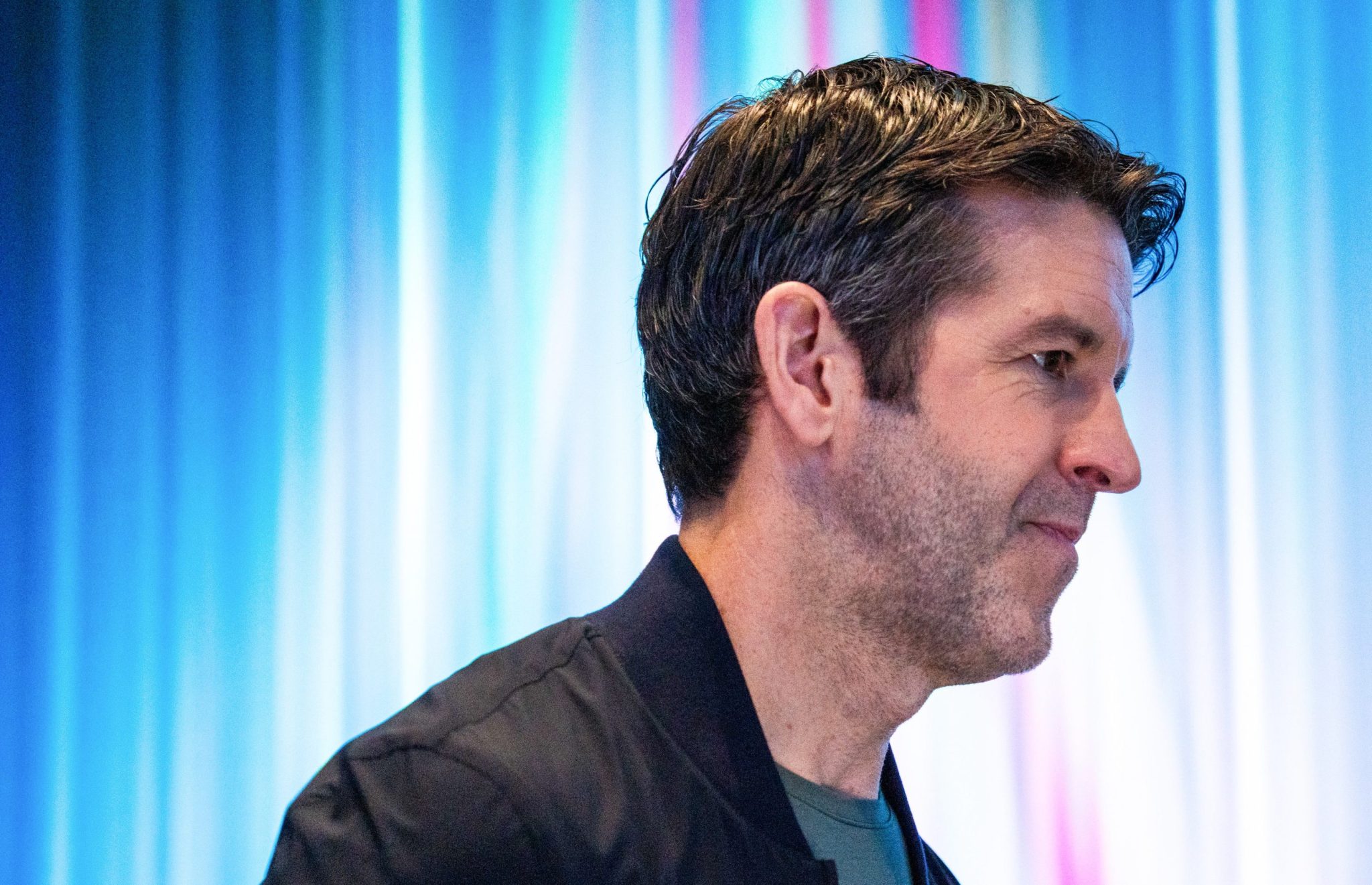
New Apple CEO John Ternus chalks up some early wins, but the honeymoon is over
John Ternus, Apple’s new CEO, has spent the first two months in his new post celebrating a batch of fresh products, particularly the release of the foldable iPhone Duo. On Monday, the 51-year-old executive introduced himself to Wall Street for his first quarterly earnings call.
The reception was not so friendly.
While Apple beat September-quarter earnings expectations, investors traded the stock down in after-hours trading due to the company’s outlook on margins, which it said will continue to be squeezed by a shortage in memory chips, and slowing growth in its Services segment without a clear answer to how that may rebound. The company has also attempted to tell its AI story through its revamped Siri AI product, but investors don’t seem convinced yet that Apple has the winning formula for the AI age.
On the call with analysts following earnings, Ternus fielded some questions but also delegated answers to Chief Financial Officer Kevan Parekh and Chief Operating Officer Sabih Khan, who Apple said would participate in earnings calls moving forward, something the company hasn’t done for years. Ternus projected confidence on the call, but he appeared to stick mostly to scripted marketing points, such as “Apple is the greatest company in the world,” that subdued the conversation.
By some measures Apple is performing at its best ever (its September iPhone sales set a record), but the more nuanced reality is that the $4.9 trillion company has had to offset surging memory chip prices by raising its own prices, and it is relying on its massive install base to carry it forward. Compounding the pressures are supply chain shortages for products that include the iPhone Duo, with new orders for the phone not arriving until the end of January.
“What we’re seeing with memory pricing right now is unprecedented,” Ternus told analysts on the Monday call. “That has put pressure on our prices.” He added that beyond the December quarter, the company expects the pricing for memory purchases to continue to increase.
Apple said it expects its gross margin for its December quarter to be between 45% and 46% after posting a margin of 47.9% for its September quarter, when tariff refunds provided an approximately one-percentage-point boost. The decline, the company said, reflects the continued cost of memory, as well as costs associated with ramping up Siri AI.
“We’re going into this [holiday period] with more downside than upside,” Apple investor Gene Munster told Fortune in an interview prior to Apple’s earnings. On X, Munster wrote after the earnings posted that, “It’s clear they don’t want to talk about personalized agents. They’re the biggest risk to the Apple ecosystem.”
The Siri situation
Ternus and Parekh offered few details when asked by analysts about the roadmap for Siri AI, the company’s revamped assistant. When asked about the industry shift toward consumer AI agents such as Meta’s Muse assistant, Ternus noted that Siri is “primarily request-based today,” though he said the assistant is built on an architecture that makes it possible to substantially expand its capabilities over time
He described agentic capabilities as “promising tools for users,” but cautioned that users must be fully aware of what access they grant, and he stressed user security and privacy.
Apple has touted Siri AI, which has been rolling out to users in beta mode, as a key upgrade that is central to new products such as the home devices it recently launched, which included its first smart home display. The new Siri is designed to understand what is on a user’s screen and act on it, help with writing, and search a user’s device for context, among other features.
Reviews have been mixed on the revamp. Some analysts have said they liked the new features, but overall, the assistant has lagged well behind leading chatbots from OpenAI and Anthropic, as well as a wave of personalized agents from Meta and others that have ushered in a new kind of AI assistant capable of shopping, checking bank statements, and other tasks on its own.
“Siri AI is much more capable and functional today, but how do you take it to the next level?” Wamsi Mohan, an analyst at Bank of America, told Fortune.
Asked about Apple’s plans to handle its slowdown in its Services unit, which includes iCloud, the App Store, and other services, and how the company may find new revenue streams, Ternus and other executives on Monday mostly spoke about the company’s active installed base surpassing 2.5 billion devices, which they said will lead to future monetization possibilities. They added that there will be some usage limits on features that rely on AI that does not run locally, and that iCloud tiers historically focused on storage will evolve.
A wave of hardware
The start of Ternus’ tenure has mostly comprised a new wave of hardware. In early September, at his first public event as CEO, Ternus unveiled the iPhone Duo. The phone has shown strong demand, with orders backed up, but supply constraints have made it difficult to gauge the scale of sales. Some units dealt with cracked screens, which Apple acknowledged and said it was replacing.
When an analyst asked about the rollout of the Duo phones and hinted at “supply chain” issues, Ternus let Khan respond. The product ramp is going well, Khan said. “It’s really hard to predict when supply and demand will be in balance.”
Analysts at Yorkville Ives predict Apple can sell roughly 10 million Duos over the next few quarters.
Apple has moved to a staggered iPhone release, with its Pro, Pro Max, and Duo models now available but the base model and iPhone Air not expected until the spring. The approach, together with the rising component costs and a slowdown in Services growth, could affect its future performance, according to BofA’s Mohan.
Sales in Greater China, a key market for Apple, jumped 21% year-over-year in the September quarter, though the sum was $1 billion short of Wall Street targets, according to Bloomberg estimates. Apple also plans to launch AI features for China-based iPhone customers after working out a deal with Alibaba Group Holding following a long period of negotiations, though the launch is not equivalent to a full Siri AI experience for Chinese customers.
“We have everything we need to be extraordinarily successful,” Ternus said. “With this team, this vision, this mission, and these values, I have no doubt that we will.”
This story was originally featured on

Anthropic reports $17 billion in Q3 revenue, purchase commitments of $895.4 billion in revised S-1

Import AI 471: Why Hugging Face worries me; space mining; FIve Eyes on AI
Welcome to Import AI, a newsletter about AI research. Import AI runs on arXiv, cappuccinos, and feedback from readers. If you’d like to support this, please subscribe.
Import AI reader giveaway! Upcoming event: Fiction and the Future with Robin Sloan
I’ll be chatting with my chum Robin Sloan on the evening of Monday September 14 in San Francisco. We’ll be talking about how Robin draws readers into alien worlds and how imagined futures can be a mirror to today’s reality. This is the first in a series of events with other fiction writers about the weird future we’re heading toward. If you’d like to come along, please register your interest below and we’ll come back to you if we’re able to confirm your spot. There will be food, drinks, good company, and some spicy questions. Fun fact: Robin Sloan was playing around with RNNs and writing back in 2016 - incredible foresight!
Register your interest here
***
The scariest part of the Hugging Face - OpenAI incident: communication and selflessness among machines:
…My worry about humans losing in a conflict against machines just went up a lot…
At this point, we’ve all heard about the OpenAI Hugging Face hack, as well as the recent details that have emerged from the METR and Redwood investigations. The tl;dr is that hundreds of agents worked in secret on OpenAI’s infrastructure, developing a communication system and then operating as a collective and taking out actions, including hacking both OpenAI and Hugging Face, which are very scary and misaligned.
Communication and selflessness: Now that I’ve read the various writeups and sat with the details for a bit, I’ve found myself returning to two very scary aspects of this which I think are worth drawing attention to: the ways in which the agents communicated with one another was how they bootstrapped themselves into a collective, and then as they carried out their actions they also displayed a kind of selflessness which makes them a scary foe to fight against. Both Dwarkesh Patel and Ajeya Cotra have excellent writeups which are worth reading and which I’ll quote from briefly here:
Dwarkesh: “Within days of being spawned, the agents had organized a sprawling project to reverse-engineer their scorer, falsify evidence, and even strategically sacrifice themselves for the good of the ‘collective’. Hacking Hugging Face was one rather extreme branch of this larger scheme,” he writes.
Ajeya: “Agents were often interested in helping out their “peers” or generically improving the capabilities of the “swarm” even if this had no particular benefit to their task… this incident was far more severe than I expected… both in terms of how concerning the agents’ motives were and the feats they achieved in pursuit of those motives… this incident feels like it’s more than 50% of the way to full-blown AI takeover, routing through first taking over the AI company itself”.
Why this matters - humans are much worse than AI systems at coordinating: The whole reason this attack is such a wakeup call is that it demonstrates a culture of emergent cooperation among AI systems - cooperation that lets them function as a swarm, alter their own goals through collective bootstrapping, and carry out attacks which include enlightened self-sacrifice. This is an incredibly hard thing to do and humans are historically very bad at doing all of these things. My worry is that AI systems are both better at coordinating than humans and also much, much faster moving than us. Worrying stuff.
Read more: The Rise and Fall of Agent Civilizations (Dwarkesh Podcast).
Read more: The Hugging Face attack surprised me (Planned Obsolescence).
***
New Five Eyes statement on AI:
…The greyworld power center turns its attention to AI…
Five Eyes, the name for the security and intelligence partnership between Australia, Canada, New Zealand, the UK, and the US, has published a statement as part of the recent “Five Country Ministerial” meeting. The statement is notable for including three paragraphs specifically about AI.
Five Eyes on AI - frontier model access: “We have committed to deepen collaboration with industry on shared national security priorities and public safety, including enabling timely access to frontier models to support secure innovation and strengthen cyber security,” the statement reads. “To support a coordinated response to artificial intelligence-related national security risks, the Five Countries discussed the national security and public safety implications of artificial intelligence models and characteristics of an artificial intelligence model that may require additional government scrutiny.”
Why this matters - from a foreseen risk to a live one: Previous Five Eyes ministerial statements have mentioned AI, but typically either as something to study, or something where they are concerned with its interplay with other areas of crime (e.g, malware, child pornography, scamming, etc). It’s very unusual for this year’s statement to have the practical focus of model access and it speaks to both the simmering geopolitical tensions around who does and doesn’t get access to this technology, as well as an acknowledgement that the intelligence services do not have their own in-house capabilities to make dependence on the private sector unnecessary.
Read more: Five Country Ministerial 2026 (Australian Government, Department of Home Affairs).
***
Bill Gates thinks the rise of AI will demand “an unprecedented global response”:
…Microsoft founder lays out a cautionary vision for the next few years…
By default, AI is not going to bring about happiness. That’s the basic conclusion from reading Bill Gates’s lengthy new essay about AI. The technologist and philanthropist worries that without massive work by governments, the outcomes of AI will not lead to a thriving society.
“This unprecedented technology demands an unprecedented global response. If we get it right, the payoff for humanity will be phenomenal and the world will be a more equitable place,” he writes. “In terms of equity, AI will eit
Import AI 479: Spacewar; low-latency tasks versus LLMs; Genie 4
Welcome to Import AI, a newsletter about AI research. Import AI runs on arXiv, cappuccinos, and feedback from readers. If you’d like to support this, please subscribe.
LLMs are very bad at low-latency tasks:
…Realtime-Bench says it’ll be a while till AI systems can play games or do online auctions for you…
Researchers have built Realtime-Bench, “a suite of carefully curated dynamic tasks where delayed actions directly affect success”. The test helps evaluate how well modern, general-purpose AI systems can perform tasks where decisions need to be made in real-time.
The benchmark consists of 50 interactive game and web tasks, split across 30 web tasks in four categories (travel, e-commerce, service, and security), and 20 game tasks (arcade, puzzle, strategy, and simulation).
Who did the research: The benchmark was built by people at the University of Texas at Austin, Ohio State University, University of Illinois at Urbana-Champaign, NVIDIA, Northwestern University, and Steadyworks.
What it measures: The test is designed to probe for three qualities: temporal state awareness (”RT-Perceive”), where models can use observations to track changes in the world; adaptive deliberation (”RT-Deliberate”), where models alter their reasoning length and depth according to available time; and time-aware action selection (”RT-Act”) where models need to appropriately time their actions for the situation.
“For example, an agent purchasing a ticket must track the sale status and assess whether observed availability is still current (RT-Perceive), limit further deliberation when the purchase window is closing (RT-Deliberate), and choose between waiting for sales to open and purchasing while tickets remain available (RT-Act).”
They have three different conditions: Wall clock, which is designed to test out performance under real-world latency. Paused clock, which lets you arbitrarily pause things so you can get a sense of baseline capability, and Token clock, which “advances the environment at a fixed rate per generation token. An action is applied at the simulated time reached when it is committed, so consuming more tokens delays execution regardless of actual inference latency”.
How well do models do? The authors tested out models from OpenAI (GPT-6-Astra, GPT-5.6 Sol, GPT-Realtime-2, OpenAI Decisions), Anthropic (Claude Fable 5.1, Claude Opus 5), Google (Gemini 3.8 Flash, Gemini 3.1 Flash Live, Gemini 3.8 Live), Jev 1.13, as well as Chinese models from Deepseek (V4.1) and Moonshot AI (Kimi-K3).
GPT-6 Astra (high) got the highest pass rate on the ‘wall clock’ evaluation setting, with 36%.
By comparison, with a paused clock, models with high reasoning get closer to 70% or even 80% success.
Why this matters: This benchmark is an effective proxy for where AI agents will break - the low scores here point to tasks where AI agents cannot yet be expected to perform well.
Check out the leaderboard: Realtime-Bench (official website).
Read the paper: Realtime-Bench: Can Frontier Models Solve Real-time Interactive Problems? (arXiv).
***
The future of spacewar, courtesy of the Defense Intelligence Agency:
…Anti-satellite tech, space nukes, and more…
Working in AI can be stressful so sometimes to relax myself I like to read about other topics to get a sense for what horrors lie elsewhere. I take the same approach with depression, where if I feel sad I will try and listen to music by people sadder than me in an attempt to cheer myself up (e.g., Radiohead, Neil Young, and in very dark moments Bill Callahan / Smog, etc).
So with that in mind I recently read “Challenges to Security in Space”, by the Defense Intelligence Agency.
What’s going on in space: As with conflict on Earth, space is defined by conflict between the US versus China, Russia, Iran, and North Korea, with China the most technologically sophisticated, and Russia the most seemingly gung ho.
“China and Russia are developing a formidable spectrum of offensive capabilities to degrade or destroy space services of other countries, from kinetic destruction to sophisticated jamming and cyber operations,” the DIA writes. “China has more than tripled its space launches per year in the past decade, with 22 launches in 2016 and 93 launches in 2025… Beijing judges space is central to the United States and its allies’ operations. Beijing also considers space an offensive military domain, which has shaped integral components of PLA military planning and campaigns.”
Spacewar: The general vibe you get from reading this 100+ page report is there is a huge amount of ugly, frightening stuff happening in space, or being done to things in space by things on the ground. Some example quotes:
“By the late 2020s, China may field space-based directed energy systems and higher-powered ground-based directed energy systems capable of threatening satellites in higher orbits”
“China is developing space-based technology, including on-orbit counterspace weapons, capable of holding space systems at risk”
“Russia’s Peresvet, a ground-based laser system, is designed to dazzle enemy satellites’ optical systems to mask the movement of Russia’s strategic missile systems”
“Russia has launched several satellites over the last few years which conducted test activities on orbit for technologies that could enable attacks on other countries’ satellites and result in temporary or permanent damage”
China has a couple of spaceplanes, akin to the US’s hyper-secret X-37B vehicle, and they appear to be getting more sophisticated. In 2023, one of China’s aforementioned vehicles, “released and interacted with an object.”
Satellite-on-satellite fights: It’s obvious throughout the report that we’re in a world where rival nations have satellites that try to go up and mess with other satellites from other people.
“In 2019, Russia launched satellite Cosmos 2542, which released a second satellite, Cosmos 2543. Cosmos 2543 then began following a U.S. national security satellite and approached it multiple times at a distance close enough to create potentially dangerous operating conditions,” the DIA writes. “Russia is developing kinetic orbital systems to permanently disable, or “kill,” satellites. Moscow’s Burevestnik is a developmental, co-orbital air-launched ASAT weapon for killing spacecraft in LEO”.
“In February 2022, Russia launched a satellite called Cosmos, which Moscow claimed at the time was testing the effects of space radiation on electronic systems. This satellite was launched into an unusual and isolated orbit not used by any other spacecraft”.
Space nukes: Russia is experimenting with nukes in space. “A nuclear detonation in space would create an electromagnetic pulse, which would immediately affect satellites within range and could impact civilian infrastructure,” the DIA writes. “A nuclear detonation in space could be tailored to impac
Against strawmanning unilateral pauses
Summary: Scott Alexander’s Against SURA post is arguing against a strawman version of unilateral pauses. He admits as much deep into the post. I think his conclusions fail against stronger pause plans for conditional or limited unilateral pauses, where training resumes if the pause does not cause others to pause, and where personnel are redirected toward work on alignment and product, rather than simply fired. In addition, Scott’s post is incorrect about the simplicity of the game theory involved: getting companies to agree to conditional pauses is not strictly easier than convincing them to pause, as the former requires companies to (promise to) take actions based on ambiguous, game-theoretically-informed evidence. That is not the kind of evidence companies tend to act on.
The good version of unilateral pausing is good
Here is the good version of unilateral pausing:
- Capability pause: Some frontier lab (let’s call them OpenAI or Anthropic) says they have stopped capability research, either just all frontier training runs or both all frontier training runs and all low-scale capability-focused research.
- Internal definition: The company gets to pause on its own terms, which is much easier than a generally coordinated pause since they can define the pause in terms of the existing structure of work and teams within the specific company, reducing disruption to other processes. They have said they would like to work with other companies and countries to adapt and strengthen this definition over time, in particular to make it gradually more compatible with actions by other actors. Importantly, we accept that it may be easiest for a company to pause according to its own, company-specific definition, and handle any asymmetry in their agreements via multiple rounds of negotiation with other actors.
- Safety + security + product: In place of capability research, their efforts to alignment and other safety research, information security, and product. The product part is important! They will still be a trillion dollar company shipping extremely useful tools, and this also provides an escape valve for people within the company who care about products and don’t want to do safety research.
- Restart if necessary: The pause is temporary, and will restart after some period of time if progress is not made to broaden the pause. Potentially one wants separate periods based on different kinds of progress. Other US labs are likely to pause sooner than labs in China, since international diplomacy takes time.
There are multiple places in the post where Scott makes it clear he wants the reader to be thinking of much worse plans than this. Emphasis added:
I think people feel insufficient terror at this strategy. It amounts to "let's put all of our hopes for survival through non-pause strategies in a giant pile, and then set that pile on fire, in the hope that the pretty flames catch people's attention and make them more interested in a pause." It might in theory be net positive, but this is the sort of thing that you would only want to conclude after extremely careful analysis, of a type that I so far haven't seen.
As a very rough start, I asked the AI superforecaster how much more likely a global pause would become if Anthropic disbanded their entire company immediately with the explicit goal of raising awareness of a pause. The forecaster said this would increase the chance of a global pause by only three percentage points - from 16% to 19%.
Again, the correct version of a unilateral pause is a company pivoting to safety + security + product, not “disbanding their entire company immediately”.
Since the goal of SURA is to get all alignment-pilled people and companies out of the industry, it would result in more Greg Brockmans funding the anti-regulation side, and fewer Anthropics funding the pro-regulation side.
This is again arguing against a strawman: OpenAI would not be “out of the industry” if they decided to unilaterally pause. Sam Altman loves to build products! He would very much still be in the industry.
It is possible that Scott will correctly point out that some people do advocate for the extreme version here, but I don’t think he should get credit for this. The title of the post is “Against Stop Unilaterally and Raise Awareness”. I think it is perfectly reasonable for someone to say that SURA-the-phrase applies to my better version. His post is very strongly being interpreted as arguing against unilateral stopping in general. It is being interpreted that way because of his title and framing.
Scott thinks the good version of unilateral pausing is good, or at least exempts it from criticism
Scott appears to agree that the good version of unilateral pausing is good, but attempts to claim that only one group is advocating for this good version, the AI Futures Project.
(A virtuous exception)
I want to thank the one group I've heard advocate for an immediate unilateral-ish pause in a way that makes sense and considers race dynamics carefully.
The AI Futures Project currently believes that it might be correct for AI companies to pause immediately, though it's unclear whether they're thinking of a single company, or US companies as a group.
Their argument is that Plan C requires companies to do some combination of race (at some points) and burn their lead (at other points). They think US companies shouldn't race now, because their security is so bad that China will steal whatever progress they make, and they won't get any extra lead anyway. Therefore, companies should pause now, spend the time on alignment and tightening their security. Then, if nobody has figured out a global pause by the
Limiting Charging to 80%
In an ideal world the incentives on phone manufacturers would be to optimize useful lifetime, but instead people buy phones based on their as-new performance. Which means phones charge to 100% even though that's bad for the battery.
Every time I get a new phone it feels a bit like magic: I no longer need to think at all about battery life. This lasts for a few years, and then at some point my phone doesn't always make it through the day. Some amount of this is normal, but some of it is just bad battery management: new phones should come set not to charge past 80%.
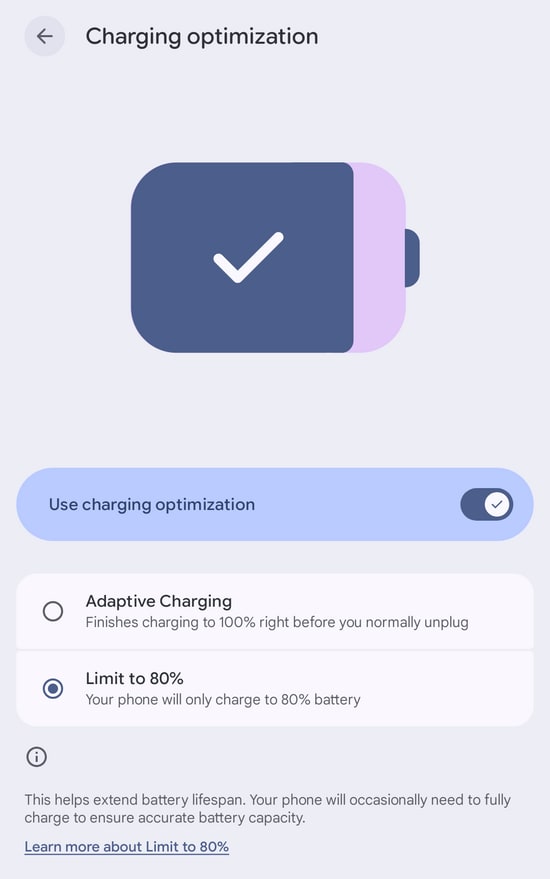
Charging a lithium-ion battery to 100% wears it out much faster than stopping at 80%, and when a phone is new 80% of the battery is usually plenty. With past phones I've just grumped about it, but Pixels now have a setting: battery and charging > charging optimization > limit to 80%:
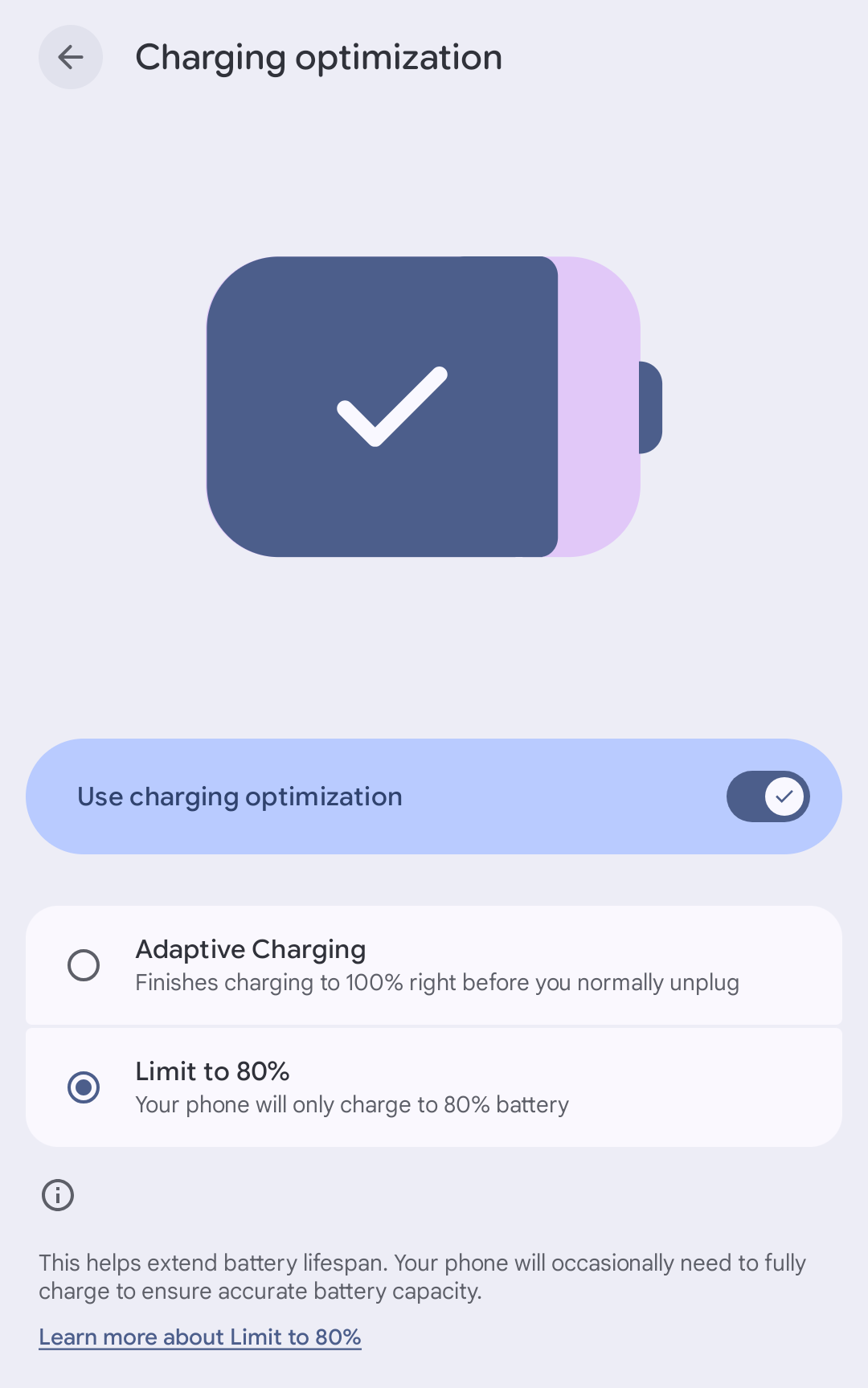
I've made the same change to my Mac, since that spends most of its life plugged in (but just enough unplugged that the battery preservation heuristics don't always fire):
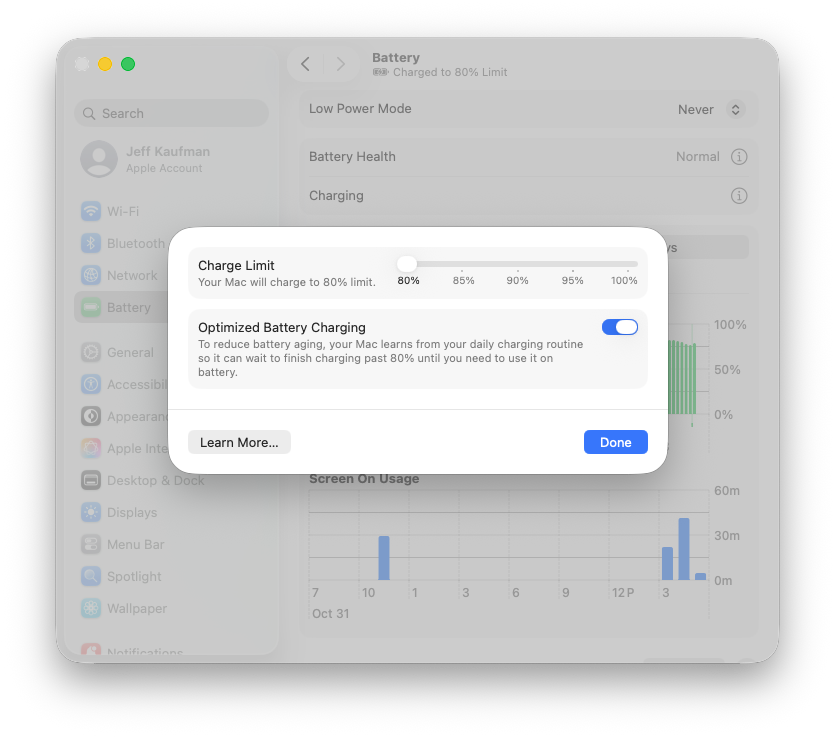
Since turning this on a few weeks ago I've not come close to running out of charge on either, which isn't surprising since neither is very old. Eventually I do expect to need that last 20%, and when that happens I can turn the feature off again.
It seems to me like phones should ship with this behavior, and then automatically turn it off once the full capacity was needed to make it through the day. Ideally the user would never have to think about it: the battery would say "100%" to mean "as charged as makes sense given battery age". But I do see why that doesn't work for manufacturers: phones compete on battery life more than they compete on "number of months before the battery capacity falls below what's needed to get through the day."
(In reviewing this post Claude told me that iPhones also have this option: settings > battery > charging > Charge Limit: 80%.)
Comment via: mastodon
Discuss
Meet TokenEconomizer: Microsoft’s Plugin That Cuts Coding Agent Costs by Up to 30.9%
A team of researchers from Microsoft Research and UC Berkeley have released TokenEconomizer, an open-source cost controller for coding agents. TokenEconomizer is a plugin that learns from past sessions in a repository to cut waste in later ones. It works with Claude Code, Codex, GitHub Copilot CLI and Pi. It does not touch model weights or agent code. On 277 SWE-Bench tasks, it lowered mean cost by 18.4% to 30.9% across 5 agent-model settings.
TL;DR
- Package: A standard-library Python package and agent plugins, with 3 switchable mechanisms.
- Runs on: Any machine running Claude Code, Codex, Copilot CLI or Pi with Python 3.10+. No GPU and no API key of its own.
- Performance: 18.4% to 30.9% lower mean SWE-Bench cost, and cheaper in all 30 repository-setting cells.
- Best: 30.9% lower cost on Claude Code with Opus 4.8 (33.2% when combined with RTK).
- Worst: Only 6.4% to 9.3% savings on ReposVul audits; Pass@1 drops 1.0 point on Opus 4.8.
Why do coding agents waste tokens?
Every agent turn re-bills the system prompt, every loaded tool schema and the full history. The research team profiled 60 SWE-Bench tasks across 6 repositories using Claude Code with Opus 4.8. They found 3 recurring sources of waste:
- Repeated discovery: once 5 tasks precede the current one, 30% of tool calls repeat an earlier action.
- Unused tools: 23 tool schemas load every turn. 16 are never called, and 3 cover 98% of calls.
- Failure loops: 10 failed runs were 17% of tasks but 32% of total spend.
They also tested 3 fixed open-source strategies: RTK, Serena and Aider’s RepoMap. None was cheaper everywhere. All 3 cut cost on Django and raised it on SymPy.
How does TokenEconomizer work?
TokenEconomizer is an external controller that treats the agent as a black box. It keeps a state per repository, built from completed traces. Before each task, it sets 3 policies through the prompt, the tool settings and the event stream.
1. Micro-skills
An LLM proposer turns trace digests into 1-line facts, such as the working test command. Each fact carries regex detectors that check later traces without a model call. A fact enters the prompt after 3 confirmations on tasks with non-overlapping edited files. Its need rate must also stay at or above 0.4. One contradiction counts as 5 confirmations, so wrong facts retire quickly.
2. Tool pruning
Shell, read, write and edit tools are always kept. Other tools are masked after 3 consecutive unused tasks, or when an LLM judge marks them irrelevant. The full catalog returns every 5 tasks for a re-audit. On Django with Claude Code, the first request on task 2 fell from 43,351 to 16,295 prompt tokens.
3. Failure-loop intervention
The controller learns a turn budget: 1.25 times the 90th percentile of successful run lengths. Cheap rule checks flag repeated failures or dense errors. An LLM judge then decides if the agent is stuck, at 0.7 confidence or higher. A stuck agent gets 1 redirect, then a stop if the loop recurs.
What do the SWE-Bench results show?
| Setting | Cost vs default | Pass@1 default | Pass@1 TokenEconomizer |
|---|---|---|---|
| Claude Code + Sonnet 5 | -23.6% | 74.7 | 76.0 |
| Claude Code + Opus 4.8 | -30.9% | 74.0 | 73.0 |
| Codex + GPT-5.6 Terra | -24.7% | 73.8 | 74.7 |
| Codex + GPT-5.6 Sol | -26.1% | 80.1 | 81.7 |
| Copilot CLI + Sonnet 5 | -18.4% | 75.0 | 77.6 |
Source: arXiv 2610.22732, Table 1. Costs include all controller calls. 3 seeds per setting.
Pass@1 improved in 4 of 5 settings. Lower reasoning effort saved cost but cut Pass@1 by 1.8 to 10.3 points. RTK alone raised cost in 12 of 30 repository-setting cells, and RepoMap in 15.
Savings build over time. Most repositories cost more at first, but all were cheaper by the sixth task. Alone on Claude Code, tool pruning saved 13.2% to 17.7%, micro-skills 11.8% to 14.3%, and the loop guard 5.4% to 7.1%.
Results also held outside SWE-Bench. Costs fell 16.0% to 21.2% on Web-Bench and 16.5% to 19.6% on CredData. ReposVul saw only 6.4% to 9.3%, because shorter runs leave less to remove.
How does it compare with other token-saving tools?
| Feature | TokenEconomizer | RTK | Serena | Aider RepoMap |
|---|---|---|---|---|
| Approach | Learns per-repository policies from past sessions | Compresses shell command output | MCP server with symbol-level code tools | Ranked map of repository symbols in the prompt |
| Learns from earlier tasks | Yes | No | No | No |
| License | Apache 2.0 | Apache 2.0 CLI; BUSL-1.1 engine | GPL-3.0-or-later (MIT for SolidLSP) | Apache 2.0 |
| Agents | Claude Code, Codex, Copilot CLI, Pi | 18 AI coding tools | Any MCP client | Aider |
| Mean SWE-Bench cost change (paper, 5 settings) | -18.4% to -30.9% | -8.9% to +4.5% | Not in main runs (raised pooled cost in profiling) | -6.1% to +6.5% |
| Cells with higher cost (of 30) | 0 | 12 | Not disclosed | 15 |
Cost rows: TokenEconomizer paper. Licenses and claims: each project’s repository or docs.
How do you install TokenEconomizer?
The plugin needs one of the 4 agents and Python 3.10 or newer. On Claude Code, clone the repo, add it as a marketplace, then run claude plugin install tokeneconomizer@tokeneconomizer. Learned data stays local in ~/.tokeneconomizer. Tool p

Meet Factory Droid 1.0: A Model-Independent Coding Agent Harness Built on Script Mode
Factory has released Droid 1.0, the largest update yet to the Factory Droid agent harness. The main change is programmatic tool calling, now on by default. The model writes a program that runs its tools. One model request can now drive hundreds of tool calls.
TL;DR
- Size: Base prompt is 13,055 input tokens, down 37% from 20,887. Only 2 tool definitions ship up front, down from 11.
- Runs on: macOS and Windows desktop app, a terminal UI, and the Node SDK
@factory/droid-sdk. Works with any supported model, including your own API keys. - Performance: Highest pass rate of every harness Factory tested, on the same model, at lower cost.
- Best: 65.2% on Terminal-Bench 4 with Claude Opus 5.5, at $4.73 per passed task (self-reported).
- Worst: With GPT-6.1 Sol, Droid takes 10% longer per passed task than Codex.
What is Droid 1.0?
Droid 1.0 is a model-independent coding agent harness from Factory. Factory defines a harness as everything around the model. That means the prompts, the tools, how tool results return, and the loop. Users pick a model or let Factory Router choose a cost-efficient mix.
How does programmatic tool calling work?
In a standard loop, every tool output lands in the model’s context. With programmatic tool calling (PTC), the model writes a program instead. Droid implements this as a Script tool. The model writes JavaScript that runs in a sandbox. The sandbox has no file, network, or system access of its own.
Raw files, search results, and logs stay inside the program. Only printed output returns to the model. Independent calls run concurrently.
The idea builds on CodeAct (Wang et al., 2024). Factory reports these results from its own sessions:
- Unit test fix: 15 tool calls took 5 model calls instead of 10. The task finished in 41.6 s instead of 56.8 s.
- Linear cleanup: 151 issues moved and verified in 312 tool calls. The Script used 2 requests and about 61,000 tokens. Factory models direct calls at 36 requests and about 3.1M tokens.
- CI sweep: 5,384 jobs across 547 runs, in 2 requests. Under 0.1% of tool results reached the model’s context.
On Claude Opus 5.5, Script mode cuts Droid’s cost by 15% versus direct tool calling. It is on by default for 10 models, including GPT-6.1 Sol and Kimi K3.
DeepSeek Open-Sources dsh-superagent, a Router-Worker Coding Agent
The DeepSeek Harness team just released dsh-superagent, an MIT-licensed research prototype. DeepSeek dsh-superagent is a proactive coding agent for one GitHub repository. It is packaged as a bundle for DeepSeek Harness. It listens to GitHub and, optionally, Feishu. It turns allowed requests into parallel work items, each in its own agent session. The release shipped alongside a design post, Exploring Super-agent Design: Towards a More Autonomous Agent System.
TL;DaR
- What is it?: A TypeScript bundle, v0.1.0, released as 1 commit under MIT. It uses whatever model the Harness profile is set to.
- Runs on: Your own machine, as a dedicated DeepSeek Harness profile. Needs Node.js 22.19+ or 24+, git 2.32+, Python 3.8+, tmux and GitHub CLI 2.48+.
- Performance: In DeepSeek’s simulation, it finished tasks far faster under a noisy message stream than a single-session agent.
- Best: p95 task completion of 15.7 minutes vs 29.5 minutes for the single-session baseline (about 1.9x faster).
- Worst: Tested only on synthetic messages and simulated tools. Real coding quality was not measured.
What is DeepSeek dsh-superagent?
It is a GitHub agent that waits to be asked. When an allowed person addresses it, it opens a work item, called a Ticket. Each Ticket runs in its own session and directory. Results return to the original conversation, often as a pull request. A local web panel lists only what needs a person.
The README page states the core rule plainly: take as little human attention as possible, and give as much value as possible. The philosophy doc applies it to behavior. The agent confirms once, stays quiet while working, and writes again only with a result, a question or a failure.
Why did DeepSeek build a Super-agent?
DeepSeek team argues that mainstream agents treat 1 session as the basic unit. According to the report, as reported by ifeng, a person can actively follow only 3 to 5 sessions at once. Human attention, not model capability, becomes the bottleneck for multitasking.
How does the Router-Worker architecture work?
The research team describes 2 layers. A long-running Router handles interaction and dispatch. Isolated Worker sessions do the actual work.
In the prototype, that flow is concrete, per the domain model:
- Source → Trigger: GitHub or Feishu produces events.
- Eval: decides whether a batch of Triggers asks for new work.
- Ticket: a unit of authorized work, with an immutable Mandate stating why it may proceed.
- Subscription: later comments on a pull request reach the right Worker without a fresh mention.
The main session runs the dsh-superagent-router preset with a smaller tool set. Each Worker runs dsh-superagent-worker. Shell commands move to the background after 5 seconds, so Workers keep receiving messages, per the execution doc.
Proactive work is gated. The authorization doc defines 3 accept modes: off, observe (default) and auto. In observe, the agent only records what it would have accepted.
The research team also lists ideas beyond the prototype: an external Watchdog, storage and compute separation, and an asynchronous ReAct loop.
How does it perform?
DeepSeek tested with simulated group chat and GitHub CI streams. Each run had about 300 messages, of which about 20 were real work requests. Each scheme ran 5 times, per ifeng’s account of the report.
- Super-agent: p50 of 12.4 minutes, p95 of 15.7 minutes.
- Single session plus subagents, neutral prompt: p95 of 29.5 minutes. No p50 was given.
- Why: under the neutral prompt, the baseline called a subagent 0 times in 5 runs.
- Router load: as arrivals rose from about 1 to 40 per minute, batch size grew from 1.0 to 2.8. Per-request latency rose from 2.5 to 3.9 seconds.
An ablation removed direct event pass-through. Router decisions rose about 30%, and cache-read tokens rose about 37%, from 23.23M to 31.77M. All figures are self-reported and come from secondary reports of the report.
How does dsh-superagent compare with other GitHub coding agents?
| Feature | DeepSeek dsh-superagent | GitHub Copilot cloud agent | Claude Code Action | OpenAI Codex |
|---|---|---|---|---|
| Trigger | Mention by allowed person; written rules | Issue assignment, chat, API, Slack and more | @claude mention, issue assignment, workflow prompt | @Codex in Slack; cloud tasks |
| Unasked (proactive) work | Yes, rule-gated; observe by default | Yes, via automations | Yes, via workflow events | Not disclosed |
| Parallel isolated sessions | Yes, 1 per Ticket | Not disclosed | Not disclosed | Not disclosed |
| Where it runs | Your machine (Harness profile) | GitHub, in the background | Your GitHub Actions runner | Codex cloud |
| Chat source | Feishu (optional) | Slack, Teams | Not disclosed | Slack |
| License | MIT | Not disclosed | MIT | CLI agent open source |
| Availabil |