Limiting Charging to 80%
In an ideal world the incentives on phone manufacturers would be to optimize useful lifetime, but instead people buy phones based on their as-new performance. Which means phones charge to 100% even though that's bad for the battery.
Every time I get a new phone it feels a bit like magic: I no longer need to think at all about battery life. This lasts for a few years, and then at some point my phone doesn't always make it through the day. Some amount of this is normal, but some of it is just bad battery management: new phones should come set not to charge past 80%.
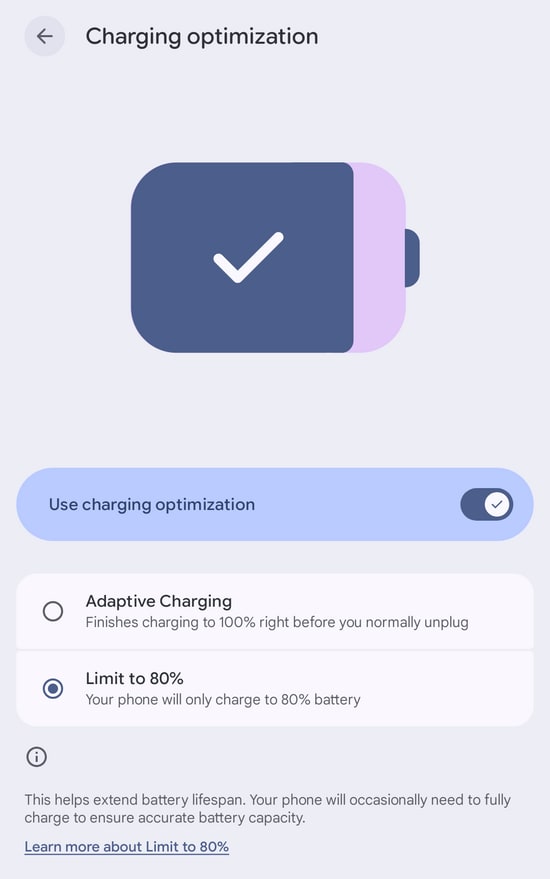
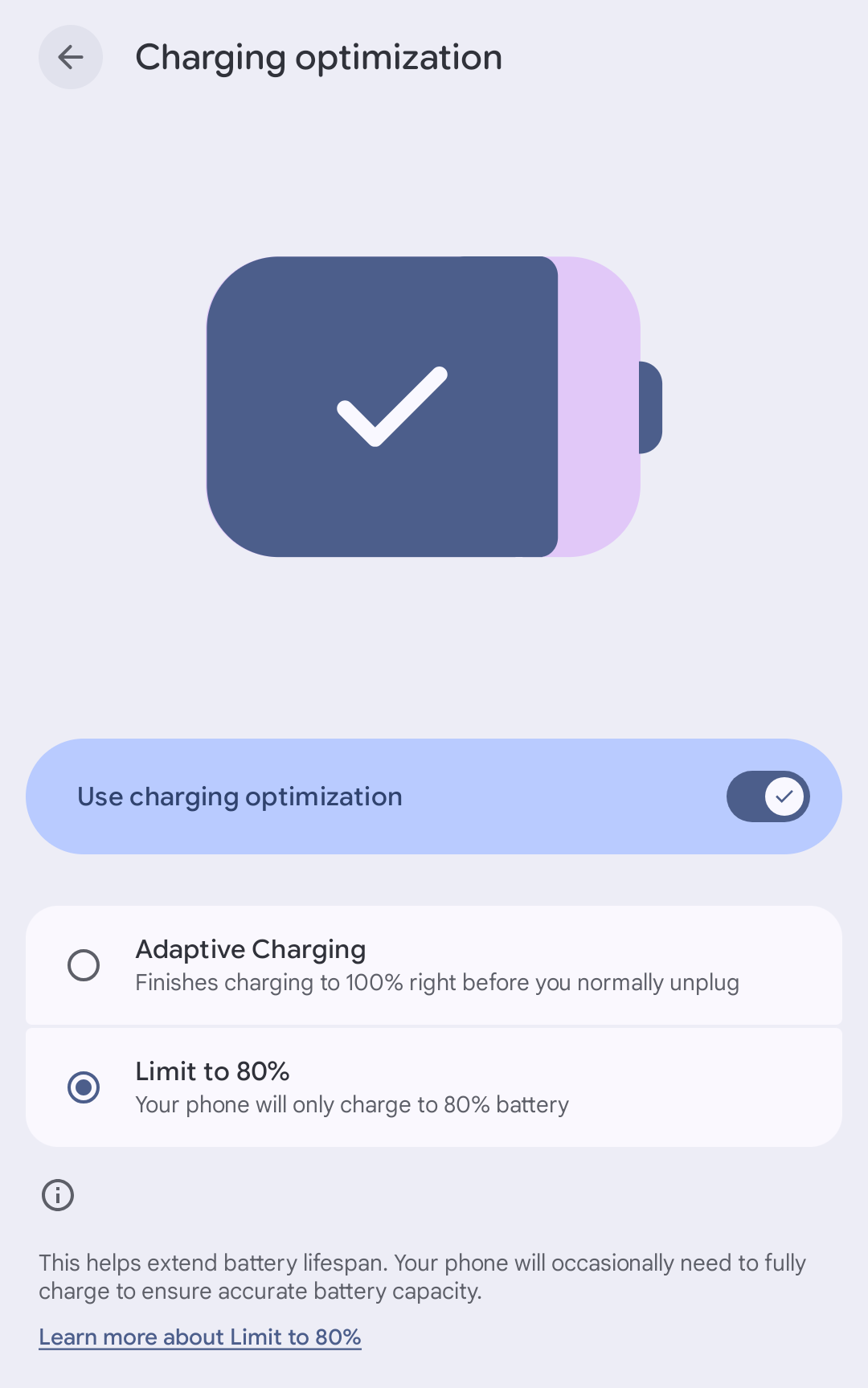
Charging a lithium-ion battery to 100% wears it out much faster than stopping at 80%, and when a phone is new 80% of the battery is usually plenty. With past phones I've just grumped about it, but Pixels now have a setting: battery and charging > charging optimization > limit to 80%:
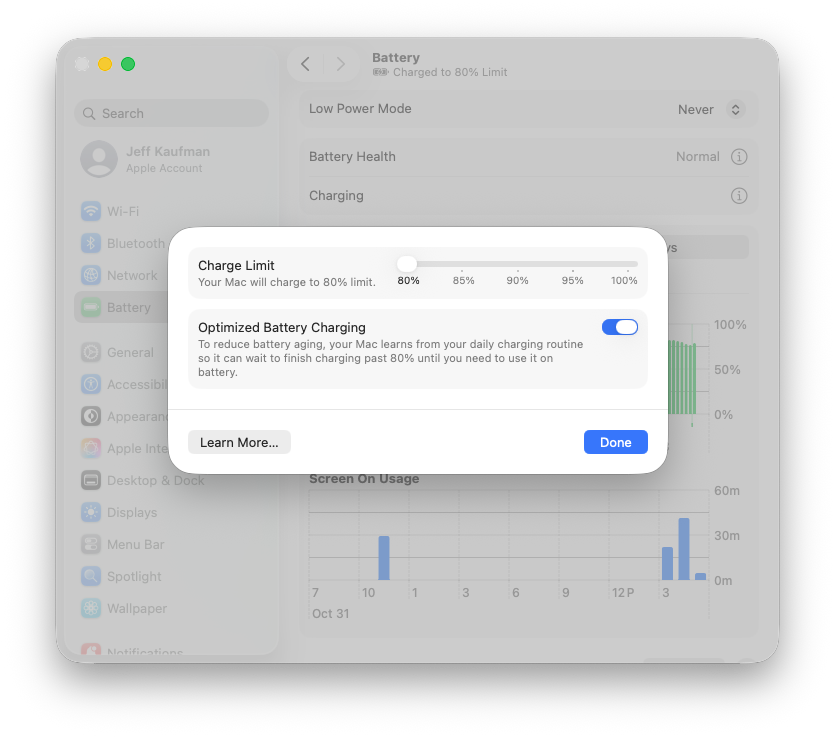
I've made the same change to my Mac, since that spends most of its life plugged in (but just enough unplugged that the battery preservation heuristics don't always fire):
Since turning this on a few weeks ago I've not come close to running out of charge on either, which isn't surprising since neither is very old. Eventually I do expect to need that last 20%, and when that happens I can turn the feature off again.
It seems to me like phones should ship with this behavior, and then automatically turn it off once the full capacity was needed to make it through the day. Ideally the user would never have to think about it: the battery would say "100%" to mean "as charged as makes sense given battery age". But I do see why that doesn't work for manufacturers: phones compete on battery life more than they compete on "number of months before the battery capacity falls below what's needed to get through the day."
(In reviewing this post Claude told me that iPhones also have this option: settings > battery > charging > Charge Limit: 80%.)
Comment via: mastodon
Discuss
In an ideal world the incentives on phone manufacturers would be to optimize useful lifetime, but instead people buy phones based on their as-new performance. Which means phones charge to 100% even though that's bad for the battery.
Every time I get a new phone it feels a bit like magic: I no longer need to think at all about battery life. This lasts for a few years, and then at some point my phone doesn't always make it through the day. Some amount of this is normal, but some of it is just bad battery management: new phones should come set not to charge past 80%.
Charging a lithium-ion battery to 100% wears it out much faster than stopping at 80%, and when a phone is new 80% of the battery is usually plenty. With past phones I've just grumped about it, but Pixels now have a setting: battery and charging > charging optimization > limit to 80%:
I've made the same change to my Mac, since that spends most of its life plugged in (but just enough unplugged that the battery preservation heuristics don't always fire):
Since turning this on a few weeks ago I've not come close to running out of charge on either, which isn't surprising since neither is very old. Eventually I do expect to need that last 20%, and when that happens I can turn the feature off again.
It seems to me like phones should ship with this behavior, and then automatically turn it off once the full capacity was needed to make it through the day. Ideally the user would never have to think about it: the battery would say "100%" to mean "as charged as makes sense given battery age". But I do see why that doesn't work for manufacturers: phones compete on battery life more than they compete on "number of months before the battery capacity falls below what's needed to get through the day."
(In reviewing this post Claude told me that iPhones also have this option: settings > battery > charging > Charge Limit: 80%.)
Comment via: mastodon
Discuss