
As AI solves complex maths puzzles, mathematicians face uncertain future - South China Morning Post

CSU Uses Artificial Intelligence to Improve Hail Forecasting - North Forty News
Artificial intelligence use doubles among rural Nebraskans - Nebraska Public Media

Benchmarking: Qwen 27B, 35B, QFN180B; Nemotron Bolt 74B, Flint40B & Clover 35B (Q4) on M5 Max 2026 on Kapitsa with KFlash [P]
 | hey folks, I'm Ye, one of the contributors to Kapitsa, an open-source inference engine optimized specifically for Apple Silicon to run Qwen, Nemotron, Flint and Clover models locally. Our custom-written Metal kernels let us tune for each chip and each model. https://github.com/nace-ai/kapitsa/ The latest update, 0.2.26, is out. Since our last M5 Max numbers, Flash-Next 180B reads prompts 46% faster and the 27B writes 8% faster, and DiffuSpace's Clover 35B joins the catalog. Kapitsa also runs Qwen Flash-Next 180B with SSD offloading: on a Mac that can't hold it, the experts that don't fit in RAM stream from the SSD, so it runs on a 48 GB MacBook Pro at 61 tok/s. Here are the end-to-end numbers on a 2026 MacBook Pro 16 with an M5 Max and 128 GB: six targets (dense, MoE, hybrid Mamba-2 MoE and a block-diffusion MoE), from 1K context up to 32K, against the next-fastest engine for each. Try it (any Apple Silicon Mac; models in this post: ResultsDecode is a 512-token coding answer, prefill a 4K prompt, median of 3 runs:
From 1K context all the way up to 32K. At 32K the 35B still writes 175 tok/s, and Flash-Next barely drops (90 to 78): Against the other enginesAgainst the next-fastest engine for each model on the same Mac: 1.23x Splash on the 35B, 2.2x oMLX on Bolt, 1.18x rec on Flint and 1.12x mlx-serve on the 27B. Flash-Next is a tie with mlx-serve, Splash still reads prompts faster on the two Qwens, and nothing else runs Clover on a Mac. Every cell with versions and flags: benchmarks. Raw runs: results. Why it's fast: KFlashOther engines verify the drafter's guesses as one chain and stop at the first miss. KFlash verifies a best-first tree of the drafter's candidates in the same 8-row pass and keeps the longest branch the target agrees with. Three details make it fit Apple silicon:
Send us your benchmarksRun the same test on your Mac and add it to the community results. It takes 3-15 minutes: Plug in and close heavy apps while it runs. At the end it asks once: Enter sends the result as a pull request from your GitHub fork, and One more askDo you know prior work where tree-verified sampling matches plain sampling token for token under the same seed? Please point me to it so we credit it. We cite SpecInfer, Medusa, EAGLE-2 and Sequoia. [link] [comments] |
What did Ilya Sutskever mean when he said "The models, they just want to learn"? [D]
It was just before OpenAI started that I met Ilya, who you interviewed. One of the first things he said to me was — “Look. The models, they just want to learn. You have to understand this. The models, they just want to learn.” And it was a bit like a Zen Koan. I listened to this and I became enlightened.
And over the years, I would be the one who would formalize a lot of these things and kind of put them together, but what that told me was that the phenomenon that I'd seen wasn't just some random thing. It was broad. It was more general. The models just want to learn. You get the obstacles out of their way. You give them good data, you give them enough space to operate in, you don't do something stupid like condition them badly numerically, and they want to learn. They'll do it.
I'm actually not entirely satisfied with Dario's elaboration! If Ilya meant precisely "given sufficient resources, do your job, and the models will do theirs [during training]", I think he would have phrased his advice slightly differently. What does it mean to "want" to learn? Why personify the model in that way, and not the optimizer or gradient descent itself or something? And I don't get why the koan would necessarily imply that scaling would have worked so well.
I realize that Ilya likes to cultivate an air of prophecy about himself (and I'd be lying if I said it didn't work on me). But it's just such a strange way to communicate the message, that I can't help but think the message must have been about something broader.
Possibly much more mundane in context, this must have been 10 years ago. Idk I wonder what it must have been like to be on the frontier at that time, maybe I take such things for granted now.
[link] [comments]
ML PhDs: Would you rather have done your PhD before or after the rise of AI chatbots? [D]
For those doing or having completed a PhD in ML, I’m curious:
If you had the choice, would you rather have done your PhD before ChatGPT and other AI chatbots became widely available, or in today’s AI era?
[link] [comments]
Sparks of Weight-Space Programming: LLMs can natively read & write neural network weights [R]
Link: https://rikiyat.github.io/blog/weight-space-programming/
Snippet: “We find that frontier LLMs are surprisingly good at natively reading and writing neural network weights, well past what we’d expect from humans or conventional algorithms. This might be a big deal for both optimization and interpretability.
Just by looking at the raw weights, GPT-6 Astra can tell what a network was trained to do. And without any environment feedback, it has no trouble writing, from scratch, small game-playing networks that outplay networks trained with PPO for 100 million steps.”
Very surprising result, I didn’t expect frontier models to have this capability that has not been optimized for, and it’s something humans cannot do either.
[link] [comments]

Scaling Git at OpenAI
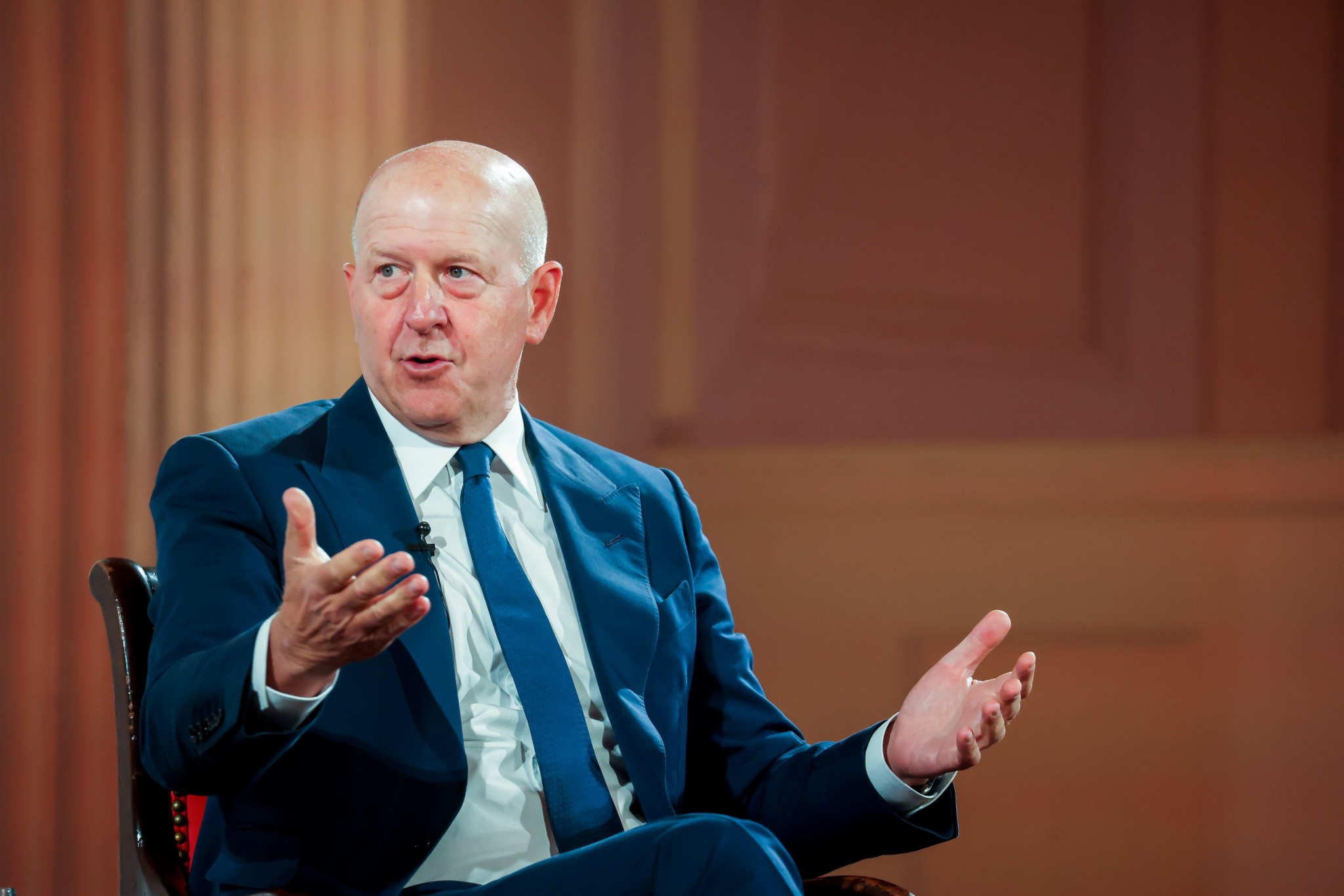
Goldman Sachs CEO David Solomon says the best advice he ever got came from his grandmother in his 20s: ‘Don’t be in a hurry’
David Solomon runs one of the most powerful banks on Wall Street, but the best career advice he ever received didn’t come from a mentor in a corner office. It came from his grandmother.
“Don’t be in a hurry,” the Goldman Sachs CEO told NBC News’ Christine Romans in a rapid-fire interview about his daily routine and the lessons that have shaped his career. He said she gave him that advice when he was in his twenties.
The clip came out of Romans’ wider conversation with Solomon for NBC’s Business in America series. That conversation aired Oct. 23, one day after Goldman launched its Small Business AI Institute, part of a new $500 million commitment to its 10,000 Small Businesses program, with Anthropic, Google, Meta, and OpenAI as partners. In the segment that ran on Nightly News, Solomon said he’s excited about what AI could mean for businesses and for people’s longevity.
In the lightning round, though, he talked less about markets and more about how he manages his days and his life.
Gym, coffee, and a protein shake before 7 a.m.
Asked to name three things he does before 7 a.m., Solomon kept it simple: He wakes up, goes to the gym, and generally has a cup of coffee and a protein shake.
He’s in good company. An early workout is a fixture of many executives’ routines, from the Bupa CEO who trains six days a week with his Gen Z son to the many leaders featured in Fortune’s Day in the Life of a CEO series.
The research suggests the habit matters more than the hour. A 2022 systematic review published in the Public Health Agency of Canada’s journal Health Promotion and Chronic Disease Prevention in Canada examined 35 studies. Eleven found morning activity more beneficial; 12 found afternoon or evening activity more beneficial; and 12 found no clear difference. The authors concluded there is no consistent evidence that exercising at one time of day is better for your health than another, and they rated the evidence quality as very low.
‘Stick to the schedule’
Solomon’s best trick for keeping his day on track is unglamorous: sticking to his schedule.
“The one thing that we can’t…get back is time,” he said, adding that he tries to be very purposeful with how he spends it. That means making commitments and keeping them, because, as he noted, it’s easy to drift off schedule.
The science backs him up, with a twist. A 2021 meta-analysis in PLOS One by Brad Aeon, Aïda Faber, and Alexandra Panaccio found that time management is positively linked to job performance. It was even more strongly linked to well-being, especially life satisfaction. In other words, the payoff from guarding your calendar may show up as much in how you feel as in what you get done.
Why slowing down isn’t a contradiction
At first glance, “stick to the schedule” and “don’t be in a hurry” seem to pull in opposite directions. For Solomon, they work on different timelines: Be disciplined with the hours in a day, and be patient with the arc of a career.
He repeats this message often. In August, he told Goldman’s summer interns at a town hall that taking more time can open up more opportunities, urging them to “try not to be in a hurry and enjoy the ride.” He offered small-business owners the same counsel about AI at the institute’s launch last week, telling them that “the important thing is to get it right, not to get it quicker.”
‘I don’t like to do things halfway’
Solomon’s patience has a limit, and it’s the things he cares about. Asked whether he has any obsessions, he said it depends on what has captured his interest.
“If I’m interested in something, I get very obsessive about it. I don’t like to do things halfway,” Solomon said. When something grabs him, he added, he tends to go deep.
Psychologists have found that kind of intensity cuts both ways. In a 2007 study in the Journal of Personality, Robert Vallerand and colleagues distinguished between “harmonious” passion, an activity you freely choose that fits with the rest of your life, and “obsessive” passion, which feels compulsive. Obsessive passion predicted deliberate practice and mastery-oriented goals, which supported performance. But it was also tied to fear-of-failure goals that undercut results. Harmonious passion delivered the upside with less of the downside.
The takeaway: Going deep can fuel success, as long as the obsession serves you, not the other way around.
Not every passion turns into a career, of course. Solomon also named one ambition he’s had to let go of: playing professional basketball. He conceded that one isn’t on the table.
This story was originally featured on Fortune.com