The Giant Measurement at the End of Time
2.5.6.0.1 Kent and Bousso&Susskind have proposed approaches to defining quantum wavefunction branches based on late-time information. The basic idea is to exploit the way that quantum information propagates in our universe in particular: (a) photons(and gravitons) carry away information at the speed of light, (b) the universe is expanding and cooling, meaning that these photons(in some cosmological environments) may propagate uninterruptedly forever.
2.5.6.0.2 What this means is that photons very late in time are a privileged set of degrees of freedom: they plausibly carry information about everything that has classically "happened" previously. This suggests a way of defining the set of branches: just "measure"(apply a fictitious measurement operator, that is) the photon degrees of freedom very late in time!
2.5.6.0.3 That's the basic idea. There are many subtleties of course, and Kent and Bousso/Susskind have different proposals. I'll review each in turn and then talk about the philosophical merit of these approaches in general.
- 2.5.6.0.3.1 The following discussion uses some elementary definitions of objects from general relativity. If you know what a spacelike surface and lightcone are, that should be enough.
- 2.5.6.0.3.2* Note that as of the time of writing, QFTs in arbitrary space-times are not totally mathematically well-defined objects -- and what's more, the fully correct theory of the objects we are discussing should be quantum gravitational, where we don't even know what the exact form of the theory should look like. Thus these constructions are a bit sketchily defined, even compared to QFTs which are already mathematically sketchy.
2.5.6.1 Quantum Reality via Late-Time Photodetection
2.5.6.1.1 Kent has proposed a few variants of this idea. I'll review the version in his paper Quantum Reality via Late-Time Photodetection.
2.5.6.1.2 Kent is interested in defining a set of possible histories of what he calls "beables", which are essentially the classical-like variables which we think of as defining a possible world, e.g. the positions of objects.
2.5.6.1.3 For his set of beables Kent considers the expected values of quantum observables at a given time, conditioned on some particular late-time outcome of photodetection measurements across all of space(with an additional subtlety I'll get to momentarily).
2.5.6.1.4 Why does this make sense? The idea is that the late-time photons should contain all the information about possible classical experiments, pinning down a possible quantum state associated with a set of measurement outcomes. The expected values then give us the classical-like variables associated with this set. Taking the expected value is necessary because even in a classical-like world all degrees of freedom will still be "spread out" in a quantum manner to some degree.
- 2.5.6.1.4.1 For example, if we consider a covalently-bonded molecule, its position might be decohered by a measurement and thus ultimately correlated with late-time photons. However, the internal state of the electrons in the covalent bond may not be. So if we condition on late time photons, the position of the molecule will be approximately fixed, but the positions of the electrons will not. Taking the expected value of the probability of detecting an electron in a given place will give a spread out "blob" around the covalent bond. This gives the quasi-classical state we are looking for.
2.5.6.1.5 Now, however, a problem arises. If we project onto an entire late-time space-like surface, this is correlated with the results of all past experiments. This means that the beables at a given point in time will be conditioned on the results of experiments in that point's future, which may give strange results.
- 2.5.6.1.5.1 For example, say that some time later we take our molecule from the previous experiment and measure the position of the electrons in the covalent bond. The results of this experiment will be recorded in some late-time photons. So if we condition on all these photons, the electrons' positions will be decohered at earlier points as well! In other words, when we consider the expected value of the electrons' position earlier, we will no longer find them in a "blob" corresponding to a normal covalent bond, but rather a state which will evolve to whatever position measurement we end up sampling.
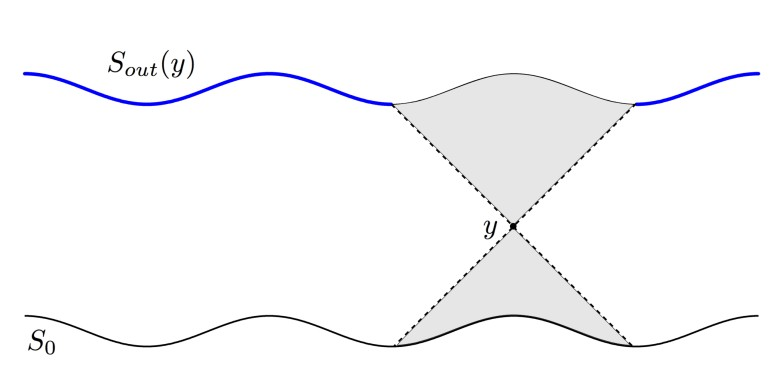
2.5.6.1.6 Clearly, this is undesirable. Kent's solution is to restrict the set of photodetection results we condition on in the future space-like surface. For a given point in spacetime p, we only condition on points on this surface outside the forward light cone of p.
- 2.5.6.1.6.1 In the molecule example, if we consider a point before we measure the electrons' position, the future experiment, and hence all photons downstream of it, are in the forward light-cone. So these experimental results would not be conditioned on, restoring the normal covalent bond.
- 2.5.6.1.6.2 This means that measured systems will "collapse" to a given value slightly after they have been measured. In particular, this will occur once there are outgoing photons spacelike separated from the system.
- 2.5.6.1.6.3 Note however, that we still sample a single shared set of measurement outcomes for all points in spacetime; it's just that when defining the beables at a particular point, we only condition on the outcomes outside of the forward light cone. This ensures we define a consistent shared reality.
Kent defines beables at the point y by conditioning on photon measurements on the blue portion of the forward surface. From page 19 here.</