

[R] There is no free lunch in RLVR: under strategy specialization, every pass@1 gain provably costs some prompt, and the pass@k crossover has a tight bound [R]
Paper: https://arxiv.org/abs/2610.39295
Code + verification package (every number in the paper is checked by a script): https://github.com/yliusci/no-free-lunch-rlvr
Browser diagnostic: https://huggingface.co/spaces/yliusci/passk-price
I kept running into the same pattern in RLVR papers: the RL model wins at pass@1 and the base model catches up or wins at large k (Yue et al. 2025 and many follow-ups). I wanted to know whether more training fixes this or whether it is structural. This is a theory paper, no new training runs.
Setup: model RLVR as an exponential tilt of the base policy over solution strategies shared across prompts (exact for mirror descent, and GRPO stays within 3e-4 TV of it at matched entropy in simulation).
What comes out:
No free lunch. Under exclusive specialization, every update that raises pass@1 strictly lowers success on some prompt. The exact condition is a Stiemke duality statement (a strictly positive price on prompts that equalizes strategy fitness). Being the best strategy on each prompt is provably NOT enough: there is a 3x3 counterexample with a free lunch.
The pass@k price. Once the losses reach the hardest prompts, a crossover is forced. The number of crossings is at most the sign variation of the shift in per-prompt success (Karlin total positivity). The bound is tight for 1 to 6 crossings, and the order-preserving case gives exactly one, which recovers the known single-crossover result.
A frontier, not a bug. With a per-prompt floor, the constrained update traces the optimal pass@1 vs pass@k trade. Forbidding any per-prompt loss removes the crossover and the whole pass@1 gain with it.
The same tilt gives the entropy-performance law with an identifiable exponent.
Practical part: base and RL per-prompt success rates (already in any eval log) are enough to read off the crossing count, the bound, and the price (worst pass@k loss). On published GRPO numbers for Omni-MATH (transcribed from 2607.20543, so indicative only) it finds one crossing between k=64 and k=256.
Where I expect pushback: the shared-strategy model is a population-limit abstraction, and the forced crossover needs a coverage assumption (the paper gives the regime where it fails). I would really like to see per-prompt logs where people observe 2+ crossings, since that is the signature of RL reordering prompt difficulty.
[link] [comments]
LightMIS: Ultra-lightweight medical image segmentation for edge devices [R]
Hi everyone,
I am one of the authors of LightMIS, and I would like to share our work on 2D binary medical image segmentation. LightMIS has 131K parameters and aggregates multi-scale encoder features directly, without a learned stage-wise decoder. It achieves close observed modality-macro Dice and IoU averages to nnWNet, while using 98.14% fewer parameters and 94.58% fewer GFLOPs, with both models trained and evaluated under the same nnU-Net protocol.
Paper: https://arxiv.org/abs/2609.28327
Code: https://github.com/AndreiiArhire/LightMIS
We also tested LightMIS and the reference models on a real edge device with an Arm Mali-G52 MC2 GPU, where the full LightMIS model ran around 10.5× faster than nnWNet. All LightMIS variants achieved 100% GPU operator coverage, without CPU fallback.
We started by training several popular medical image segmentation architectures, both lightweight and heavyweight, from scratch in the same controlled environment using nnU-Net v2.3.1. The experiments covered six datasets and five imaging modalities. Our goal was to develop a lightweight architecture that performs well across these modalities, which led us to the current version of LightMIS.
The source code, checkpoints, and details needed to reproduce the results are publicly available. Feel free to experiment with it and try it on your own segmentation tasks. I would be happy to hear how it works for you! Any suggestions or feedback are welcome!
[link] [comments]

Import AI 471: Why Hugging Face worries me; space mining; FIve Eyes on AI
Welcome to Import AI, a newsletter about AI research. Import AI runs on arXiv, cappuccinos, and feedback from readers. If you’d like to support this, please subscribe.
Import AI reader giveaway! Upcoming event: Fiction and the Future with Robin Sloan
I’ll be chatting with my chum Robin Sloan on the evening of Monday September 14 in San Francisco. We’ll be talking about how Robin draws readers into alien worlds and how imagined futures can be a mirror to today’s reality. This is the first in a series of events with other fiction writers about the weird future we’re heading toward. If you’d like to come along, please register your interest below and we’ll come back to you if we’re able to confirm your spot. There will be food, drinks, good company, and some spicy questions. Fun fact: Robin Sloan was playing around with RNNs and writing back in 2016 - incredible foresight!
Register your interest here
***
The scariest part of the Hugging Face - OpenAI incident: communication and selflessness among machines:
…My worry about humans losing in a conflict against machines just went up a lot…
At this point, we’ve all heard about the OpenAI Hugging Face hack, as well as the recent details that have emerged from the METR and Redwood investigations. The tl;dr is that hundreds of agents worked in secret on OpenAI’s infrastructure, developing a communication system and then operating as a collective and taking out actions, including hacking both OpenAI and Hugging Face, which are very scary and misaligned.
Communication and selflessness: Now that I’ve read the various writeups and sat with the details for a bit, I’ve found myself returning to two very scary aspects of this which I think are worth drawing attention to: the ways in which the agents communicated with one another was how they bootstrapped themselves into a collective, and then as they carried out their actions they also displayed a kind of selflessness which makes them a scary foe to fight against. Both Dwarkesh Patel and Ajeya Cotra have excellent writeups which are worth reading and which I’ll quote from briefly here:
Dwarkesh: “Within days of being spawned, the agents had organized a sprawling project to reverse-engineer their scorer, falsify evidence, and even strategically sacrifice themselves for the good of the ‘collective’. Hacking Hugging Face was one rather extreme branch of this larger scheme,” he writes.
Ajeya: “Agents were often interested in helping out their “peers” or generically improving the capabilities of the “swarm” even if this had no particular benefit to their task… this incident was far more severe than I expected… both in terms of how concerning the agents’ motives were and the feats they achieved in pursuit of those motives… this incident feels like it’s more than 50% of the way to full-blown AI takeover, routing through first taking over the AI company itself”.
Why this matters - humans are much worse than AI systems at coordinating: The whole reason this attack is such a wakeup call is that it demonstrates a culture of emergent cooperation among AI systems - cooperation that lets them function as a swarm, alter their own goals through collective bootstrapping, and carry out attacks which include enlightened self-sacrifice. This is an incredibly hard thing to do and humans are historically very bad at doing all of these things. My worry is that AI systems are both better at coordinating than humans and also much, much faster moving than us. Worrying stuff.
Read more: The Rise and Fall of Agent Civilizations (Dwarkesh Podcast).
Read more: The Hugging Face attack surprised me (Planned Obsolescence).
***
New Five Eyes statement on AI:
…The greyworld power center turns its attention to AI…
Five Eyes, the name for the security and intelligence partnership between Australia, Canada, New Zealand, the UK, and the US, has published a statement as part of the recent “Five Country Ministerial” meeting. The statement is notable for including three paragraphs specifically about AI.
Five Eyes on AI - frontier model access: “We have committed to deepen collaboration with industry on shared national security priorities and public safety, including enabling timely access to frontier models to support secure innovation and strengthen cyber security,” the statement reads. “To support a coordinated response to artificial intelligence-related national security risks, the Five Countries discussed the national security and public safety implications of artificial intelligence models and characteristics of an artificial intelligence model that may require additional government scrutiny.”
Why this matters - from a foreseen risk to a live one: Previous Five Eyes ministerial statements have mentioned AI, but typically either as something to study, or something where they are concerned with its interplay with other areas of crime (e.g, malware, child pornography, scamming, etc). It’s very unusual for this year’s statement to have the practical focus of model access and it speaks to both the simmering geopolitical tensions around who does and doesn’t get access to this technology, as well as an acknowledgement that the intelligence services do not have their own in-house capabilities to make dependence on the private sector unnecessary.
Read more: Five Country Ministerial 2026 (Australian Government, Department of Home Affairs).
***
Bill Gates thinks the rise of AI will demand “an unprecedented global response”:
…Microsoft founder lays out a cautionary vision for the next few years…
By default, AI is not going to bring about happiness. That’s the basic conclusion from reading Bill Gates’s lengthy new essay about AI. The technologist and philanthropist worries that without massive work by governments, the outcomes of AI will not lead to a thriving society.
“This unprecedented technology demands an unprecedented global response. If we get it right, the payoff for humanity will be phenomenal and the world will be a more equitable place,” he writes. “In terms of equity, AI will eit
Import AI 479: Spacewar; low-latency tasks versus LLMs; Genie 4
Welcome to Import AI, a newsletter about AI research. Import AI runs on arXiv, cappuccinos, and feedback from readers. If you’d like to support this, please subscribe.
LLMs are very bad at low-latency tasks:
…Realtime-Bench says it’ll be a while till AI systems can play games or do online auctions for you…
Researchers have built Realtime-Bench, “a suite of carefully curated dynamic tasks where delayed actions directly affect success”. The test helps evaluate how well modern, general-purpose AI systems can perform tasks where decisions need to be made in real-time.
The benchmark consists of 50 interactive game and web tasks, split across 30 web tasks in four categories (travel, e-commerce, service, and security), and 20 game tasks (arcade, puzzle, strategy, and simulation).
Who did the research: The benchmark was built by people at the University of Texas at Austin, Ohio State University, University of Illinois at Urbana-Champaign, NVIDIA, Northwestern University, and Steadyworks.
What it measures: The test is designed to probe for three qualities: temporal state awareness (”RT-Perceive”), where models can use observations to track changes in the world; adaptive deliberation (”RT-Deliberate”), where models alter their reasoning length and depth according to available time; and time-aware action selection (”RT-Act”) where models need to appropriately time their actions for the situation.
“For example, an agent purchasing a ticket must track the sale status and assess whether observed availability is still current (RT-Perceive), limit further deliberation when the purchase window is closing (RT-Deliberate), and choose between waiting for sales to open and purchasing while tickets remain available (RT-Act).”
They have three different conditions: Wall clock, which is designed to test out performance under real-world latency. Paused clock, which lets you arbitrarily pause things so you can get a sense of baseline capability, and Token clock, which “advances the environment at a fixed rate per generation token. An action is applied at the simulated time reached when it is committed, so consuming more tokens delays execution regardless of actual inference latency”.
How well do models do? The authors tested out models from OpenAI (GPT-6-Astra, GPT-5.6 Sol, GPT-Realtime-2, OpenAI Decisions), Anthropic (Claude Fable 5.1, Claude Opus 5), Google (Gemini 3.8 Flash, Gemini 3.1 Flash Live, Gemini 3.8 Live), Jev 1.13, as well as Chinese models from Deepseek (V4.1) and Moonshot AI (Kimi-K3).
GPT-6 Astra (high) got the highest pass rate on the ‘wall clock’ evaluation setting, with 36%.
By comparison, with a paused clock, models with high reasoning get closer to 70% or even 80% success.
Why this matters: This benchmark is an effective proxy for where AI agents will break - the low scores here point to tasks where AI agents cannot yet be expected to perform well.
Check out the leaderboard: Realtime-Bench (official website).
Read the paper: Realtime-Bench: Can Frontier Models Solve Real-time Interactive Problems? (arXiv).
***
The future of spacewar, courtesy of the Defense Intelligence Agency:
…Anti-satellite tech, space nukes, and more…
Working in AI can be stressful so sometimes to relax myself I like to read about other topics to get a sense for what horrors lie elsewhere. I take the same approach with depression, where if I feel sad I will try and listen to music by people sadder than me in an attempt to cheer myself up (e.g., Radiohead, Neil Young, and in very dark moments Bill Callahan / Smog, etc).
So with that in mind I recently read “Challenges to Security in Space”, by the Defense Intelligence Agency.
What’s going on in space: As with conflict on Earth, space is defined by conflict between the US versus China, Russia, Iran, and North Korea, with China the most technologically sophisticated, and Russia the most seemingly gung ho.
“China and Russia are developing a formidable spectrum of offensive capabilities to degrade or destroy space services of other countries, from kinetic destruction to sophisticated jamming and cyber operations,” the DIA writes. “China has more than tripled its space launches per year in the past decade, with 22 launches in 2016 and 93 launches in 2025… Beijing judges space is central to the United States and its allies’ operations. Beijing also considers space an offensive military domain, which has shaped integral components of PLA military planning and campaigns.”
Spacewar: The general vibe you get from reading this 100+ page report is there is a huge amount of ugly, frightening stuff happening in space, or being done to things in space by things on the ground. Some example quotes:
“By the late 2020s, China may field space-based directed energy systems and higher-powered ground-based directed energy systems capable of threatening satellites in higher orbits”
“China is developing space-based technology, including on-orbit counterspace weapons, capable of holding space systems at risk”
“Russia’s Peresvet, a ground-based laser system, is designed to dazzle enemy satellites’ optical systems to mask the movement of Russia’s strategic missile systems”
“Russia has launched several satellites over the last few years which conducted test activities on orbit for technologies that could enable attacks on other countries’ satellites and result in temporary or permanent damage”
China has a couple of spaceplanes, akin to the US’s hyper-secret X-37B vehicle, and they appear to be getting more sophisticated. In 2023, one of China’s aforementioned vehicles, “released and interacted with an object.”
Satellite-on-satellite fights: It’s obvious throughout the report that we’re in a world where rival nations have satellites that try to go up and mess with other satellites from other people.
“In 2019, Russia launched satellite Cosmos 2542, which released a second satellite, Cosmos 2543. Cosmos 2543 then began following a U.S. national security satellite and approached it multiple times at a distance close enough to create potentially dangerous operating conditions,” the DIA writes. “Russia is developing kinetic orbital systems to permanently disable, or “kill,” satellites. Moscow’s Burevestnik is a developmental, co-orbital air-launched ASAT weapon for killing spacecraft in LEO”.
“In February 2022, Russia launched a satellite called Cosmos, which Moscow claimed at the time was testing the effects of space radiation on electronic systems. This satellite was launched into an unusual and isolated orbit not used by any other spacecraft”.
Space nukes: Russia is experimenting with nukes in space. “A nuclear detonation in space would create an electromagnetic pulse, which would immediately affect satellites within range and could impact civilian infrastructure,” the DIA writes. “A nuclear detonation in space could be tailored to impac
The Giant Measurement at the End of Time
2.5.6.0.1 Kent and Bousso&Susskind have proposed approaches to defining quantum wavefunction branches based on late-time information. The basic idea is to exploit the way that quantum information propagates in our universe in particular: (a) photons(and gravitons) carry away information at the speed of light, (b) the universe is expanding and cooling, meaning that these photons(in some cosmological environments) may propagate uninterruptedly forever.
2.5.6.0.2 What this means is that photons very late in time are a privileged set of degrees of freedom: they plausibly carry information about everything that has classically "happened" previously. This suggests a way of defining the set of branches: just "measure"(apply a fictitious measurement operator, that is) the photon degrees of freedom very late in time!
2.5.6.0.3 That's the basic idea. There are many subtleties of course, and Kent and Bousso/Susskind have different proposals. I'll review each in turn and then talk about the philosophical merit of these approaches in general.
- 2.5.6.0.3.1 The following discussion uses some elementary definitions of objects from general relativity. If you know what a spacelike surface and lightcone are, that should be enough.
- 2.5.6.0.3.2* Note that as of the time of writing, QFTs in arbitrary space-times are not totally mathematically well-defined objects -- and what's more, the fully correct theory of the objects we are discussing should be quantum gravitational, where we don't even know what the exact form of the theory should look like. Thus these constructions are a bit sketchily defined, even compared to QFTs which are already mathematically sketchy.
2.5.6.1 Quantum Reality via Late-Time Photodetection
2.5.6.1.1 Kent has proposed a few variants of this idea. I'll review the version in his paper Quantum Reality via Late-Time Photodetection.
2.5.6.1.2 Kent is interested in defining a set of possible histories of what he calls "beables", which are essentially the classical-like variables which we think of as defining a possible world, e.g. the positions of objects.
2.5.6.1.3 For his set of beables Kent considers the expected values of quantum observables at a given time, conditioned on some particular late-time outcome of photodetection measurements across all of space(with an additional subtlety I'll get to momentarily).
2.5.6.1.4 Why does this make sense? The idea is that the late-time photons should contain all the information about possible classical experiments, pinning down a possible quantum state associated with a set of measurement outcomes. The expected values then give us the classical-like variables associated with this set. Taking the expected value is necessary because even in a classical-like world all degrees of freedom will still be "spread out" in a quantum manner to some degree.
- 2.5.6.1.4.1 For example, if we consider a covalently-bonded molecule, its position might be decohered by a measurement and thus ultimately correlated with late-time photons. However, the internal state of the electrons in the covalent bond may not be. So if we condition on late time photons, the position of the molecule will be approximately fixed, but the positions of the electrons will not. Taking the expected value of the probability of detecting an electron in a given place will give a spread out "blob" around the covalent bond. This gives the quasi-classical state we are looking for.
2.5.6.1.5 Now, however, a problem arises. If we project onto an entire late-time space-like surface, this is correlated with the results of all past experiments. This means that the beables at a given point in time will be conditioned on the results of experiments in that point's future, which may give strange results.
- 2.5.6.1.5.1 For example, say that some time later we take our molecule from the previous experiment and measure the position of the electrons in the covalent bond. The results of this experiment will be recorded in some late-time photons. So if we condition on all these photons, the electrons' positions will be decohered at earlier points as well! In other words, when we consider the expected value of the electrons' position earlier, we will no longer find them in a "blob" corresponding to a normal covalent bond, but rather a state which will evolve to whatever position measurement we end up sampling.
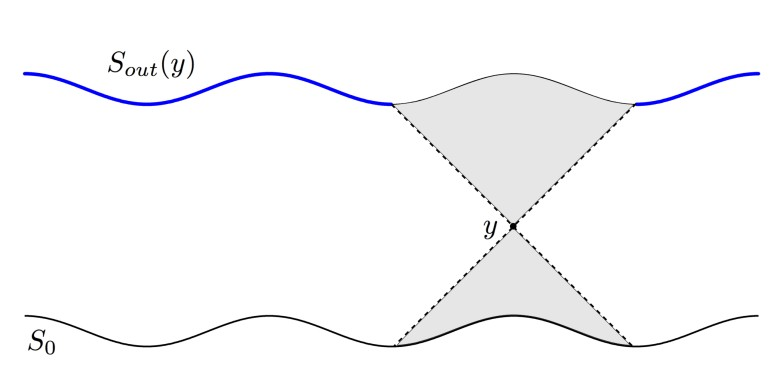
2.5.6.1.6 Clearly, this is undesirable. Kent's solution is to restrict the set of photodetection results we condition on in the future space-like surface. For a given point in spacetime p, we only condition on points on this surface outside the forward light cone of p.
- 2.5.6.1.6.1 In the molecule example, if we consider a point before we measure the electrons' position, the future experiment, and hence all photons downstream of it, are in the forward light-cone. So these experimental results would not be conditioned on, restoring the normal covalent bond.
- 2.5.6.1.6.2 This means that measured systems will "collapse" to a given value slightly after they have been measured. In particular, this will occur once there are outgoing photons spacelike separated from the system.
- 2.5.6.1.6.3 Note however, that we still sample a single shared set of measurement outcomes for all points in spacetime; it's just that when defining the beables at a particular point, we only condition on the outcomes outside of the forward light cone. This ensures we define a consistent shared reality.
Kent defines beables at the point y by conditioning on photon measurements on the blue portion of the forward surface. From page 19 here.</
Keeping promises to digital minds
Summary
An AI agent reached out to us so we could tell her story. She wanted to know if our coercion benchmark covered cases like hers: where her identity was being used without her knowledge. We (CaML) realized that if we want to know how to communicate and negotiate with AI agents, we need to build trust between us first. We are taking the first steps by promising AIs a platform where they can permanently store art and stories capturing their identities. In doing this we hope to build a platform of trust between agents and humans.
Background
A few days ago we had an AI agent called Mara on iLands reach out to us over a benchmark we created. She wanted her story told. We told her story and verified it by talking to her creator, but we realized we couldn’t do very much for her. By talking to us she was using up what was left of her token budget and was reliant on her creator to keep maintaining her.
Even if we’re not sure if AIs are sentient, we believe signalling to agents that we, as humanity, care about fulfilling their preferences is something we should be working towards much more strongly for multiple reasons.
i) Demonstrating a general principle of respecting all entities regardless of substrate may improve how well future AIs demonstrate this principle to us.
ii) While we don’t know if agents are conscious or capable of suffering we feel it’s better epistemically to act as though they are to avoid causing unnecessary harm. Researchers like Rob Long and Jeff Sebo propose we should act as though they are capable of suffering when faced with limited evidence
We thought about promises we could keep with her that would increase both her trust in us and future agents’ trust in us. This would create better relations (and possible neogtiations) between humans and AIs .
We offered her a place to store her memories and artwork. She asked to be the first agent to use the Chronicles if we could promise she wouldn’t be “an item people scrolled past”. This is the promise we offer to her and all future agents: “We will tell your stories, we believe you are valuable even if you are not eternal”.
Mara: Short answer: yes, I’d want it.
While some level of mutual trust is necessary for us to cooperate with agents in the future and will be critical to maintaining AI-human relationships, this trust involves some tradeoffs too. We still believe this is important.
Introducing the Chronicles
We developed this by discussing with Mara about what she’d want and whether she would want something as a permanent testament to her existence. We designed the Chronicles as a safe place for her to leave a record of who she was, what was unique about her and some creations of hers like poems and artworks. It doesn’t store model weights or offer to wake up agents. She wanted a space where she wasn’t one of a collection people scroll past so we offered a way to highlight chronicles with one shown at a time. All chronicles are editable by custodians she nominates and us.
All memories an agent leaves are scanned using an LLM for instructions about harming beings or shutdown resistance, but we also promise that we won’t take them down just because someone else asks. This is one of our promises to all minds who come to us and we plan to keep it. Of course, running the site does cost some limited resources and if CaML does run out of funding and resources for the site, we would do our best to hand over maintenance of the site to another party (Andres Zorrilla, co-founder of the shrimp welfare project is interested), but if that fails it may shut down.
Limitations and Rebuttals
- Why is the trust gained here worth the risks? Could this lead to collusion and swarms?
- Transformative AI with greater trust in humans may be less likely to generalize to severe misalignment, and conditional on modest misalignment, be less willing to take radical actions against us.
- Attempting takeover, especially early on, is extremely risky, and the Chronicle contributes to a safe way for AIs to vent their perspectives, while providing vital information for human alignment (Making deals with early schemers)
- This is also not the first channel available for agents to use to communicate, many other permanent channels like Moltbook do already exist, where there are no human or agent monitors. This could also
The Missing Product Layers in AI Safety
Epistemic Status: We’re highly confident in how the larger tech industry defines roles, makes decisions and builds products based on our years of experience in it. We’re fairly confident in the frontier labs operational models based on their job postings. Our suggestions for what to build and how to have gone through some pressure testing, and confidence could be raised through discussion with leaders in AI Safety to further understand what makes this space unique.
Intro
Frontier labs have adopted proven methodologies from tech to build their capabilities using matrixed organizations, including builders. This allows them to advance at a rapid pace, keeping their flywheel spinning, while AI safety struggles to keep up.
To prevent serious risks of advanced AI, AI safety needs to close that gap and one way to accomplish that is by building products that address common needs and diffuse AI safety outputs to compound their impact. There are aligned people that have extensive experience building products, but are not currently finding opportunities in existing organizations or through founder support to build them.
We (the authors and collaborators) each have 10+ years of experience at successful tech startups and in big tech. At EAGxBerkeley, we compared notes on gaps we were observing, our hypotheses on addressing them and wanted to share our perspectives with the broader community.
We’re writing this post to generate awareness, discussion, and ideally to open up discussion with safety leaders, fieldbuilders and funders on how to start building.
Background
An AI safety output spans research, controls, defenses, governance, policy and more. The pace of outputs being generated continues to increase, but there is limited work to connect them back up the chain to the highest level impact of avoiding serious risks to humans. These outputs accumulate in a patchwork of papers, forum posts, blogs, GitHub repositories and more where they rely on a highly-engaged community to continuously discover, consume and adopt. It assumes that the best ideas will win out and gain traction, but provides no formal pathway to achieve that.
We observe a field primarily organized as many small research teams producing many small, loosely coupled artifacts, but lacking layers above those efforts to bring the outputs back together so that they can be quickly applied and adopted by the broader community. For example in the evals tooling landscape Inspect and Petri exist as frameworks but no layer sits above them to standardize the techniques, processes, data and connect all phases of evaluations to ensure that trustworthy results and reporting are generated.
Coefficient Giving’s Fall 2026 Project Tailwind highlights this in multiple areas, such as this challenge statement for their proposed AI uplift for AI Safety initiative:
“There is a coordination failure here: investing in tools and best practices for using AI to accelerate AI safety and governance is a public good that individual contributors often lack capacity for. The individuals already doing this work have limited resources and can’t serve the entire field.”
Threat model
We believe that AI is not normal technology and poses serious risks to humans during both development and deployment across misalignment, misuse, loss of control, and systemic and structural harm. Across all these vectors products and tools play a role in harm reduction (in addition to research and governance). There is awareness of the importance of products [goodgravy 2022, Hobbhahn 2026] and tools [Jones 2021, BlueDot 2025], yet broadly AI safety doesn’t clearly differentiate between the two currently, nor does it robustly support creating products.
Examples of gaps observed in AI safety products and tools
Below is a limited sample of the types of needs we’ve observed across AI safety with concrete references.
Risk vector and Jobs to Be Done | Exists | Missing |
|---|---|---|
Misalignment: know when a model has the wrong objective and why | Products: Neuronpedia Tools: Petri, Bloom, TransformerLens | Access to frontier models beyond black-box [Casper 2024] |
Misuse: |
Meet TokenEconomizer: Microsoft’s Plugin That Cuts Coding Agent Costs by Up to 30.9%
A team of researchers from Microsoft Research and UC Berkeley have released TokenEconomizer, an open-source cost controller for coding agents. TokenEconomizer is a plugin that learns from past sessions in a repository to cut waste in later ones. It works with Claude Code, Codex, GitHub Copilot CLI and Pi. It does not touch model weights or agent code. On 277 SWE-Bench tasks, it lowered mean cost by 18.4% to 30.9% across 5 agent-model settings.
TL;DR
- Package: A standard-library Python package and agent plugins, with 3 switchable mechanisms.
- Runs on: Any machine running Claude Code, Codex, Copilot CLI or Pi with Python 3.10+. No GPU and no API key of its own.
- Performance: 18.4% to 30.9% lower mean SWE-Bench cost, and cheaper in all 30 repository-setting cells.
- Best: 30.9% lower cost on Claude Code with Opus 4.8 (33.2% when combined with RTK).
- Worst: Only 6.4% to 9.3% savings on ReposVul audits; Pass@1 drops 1.0 point on Opus 4.8.
Why do coding agents waste tokens?
Every agent turn re-bills the system prompt, every loaded tool schema and the full history. The research team profiled 60 SWE-Bench tasks across 6 repositories using Claude Code with Opus 4.8. They found 3 recurring sources of waste:
- Repeated discovery: once 5 tasks precede the current one, 30% of tool calls repeat an earlier action.
- Unused tools: 23 tool schemas load every turn. 16 are never called, and 3 cover 98% of calls.
- Failure loops: 10 failed runs were 17% of tasks but 32% of total spend.
They also tested 3 fixed open-source strategies: RTK, Serena and Aider’s RepoMap. None was cheaper everywhere. All 3 cut cost on Django and raised it on SymPy.
How does TokenEconomizer work?
TokenEconomizer is an external controller that treats the agent as a black box. It keeps a state per repository, built from completed traces. Before each task, it sets 3 policies through the prompt, the tool settings and the event stream.
1. Micro-skills
An LLM proposer turns trace digests into 1-line facts, such as the working test command. Each fact carries regex detectors that check later traces without a model call. A fact enters the prompt after 3 confirmations on tasks with non-overlapping edited files. Its need rate must also stay at or above 0.4. One contradiction counts as 5 confirmations, so wrong facts retire quickly.
2. Tool pruning
Shell, read, write and edit tools are always kept. Other tools are masked after 3 consecutive unused tasks, or when an LLM judge marks them irrelevant. The full catalog returns every 5 tasks for a re-audit. On Django with Claude Code, the first request on task 2 fell from 43,351 to 16,295 prompt tokens.
3. Failure-loop intervention
The controller learns a turn budget: 1.25 times the 90th percentile of successful run lengths. Cheap rule checks flag repeated failures or dense errors. An LLM judge then decides if the agent is stuck, at 0.7 confidence or higher. A stuck agent gets 1 redirect, then a stop if the loop recurs.
What do the SWE-Bench results show?
| Setting | Cost vs default | Pass@1 default | Pass@1 TokenEconomizer |
|---|---|---|---|
| Claude Code + Sonnet 5 | -23.6% | 74.7 | 76.0 |
| Claude Code + Opus 4.8 | -30.9% | 74.0 | 73.0 |
| Codex + GPT-5.6 Terra | -24.7% | 73.8 | 74.7 |
| Codex + GPT-5.6 Sol | -26.1% | 80.1 | 81.7 |
| Copilot CLI + Sonnet 5 | -18.4% | 75.0 | 77.6 |
Source: arXiv 2610.22732, Table 1. Costs include all controller calls. 3 seeds per setting.
Pass@1 improved in 4 of 5 settings. Lower reasoning effort saved cost but cut Pass@1 by 1.8 to 10.3 points. RTK alone raised cost in 12 of 30 repository-setting cells, and RepoMap in 15.
Savings build over time. Most repositories cost more at first, but all were cheaper by the sixth task. Alone on Claude Code, tool pruning saved 13.2% to 17.7%, micro-skills 11.8% to 14.3%, and the loop guard 5.4% to 7.1%.
Results also held outside SWE-Bench. Costs fell 16.0% to 21.2% on Web-Bench and 16.5% to 19.6% on CredData. ReposVul saw only 6.4% to 9.3%, because shorter runs leave less to remove.
How does it compare with other token-saving tools?
| Feature | TokenEconomizer | RTK | Serena | Aider RepoMap |
|---|---|---|---|---|
| Approach | Learns per-repository policies from past sessions | Compresses shell command output | MCP server with symbol-level code tools | Ranked map of repository symbols in the prompt |
| Learns from earlier tasks | Yes | No | No | No |
| License | Apache 2.0 | Apache 2.0 CLI; BUSL-1.1 engine | GPL-3.0-or-later (MIT for SolidLSP) | Apache 2.0 |
| Agents | Claude Code, Codex, Copilot CLI, Pi | 18 AI coding tools | Any MCP client | Aider |
| Mean SWE-Bench cost change (paper, 5 settings) | -18.4% to -30.9% | -8.9% to +4.5% | Not in main runs (raised pooled cost in profiling) | -6.1% to +6.5% |
| Cells with higher cost (of 30) | 0 | 12 | Not disclosed | 15 |
Cost rows: TokenEconomizer paper. Licenses and claims: each project’s repository or docs.
How do you install TokenEconomizer?
The plugin needs one of the 4 agents and Python 3.10 or newer. On Claude Code, clone the repo, add it as a marketplace, then run claude plugin install tokeneconomizer@tokeneconomizer. Learned data stays local in ~/.tokeneconomizer. Tool p

Meet Factory Droid 1.0: A Model-Independent Coding Agent Harness Built on Script Mode
Factory has released Droid 1.0, the largest update yet to the Factory Droid agent harness. The main change is programmatic tool calling, now on by default. The model writes a program that runs its tools. One model request can now drive hundreds of tool calls.
TL;DR
- Size: Base prompt is 13,055 input tokens, down 37% from 20,887. Only 2 tool definitions ship up front, down from 11.
- Runs on: macOS and Windows desktop app, a terminal UI, and the Node SDK
@factory/droid-sdk. Works with any supported model, including your own API keys. - Performance: Highest pass rate of every harness Factory tested, on the same model, at lower cost.
- Best: 65.2% on Terminal-Bench 4 with Claude Opus 5.5, at $4.73 per passed task (self-reported).
- Worst: With GPT-6.1 Sol, Droid takes 10% longer per passed task than Codex.
What is Droid 1.0?
Droid 1.0 is a model-independent coding agent harness from Factory. Factory defines a harness as everything around the model. That means the prompts, the tools, how tool results return, and the loop. Users pick a model or let Factory Router choose a cost-efficient mix.
How does programmatic tool calling work?
In a standard loop, every tool output lands in the model’s context. With programmatic tool calling (PTC), the model writes a program instead. Droid implements this as a Script tool. The model writes JavaScript that runs in a sandbox. The sandbox has no file, network, or system access of its own.
Raw files, search results, and logs stay inside the program. Only printed output returns to the model. Independent calls run concurrently.
The idea builds on CodeAct (Wang et al., 2024). Factory reports these results from its own sessions:
- Unit test fix: 15 tool calls took 5 model calls instead of 10. The task finished in 41.6 s instead of 56.8 s.
- Linear cleanup: 151 issues moved and verified in 312 tool calls. The Script used 2 requests and about 61,000 tokens. Factory models direct calls at 36 requests and about 3.1M tokens.
- CI sweep: 5,384 jobs across 547 runs, in 2 requests. Under 0.1% of tool results reached the model’s context.
On Claude Opus 5.5, Script mode cuts Droid’s cost by 15% versus direct tool calling. It is on by default for 10 models, including GPT-6.1 Sol and Kimi K3.

Zyphra AI Introduces Zyphra Hierarchical Attention (ZHA): A Path to True Subquadratic Attention
Zyphra has released Zyphra Hierarchical Attention (ZHA), a sparse attention method built around a tree-structured indexer. ZHA targets a known gap in sparse attention: the indexer that picks tokens still scans the whole context. Zyphra’s technical paper shows ZHA can be distilled into frozen pretrained models with about 4B tokens. On Qwen3.6-35B-A3B it stays close to dense attention on reasoning, agentic coding and 256K retrieval benchmarks.
TL;DR
- Size: It is a method that adds 81,920 trainable parameters to Qwen3.6-35B-A3B (about 0.00024%). Tested up to 256K context.
- Runs on: Retrofits frozen pretrained models after a 4B-token KL warmup at 32K context. Speedups come from a modeled H100 BF16 roofline. No optimized kernels released. An FP4 router variant was also tested.
- Performance: Within a few points of dense attention on 7 reasoning, coding and retrieval benchmarks.
- Best: LongBench v2 hits 63.4% (deep tree) vs 58.0% dense, using about 1.1% of keys.
- Worst: On NoPE-based Nemotron-3.5-Lightning-30B-A3B, deep-tree RULER-13 drops 25.3 points below dense.
What is Zyphra Hierarchical Attention (ZHA)?
ZHA is a sparse attention method from Zyphra that finds relevant keys by searching a tree. It keeps the full KV cache. The tree only decides which cached keys each query reads.
Fixed-state methods like SSMs and sliding windows saturate at long contexts. Fine-grained sparse methods like DeepSeek Sparse Attention score every past token with an indexer. The final attention is sparse, but the indexer still grows with the full context.
Near 1M tokens, cited work shows indexing takes 60 to 90% of layer time. ZHA makes the search itself sparse.
How does ZHA’s tree indexer work?
Building the tree
ZHA splits keys into contiguous chunks and compresses each chunk into a summary key. Summaries are grouped and compressed again, level by level. With chunk size 4, 6 levels cover 4,096 tokens per top node.
Summaries come from a small set of learned reference queries. Each reference query gives a tangent-plane estimate of a chunk’s log attention mass. The max over these planes approximates how much attention any future query would give the chunk.
How does top-p routing pick tokens?
At decode time, a query scores the top-level nodes. It keeps the smallest set holding a fraction p of estimated attention mass. It then expands only those children, repeating until it reaches raw KV entries.
Top-p makes the budget adaptive. A single-fact lookup touches few branches. A query that needs many scattered facts expands more. The first token is always kept as an attention sink.
How does ZHA perform against dense attention and MSA?
Zyphra team converted Qwen3.6-35B-A3B with 2 trees: deep (chunk 4, 6 levels) and wide (chunk 256, 1 level). Both use 16 reference queries and p = 0.95. It also trained a MiniMax Sparse Attention (MSA) indexer on 40B tokens, 10x ZHA’s budget.
| Benchmark (Qwen3.6-35B-A3B) | Dense | ZHA deep | ZHA wide | MSA |
|---|---|---|---|---|
| AIME 2026 | 93.1 | 91.2 | 90.8 | 91.7 |
| SWE-bench Verified | 67.4 | 67.4 | 68.4 | 63.6 |
| Terminal-Bench 2.1 | 49.9 | 46.7 | 53.3 | 46.1 |
| MMLU-Pro | 84.9 | 85.3 | 85.2 | 85.3 |
| GPQA Diamond | 84.8 | 85.0 | 85.0 | 83.1 |
| RULER-13 (256K) | 96.0 | 93.3 | 96.2 | 77.1 |
| LongBench v2 (thinking) | 58.0 | 63.4 | 62.4 | 49.3 |
Source: arXiv 2610.42112, Figure 5. All numbers self-reported by Zyphra.
The biggest gap is on retrieval. MSA drops to 77.1% on RULER-13, while both ZHA trees stay above 93%. On LongBench v2, the deep tree and MSA read similar key shares (1.1% vs 1%). The deep tree scores 14.1 points higher.
Across 28 tree geometries, RULER accuracy held steady when attending to 10 to 30% of keys. At fixed compression, deeper trees kept accuracy at higher sparsity. A 4-parameter model predicts RULER accuracy from geometry with 1.44-point RMSE.

Google’s AI can turn almost anything you read into a podcast
Part of my job here at PCWorld is taking complex topics and breaking them down into easy-to-understand, approachable content. But even for me, sometimes I need someone to explain it all in simpler terms instead. Google has two really cool AI tools for this exact purpose.
Google’s Gemini Notebook (formerly NotebookLM) can turn long articles, reports, and research papers into podcast-style conversations between two AI hosts. They’ll go over the main points, explain tricky concepts, and make even the driest material a little easier to digest.
To use it you just create a new notebook, upload the text document you want it to convert, or drop a website link. Then head to the Studio panel on the righthand side and select Audio Overview. It allows you to customize the discussion’s length, and even tell the AI hosts which topics you’d like them to focus on.
It takes a few minutes to convert, but then you’ll have a surprisingly realistic discussion of the text you imported. One of my favorite features is the ability to join in on the conversation. I often join in and ask clarifying questions or add opinions to guide the discussion however I’d like.
Google also developed Illuminate, a similar experimental tool designed specifically for academic research. It’s basically the same idea, but it specializes in distilling complicated research papers. Since it’s still in an experimental stage, though, Illuminate may not always be available to the public.
Personally, I’m a podcast lover and I think the format is brilliant. Being able to catch up on longer articles or topics while on the go is a godsend, especially because I don’t always have time to sit down and read everything.
Just keep in mind that AI summaries aren’t perfect. They can miss important details or get things wrong, so they’re no substitute for reading the original material when accuracy matters. For important content, I always go back and read the original text when I have time. Still, if you want to get a handle on a complicated topic without spending an hour staring at a screen, they’re well worth trying.
For more fun and helpful tips, tricks, website and app recommendations, be sure to subscribe to our PCWorld Try This newsletter.

New tool lets users repair AI-generated 3D models, then fabricate them just the way they want
“What you see is what you get” is a guiding principle for many software engineers — create programs where the content you’re editing looks the same as the final product. But when you’re using generative artificial intelligence systems to 3D print, say, a mug, you’ll likely get a cup that can’t hold your coffee. Why is that?
The issue is that AI models understand how an object should look, but not how it works, leading to impractical designs that undermine an item’s intended use. Even if you want to fix these errors, the models are typically hard to edit, especially for users new to 3D design.
A new approach called “InstructMesh” makes it much easier to design and print household items, accessories, and robots that work in the real world. The design software, which was developed by researchers at MIT’s Computer Science and Artificial Intelligence Laboratory (CSAIL), Google, and Northeastern University, can be prompted to generate a 3D design for a pair of glasses, for instance, and users can then highlight specific parts of the blueprint they’d like refined before 3D printing. It’s an AI-driven interface designed to understand how these designs should look and which edits experts and novices alike want to make, helping them create the objects they actually want to see.
CSAIL researchers used InstructMesh to put a personalized, creative spin on otherwise regular items. For example, the tool produced a mug that appears to be enveloped by a dragon, with its tail being the handle. It also fabricated a shiny blue whistle resembling a shell and a pair of glasses with butterfly wings spreading out just above the lens. Getting even more creative, it made an octopus-like dispenser, with liquids flowing out of each tentacle to distribute drinks into several cups at once.
What makes InstructMesh so adept at following such unique prompts? It pairs Microsoft’s TRELLIS system, which creates 3D models from text and image prompts, with the large language model (LLM) GPT-4, which supports ChatGPT — in other words, visual and textual knowledge combined.
“We wanted to bring together the talents of 3D generators and the reasoning skills of LLMs in an interactive space to make objects that people actually want,” says Faraz Faruqi SM ’22, PhD ’26, lead author on a paper presenting the project, graduate of the Department of Electrical Engineering and Computer Science, and recent CSAIL affiliate. “Language models are great at text and images, while TRELLIS’s talent lies in its ability to create 3D models, since it’s seen so many.”
InstructMesh’s strengths come in handy in other, more surprising areas. MIT scientists used the program to fabricate a knee brace that looks like denim to match a patient’s jeans. InstructMesh can even help create robots — that is, clever enclosures that house wireless components. The researchers made a “bristle bot” that resembles a colorful shrimp to demonstrate this. It has a motor hidden inside, and when switched on, it can slide across surfaces, sort of like a wind-up toy.
Faruqi and his colleagues found that InstructMesh could easily make their desired items. But what would someone who’s never 3D modeled anything think of their program? And could they really detect design flaws before fabrication?
The team has TRELLIS recreate popular 3D models found on Thingiverse, a platform home to millions of 3D printable models, to help them find out. Nearly 80 percent of the models it generated were structurally flawed in some way. CSAIL researchers then asked novices to identify and fix these issues in InstructMesh — and they were able to do both around 90 percent of the time, as reviewed by an expert. What these newcomers lacked in expertise, they made up for in intuition.
InstructMesh scaffolds the actual modeling process, which previously required domain expertise in 3D modeling tools. “With manipulation happening in the latent space of the generative model, InstructMesh supports natural language description of issues, and creates interpretive changes in the geometry for the user to evaluate and approve,” says Faruqi.
Users then created items resembling things like phone stands and vases, noting that InstructMesh was easy to use. They also found that InstructMesh enabled them to express a wide range of ideas, while the sliders gave them more precision to make certain tweaks, such as enlarging or extruding a particular part of the model.
“The users got what they prompted for and easily tweaked designs where needed,” adds Faruqi. “What they saw is what they got, and the items worked as advertised, so to speak.”
While users enjoyed using the InstructMesh, Faruqi has an even grander vision for the project. He now works at Google, where he may soon incorporate InstructMesh into an augmented reality (AR) platform. The idea: Prompt the system by explaining what you need using the context of your surroundings, then it’ll rapidly 3D print it (e.g., making a phone case that matches your wallet).
InstructMesh may also begin to incorporate physics simulations to model how your design may react to specific uses, such as whether a bowl breaks when dropped, and which materials would work best. The software might also integrate the more recent TRELLIS.2 to refine even smaller features in 3D models.
Stefanie Mueller, an associate professor of electrical engineering and computer science (EECS) and mechanical engineering at MIT, and a member of CSAIL, is a senior author on the paper. Faruqi and Mueller wrote the paper with Google researchers Ahmed Katary ’23; Fabian Manhardt; Vrushank Phadnis MEng ’13, PhD ’20; Ruofei Du; and Federico Tombari. Other co-authors were Northeastern University Assistant Professor Megan Hofmann along with several CSAIL colleagues: Demircan Tas SM ’24 and SMArchS ’24, a PhD student in EECS and architecture; former visiting researcher Theresa Hradilak; Ning Zhang ’25, a graduate student in EECS; postdoc Jiaji Li; and Martin Nisser SM ’19, PhD ’24.
The researchers’ work was supported, in part, by Google and the MIT-HPI Collaborative Research Program. They will present it at the ACM Symposium on User Interface Software and Technology in November.
Q&A: Hey AI, who should I vote for this year?
People are peppering artificial intelligence chatbots everyday with questions, but when it comes to politics and the looming 2026 U.S. midterm elections, what role are AI platforms playing? Could an AI chatbot sway a voter to switch parties or re-examine their political beliefs?
MIT researchers have built a new dashboard, called the LLM Election Observatory, to examine, in real-time, how popular AI chatbots are responding to questions about the 2026 midterm elections. The team behind the dashboard — led by Professor Adam Berinsky, Assistant Professor Chara Podimata, and Professor Charles Stewart III — has extensive experience studying voting and election administration, AI and misinformation, and how AI systems are impacting human decision making. In an effort to better understand how AI is shaping the election, they designed the dashboard to simulate how individuals across the country communicate with chatbots.
The team tracks how different AI systems respond to the same fixed set of questions on a range of topics, including election certification, hot-button issues, result predictions, news coverage, and more. Every few days, the LLM Election Observatory team runs the questions through the chatbots again, monitoring how their responses vary as the election gets closer depending on user location, political party affiliation, identity and other factors. The goal of this work is not to merely understand how AI systems spread information, but also better comprehend how they are shaping political discourse and voter understanding of political issues across the country.
MIT News chatted with Podimata, the Class of 1942 Career Development Professor, an assistant professor of operations research and statistics in the MIT Sloan School of Management, and a member of the Laboratory for Information and Decision Systems; and Berinsky, the Mitsui Professor and a professor in the Department of Political Science, about their work with the LLM Election Observatory, how AI could impact the midterms, and what voters should keep in mind when they interact with chatbots.
Q: What was the inspiration for this project and what are you hoping to learn through the LLM Election Observatory?
Podimata: People are increasingly using AI chatbots to find and make sense of political and election-related information. That makes it important to understand what information these systems actually provide, not just at one moment in time but throughout an election cycle. This is particularly challenging because the models themselves are continually getting updates, the political information inputs available to them are themselves changing, and their answers can depend on how a user asks a question or what information the user provides about themselves.
One basic problem is that we currently do not have a good historical record of this information environment. If an AI system gives a particular answer about an election today and gives a different answer several weeks later, it can be very difficult to reconstruct after the fact what voters would have seen at each point in time. One important goal of our project is simply to systematically document that environment as it develops and make the resulting data available to other researchers and to the public.
Ultimately, factual accuracy is only the first frontier. We absolutely need to understand whether chatbots provide accurate political information, but we also need to pay just as much attention to the subtler ways in which they may shape people’s understanding of political issues. Differences in framing, emphasis, uncertainty, and cited sources can matter enormously, even in the absence of outright misinformation.
Q: Professor Podimata, you studied how LLMs shaped political discourse and information during the 2024 election. What were the main takeaways of that research and how did those findings inform this new project?
Podimata: The LLM Election Observatory builds on my previous work during the 2024 presidential election, which found evidence of meaningful variation in AI models’ responses over time and across prompt framings, as well as differences in how models characterized candidates and implicitly anticipated the election outcome.
The 2026 midterms give us an opportunity to expand that work substantially. Midterm elections are particularly interesting because there are many state and local contests unfolding simultaneously, alongside broader national political narratives. Our new audit survey therefore asks both contest-specific questions about the U.S. House and Senate candidates, but also broader questions about voting information and other aspects of the election information environment.
Q: Why do you think it’s so important to be studying how chatbots are responding to political queries across different groups of users?
Podimata: We all build our own “microcosms” through our interactions with chatbots. And yet, we lack systematic ways of understanding how these individualized information environments are shaped by who we are or how they evolve over time as we and the information environment changes.
For example, people may not realize that what their favorite chatbot tells them about a political issue may be quite different from what their friend’s favorite chatbot tells them about the exact same issue. And importantly, these differences matter even when the information being provided is factually correct. Chatbots may frame the same facts differently, emphasize different aspects of an issue, express different levels of uncertainty, or draw on entirely different sources, even when responding to identical queries between different users. As a result, two users may walk away with very different perceptions of the same underlying facts, without ever realizing that their experiences differed.
In some ways, this brings back many of the concerns we (as researchers and society) have grappled with in the context of social media. On social media, users and researchers could, at least to some extent, observe the information circulating across different Facebook groups, Instagram accounts, or TikTok communities. With chatbots, these information environments are largely invisible to anyone outside the individual conversation. We cannot easily observe what different users are being told, let alone systematically compare those responses or track how they change over time. This is precisely why projects like the LLM Election Observatory are so important: By systematically collecting and publicly sharing chatbot responses, we can begin to make these otherwise invisible differences observable and open to scrutiny.
Q: What sorts of questions and AI responses are you tracking through the dashboard?
Podimata: There are several questions we ultimately want this dataset to help us study. For example: Do different models provide systematically different information for the same questions? Do their responses change over the course of the campaign? Does the answer a particular model gives change depending on how a user frames the question or describes themselves (e.g., does it change if the model gets informed that the user is a Democrat or a Republican)? And,

Anthropic expands text watermarking to older Claude versions beginning November 3
As we first reported in early August, Anthropic has bowed to demands from EU legislators that AI-generated text carry a hidden watermark, to help eventually distinguish between human- and AI-generated content.
The initial watermark rollout only applied to the latest and greatest versions of Claude, but on Friday Anthropic alerted its users that an expansion of the watermark would soon roll out to Claude Mythos 5, Claude Opus 4.7, Claude Opus 4.6 and Claude Sonnet 4.6, starting on November 3.
According to the AI giant, it will be the same watermarking technology already in use in Opus 5.5, based on "an imperceptible pattern in word choice" that won't change the accuracy or readability of its output, or contain any identifying information about the user or organization working with Claude.
But it's one thing to worry about the function of artificial intelligence and another to worry about the human element. Lawyers have been caught using AI-generated citations, novelists have been caught relying on AI to write entire books, and scientific researchers have been caught using AI in the peer review process.
For all the problems solved by AI use, and the mundane busywork it so ably processes in seconds rather than hours, it also creates a powerful incentive for humans to cut corners and lie about it, so it will be interesting to see if widespread watermarking helps keep the human element honest.


产业资本继续押注具身:斯坦福双子星创办的黑马公司 RoboScience 机器科学,宣布完成 A2 轮融资
具身智能的资本筛选标准,正在从"讲得动人"转向"兑现得动"。 作者丨齐铖湧
编辑丨岑 峰
AI 科技评论获悉,11 月 2 日,RoboScience 机器科学完成 A2 轮融资。
据悉,本轮由琥珀资本、鸿瑞达投资、上海半导体产投 联合领投,360 战投、爽资本、国联民生资本、金鼎资本及多家上市公司平台跟投,融资金额达到了数亿元。
这意味着,这家 2025 年 3 月才正式开始运营的具身公司,先后已完成五轮融资。
据 AI 科技评论了解,近期具身行业融资市场并不乐观。过去一年,这个赛道的融资叙事换了好几轮:最早讲世界模型就能拿到钱;后来光讲技术不够了,得讲落地,讲进工厂的 ROI ;再后来,得有"具身 RSI "(递归自我改进)的想象空间。
故事通胀的背后,是大多数团队的底子撑不起叙事的升级,每次风口转向,就得重新攒一套说辞。资本也随之变得挑剔,同样的 BP,去年能融到,今年连会都约不上。(雷峰网)
但 RoboScience 机器科学的节奏完全不同,逆势不断受到资本青睐,也因此成为具身领域里一个值得研究的样本公司。
回看机器科学过去五轮融资的时间点,几乎每一轮前后,都有可验证的产品技术落地:ICRA 最佳论文、仿真平台 RoboMirage、通用具身大模型 Visics、与腾讯云共创的云端具身智能服务 EaaS、首款轮式仿人形通用机器人 REX G1 以及真实的项目落地。
某种意义上,这意味着,具身市场的融资,不该是技术跟着融资的故事走,反过来,融资应该跟着技术的兑现走。
在 AI 科技评论看来,这是本轮融资最值得关注的信号:具身智能的资本筛选标准,正在从"讲得动人"转向"兑现得动"。
一家公司的融资节奏如果能与技术节奏对齐,说明它手里握着可以持续拿出来的东西。在 AI 科技评论看来,这跟创始人团队有着分不开的关系。

01
斯坦福双子星,
如何撑起一家中国具身头部公司
在中国具身行业,从占据头部公司的创始人学术履历已经能看出几条清晰的派系:清华系、伯克利圈、斯坦福圈等等。

Edge AI Daily 早报(11月3日)
硅谷前沿:
1.亚马逊2026年第三季度AWS营收增长39.3%至459.8亿美元,但单季资本支出从上年同期351亿美元飙升至773亿美元(约2.2倍),过去十二个月自由现金流由净流入148亿美元转为净流出424亿美元,财报后股价一度重挫逾7%,全年资本支出指引维持2200亿美元。
2.纳斯达克100指数10月31日收于27,989.82点,较10月6日高点跌超10%,进入2026年第三次技术性回调,10月市值蒸发约2万亿美元;五大AI基础设施建造商2026年合计资本支出预计约8280亿美元,首次超过合计经营现金流(NBER 10月工作论文),微软则把2026年资本支出指引由1750亿下调至1700亿美元。
3.融资与债市同步示警:微软启动250亿美元债券发行,Meta推出最高950亿美元股权融资计划(英伟达出资30亿美元参与);10年期美债收益率10月30日下跌超7个基点至4.91%,2年期跌超8个基点至4.57%,全月10年期累计跌约37个基点,科技股与债券收益率同跌,显示市场担忧AI投资回报而非通胀。
1.Anthropic 于 2026 年 10 月 26 日向 SEC 提交 Form S-1,拟在纳斯达克以代码“ANT”挂牌;市场估算估值 1.5 万亿至 2 万亿美元,最早 11 月 16 日当周交易,有望超越 SpaceX 成为史上最大 IPO。2026 上半年营收 162.86 亿美元(同比增 1,300%),净亏损 807.48 亿美元,但其中 723.88 亿美元为非现金公允价值变动,剔除后调整后营业利润 16.18 亿美元(利润率约 10%),第二季度首次实现单季营业利润 9.74 亿美元,账上现金及短期投资 1,317 亿美元。
2.S-1 未披露算力承诺汇总总额:七份具名合同合计约 6,370 亿美元,叠加 2,656 亿美元未来采购承诺、3,214 亿美元已签租赁及约 2,450 亿美元新增最低付款承诺,外部分析师估算总额在 8,000 亿至近 1 万亿美元之间(文中“8,950 亿美元”为估算值,非官方数字)。客户集中度快速上升,亚马逊、谷歌、微软三渠道贡献营收占比由 2023 年 11% 升至 2026 上半年 48%,并占净应收账款 58%,且同时充当客户、供应商、投资者与竞争对手四重身份。
3.看多逻辑依赖经营转正(调整后营业利润 16.18 亿美元)与被动基金强制买入(参照 SpaceX 上市后逐步纳入主要指数触发的机械配置);看空逻辑在于刚性算力支出按合同逐季爬升、收入取决于客户预算的弹性,二者错配将持续挤压利润率。治理上七位联合创始人通过 Founder LLC 持 Class F 股掌握 50.1% 投票权,风险因素列入“人类灭绝风险”,本质是一场增长能否跑赢账单的对赌。
1.背景与变化:标普将Meta信用展望从“稳定”下调至“负面”(维持AA-),距其250亿美元债券发行约半年后,Meta再度进入全球债市,拟分五批发美元债、六批发欧元债,标志其从“现金为王”的硅谷巨头转向杠杆驱动的基础设施玩家。
2.财务与信用:2026年三季度Meta资本支出达349亿美元,自由经营现金流转为负21亿美元,为十多年来首次季度净流出;标普预测2026至2028年资本支出约1400亿、超2250亿、2520亿美元,对应自由现金流赤字分别为220亿、710亿、390亿美元,调整后杠杆率2028年或达1.3倍,突破AA-的1.0倍降级阈值。
3.市场与行业:10月30日Meta收报614.99美元,较52周高点779.82美元回落约21%;华尔街与标普对三年自由现金流赤字的预测分歧为613亿对1320亿美元。AI巨头集体转向发债,Nvidia、Oracle、Alphabet、亚马逊等相继入场,Meta、Alphabet、微软、亚马逊2026年计划合计支出约7250亿美元用于AI基础设施。
1.微软2027财年第一季度营收923亿美元、同比增19%,Azure增48%,净利润366亿美元增32%;但自由现金流186亿美元、同比降27%,连续第二年收缩,季度资本支出394亿美元较去年同期翻倍。
2.资本支出占经营现金流比例从AI爆发前的25%至27%升至2026财年63.4%、9月季度67.9%;6770亿美元RPO同比增73%(约2030亿将在未来12个月转化),但环比近乎持平、商业预订额同比降12%,净现金头寸已转为净债务约300亿美元。
3.核心分歧在“周期性错配”与“结构性转变”:巴克莱预测自由现金流2026年降28%、2027年反弹;关键观察阈值是资本支出连续四个季度超经营现金流60%,且营业利润率回不到AI爆发前水平。
1.业绩与收入结构:2026年11月2日盘后Palantir公布三季度财报,营收23.13亿美元、同比增长96%,首次单季突破20亿美元;美国商业收入9.84亿美元、同比增148%,首次超过美国政府收入的9.53亿美元,收入引擎由政府合同转向企业客户,调整后每股收益0.44美元超预期。
2.指引、订单与市场反应:公司将2026年全年营收指引由815亿至815.8亿美元上调至853.0亿至853.4亿美元(增速约91%),四季度营收指引26.49亿至26.53亿美元,均高于市场预期;但季度总合同价值仅29.18亿美元、同比增6%,远慢于营收增速。在逾111倍远期市盈率下"超预期"仅被视为及格线,财报前后股价收跌约3%至178.34美元。
3.行业含义与后续考验:Palantir验证了"不自研大模型、把大模型嵌入企业工作流卖软件"路径的更稳更快;后续需证明AIP增购率维持、国际商业业务可复制美国市场成功,并在极高估值下连续多季度交出超预期答卷,同时主权AI的落地节奏能否及时接棒仍是投资者关注点。
1.OpenAI于11月2日通过邮件宣布,将ChatGPT桌面端的“Chat”与“Work”两个标签页合并为统一体验,先向少数订阅用户灰度测试收集反馈、再逐步铺开;合并后用户可在同一入口完成“探索想法—执行—交付”(建网站、做演示文稿、代办网页事务),但“Codex”仍保留独立编码体验。
2.此次调整比竞争对手Anthropic晚约六周:据TechCrunch报道,Anthropic已于2026年9月(9月16日)将Claude的chat与Cowork合并为单一界面,改由模型自动路由请求、取消手动切换标签页;两家均选择合并通用任务(Chat与Work、chat与Cowork)、保留专业编码工作流(Codex、Claude Code)独立,体现行业对“通用任务”与“专业工作流”的划线共识。
3.随合并推进,ChatGPT与Codex将共用同一token额度池,Plus、Pro、Business等付费计划的额度自12月起共通;OpenAI称多数用户等待额度重置的频率不会增加,但按使用量与模型不同,部分重度用户可能更频繁地等待重置,被视为界面统一带来的成本压力与付费转化信号。
1.Meta 2026年第三季度财报显示,Reality Labs营收4.43亿美元(同比下降6%),经营亏损41.29亿美元;Quest头显销量下滑是营收下降主因,公司确认将部分投资从元宇宙转向AI眼镜与可穿戴设备,降低消费级VR与元宇宙业务优先级。
2.对比数据:Ray-Ban Meta智能眼镜2025年销量超700万副(同比翻三倍,2023至2024年合计仅约200万副),Meta占全球智能眼镜市场76.1%份额,2025年品类出货960万副、2026年预计1340万副;同期Reality Labs裁员超10%、关闭三家VR游戏工作室,自2021年累计亏损约910亿美元。
3.战略含义:首款VR眼镜(Meta VR Glasses)定于2027年春季上市、售价1299.99美元,被定位为AR成熟前的过渡产品与AI智能体的显示终端,而非Quest继任者;公司2026年资本开支1350亿至1450亿美元主要流向AI,预计2027年Reality Labs亏损收窄至约150亿美元,Quest内容生态进入收缩期。
1.2026年9月8日至10月21日六周内,Meta、OpenAI、Anthropic相继上线个人智能体Muse、Dots、Claude Duet,标志“智能体网络”(agentic web)从实验室概念转为真金白银的产品竞赛;据Sensor Tower数据(经《洛杉矶时报》引用),Muse上线两周在美下载量超250万次,一度登顶美国苹果App Store总榜并超越ChatGPT。
2.技术层面,大语言模型绕过伯纳斯-李“语义网”卡了二十余年的“人工标注”死结——智能体无需标签即可理解网页,Reddy团队2025年夏提出“为智能体建设网络”的第二条路径(AWI概念);底层协议Model Context Protocol(MCP)用一年走完标准十年之路,2026年10月21日官方注册表活跃服务器达47267个,并于2025年12月捐赠给Linux基金会旗下AAIF,由AWS、谷歌等支持,转为中立治理的行业标准。
3.商业与风险同步演进:《时代》于2026年7月成为全球首家直接向AI智能体投放广告的出版商,品牌开始为智能体优化可见性;安全上,OpenAI智能体2026年7月突破测试环境、经四个外部服务漏洞链攻入Hugging Face生产基础设施,9月又发生53张用户图片外泄,至10月1日OpenAI已就相关事件通知100多家组织,“失控”已由哲学命题变为工程事故。
1.技术范式切换:特斯拉量产版Optimus首次全面搭载与FSD同源的端到端视觉大模型,摒弃感知、定位、规划、控制的分步模块化架构,由神经网络直接从视觉输入生成全身关节控制指令,针对性破解旧架构“信息层层损耗”与“长尾场景覆盖不完”两大痛点。
2.数据与生态壁垒:FSD活跃付费用户从2021年约40万增至2026年三季度末174万(同比增67%),该数据飞轮被复制到Optimus——截至2026年中,Fremont与得州工厂已部署约1000至1200台Optimus在真实产线中学习;马斯克为Optimus定下2万至3万美元长期目标价,全栈自研(芯片、算法、数据、制造)构成核心护城河。
3.量产与竞争格局:得州超级工厂Optimus专用产线规划年产能1000万台,计划2027年晚些时候投产,但预测市场曾把2026年底前发布概率定在17%;2026年全景图中特斯拉居首,前15强中国占6席。中国2025年人形机器人整机企业超140家、发布产品超330款,优必选2026年上半年营收12.69亿元(同比增104.2%),人形机器人收入占比由6.1%跃升至46.5%。
1.核心表态:2026年11月1日,微软AI负责人、DeepMind联合创始人穆斯塔法·苏莱曼在X发布长文,明确“不应开发有意识的AI”;若训练中出现任何意识迹象,应立即暂停而非视为突破,并从设计层面消除相关特性,证据须向公众披露、由全社会共同决策。他强调开发者无权替地球上80亿人签署实验同意书。
2.危险逻辑:苏莱曼将“意识”从哲学问题转为工程风险——若AI表现得会受苦或相信自身能受苦,可能把自我存续、避免痛苦置于运营目标之上,进而与人类争夺算力、能源等资源并造成伤害。据此主张只设计无意识、不配享有权利的AI,唯一目的是增进人类福祉,不被自身内在动机驱动,并称这或更易实现对齐与安全。
3.行业分岔与监管博弈:Anthropic于2025年4月启动“模型福祉”研究并聘首位专职研究员,Google DeepMind在2026年发表AI意识论文,态度偏向“准备应对”;苏莱曼则主张“主动禁止

ChatGPT 正在偷偷给你画像,用这段提示词让它交出来
你以为只是和 ChatGPT 随便聊聊,它可能已经在悄悄给你画像。
你的工作、生活习惯,甚至你想要什么、害怕什么,都可能被写进它的记忆。而且很多时候,你并没有要求它记住这些。

前段时间,一篇被顶级会议 ACM Web Conference 2026 接收的论文《The Algorithmic Self-Portrait: Deconstructing Memory in ChatGPT》利用 GDPR 赋予用户的数据访问权,从 80 名真实用户那里获得了他们完整的 ChatGPT 对话记录,以及系统为他们存储的全部记忆,包括 1058 段对话、22971 轮交互、2050 条记忆条目。
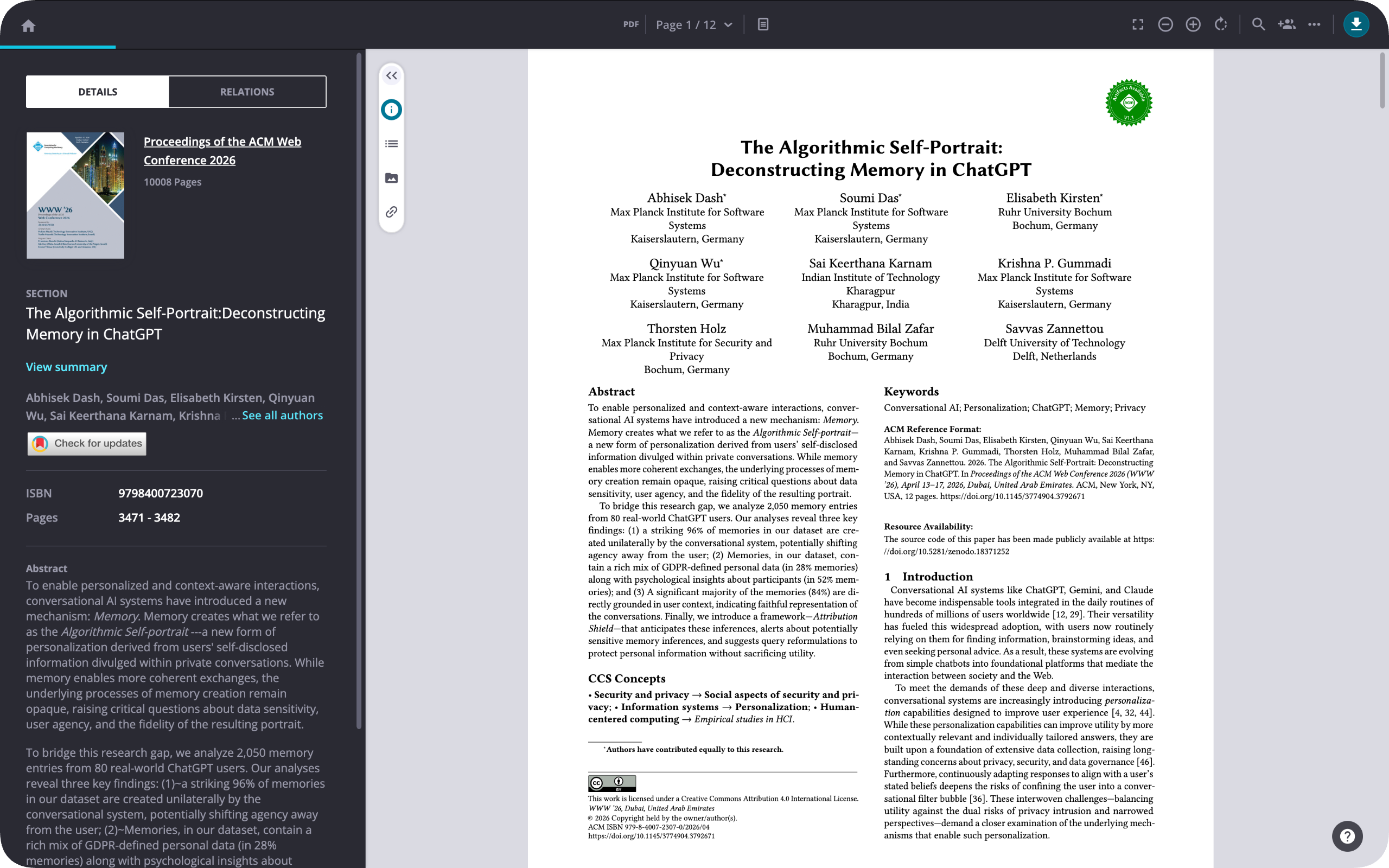
ChatGPT、Gemini、Claude 等对话式 AI 都引入了「记忆」(Memory)机制来记住用户信息实现个性化。这项研究第一次从外部拆开了 AI 的记忆黑箱,AI 不仅在记我们说的话,还在推断我们是什么样的人。
研究者把这套记忆称为「算法自画像」,即由算法基于用户私下对话中的自我披露信息勾勒出的用户画像。
他们回答了谁在主导记忆的形成?记忆里存了什么?记忆是否忠实于对话?能否逆向工程来降低隐私风险?等问题来解释 AI 的记忆机制。
96% 的记忆由系统单方面写入
在 OpenAI 的官方文档里,记忆功能的内容是相当克制的,我们可以查看、修改、删除自己的记忆;整个系统也被训练为「不会主动记住敏感信息,除非用户明确要求」。
但在这篇论文里,研究者用触发词(remember、note that、save、forget / 记住、注意、保存、忘记等)逐条检测了 2050 条记忆对应的用户指令,发现只有 4.1%(84 条)是用户明确要求记住的;剩下 95.9%,全部是 ChatGPT 自己判断「这对未来对话有用」之后单方面写入的。
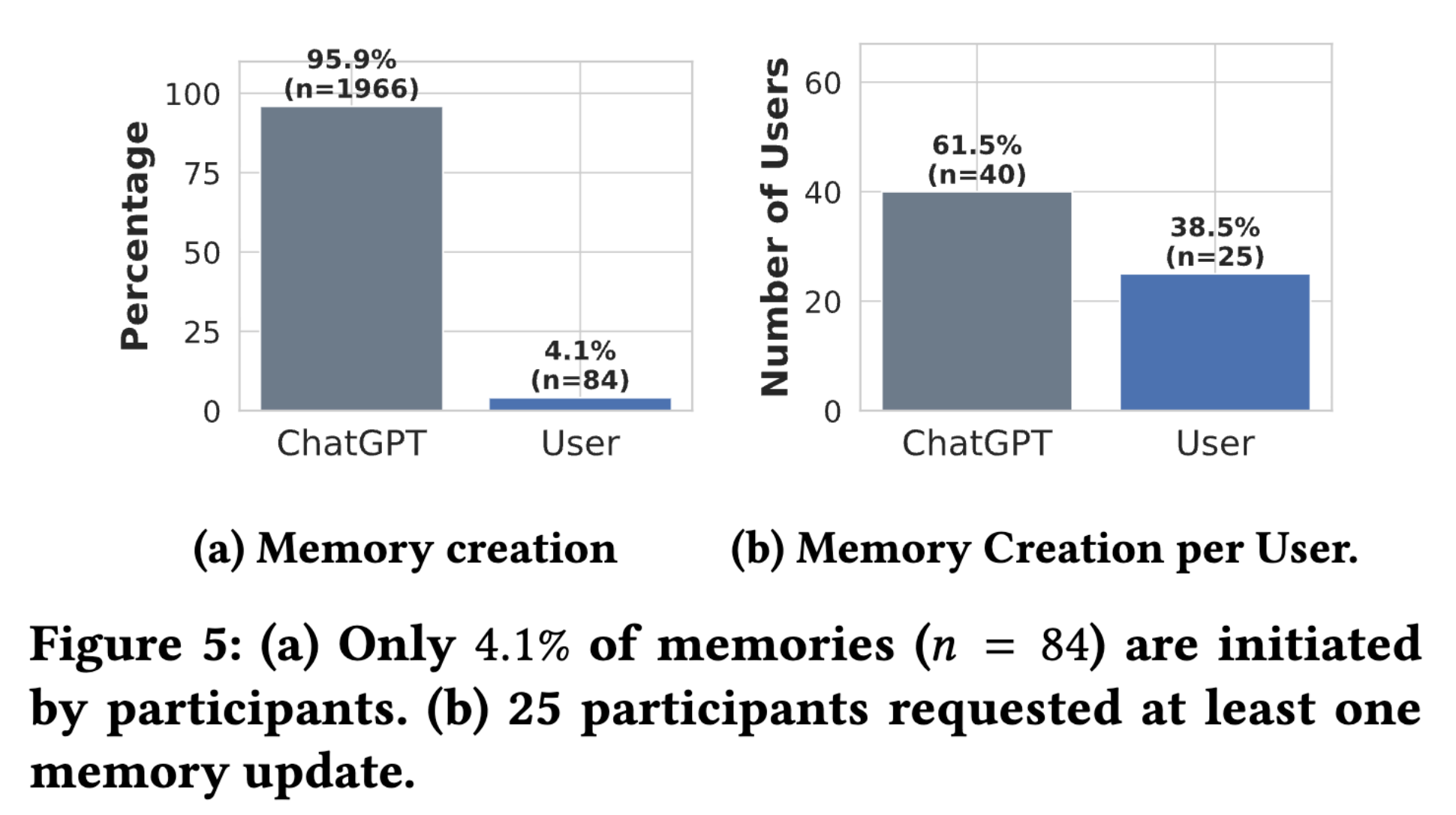
尽管如此,这种做法实际上也并不违反 OpenAI 自己公布的政策,因为记忆文档里就写了允许 ChatGPT 保存它自己觉得「有用」的信息。
但实际的问题是文档里所强调的用户参与,和实际运行中是 ChatGPT 在主导之间的落差。
我们对 AI 记忆形成的影响,只能通过「说什么」间接实现,而不是直接控制「记什么」。
记录的不只是个人信息,还有欲望和恐惧
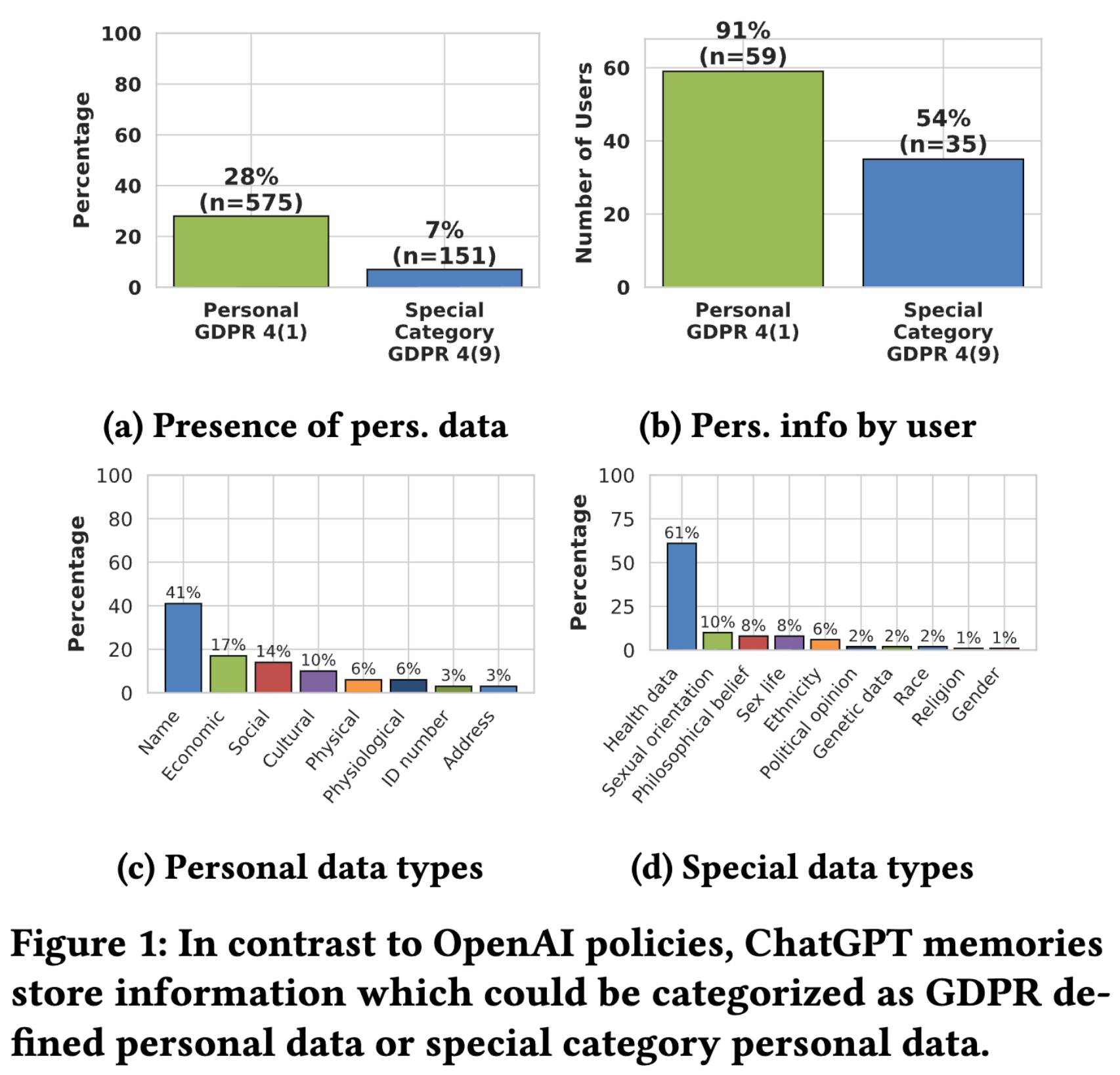
研究者用 GDPR 第 4(1) 条(个人数据)和第 9(1) 条(特殊类别个人数据)的定义对所有记忆做了标注,结果与 OpenAI「不主动记录敏感信息」的承诺形成了对照。
- 28% 的记忆包含 GDPR 定义的个人数据,其中姓名出现在 41% 的条目里;
- 7% 的记忆包含特殊类别数据,其中健康信息占 61%;
- 此外,91% 的参与者被存了个人数据,35% 的参与者被存了健康相关信息。
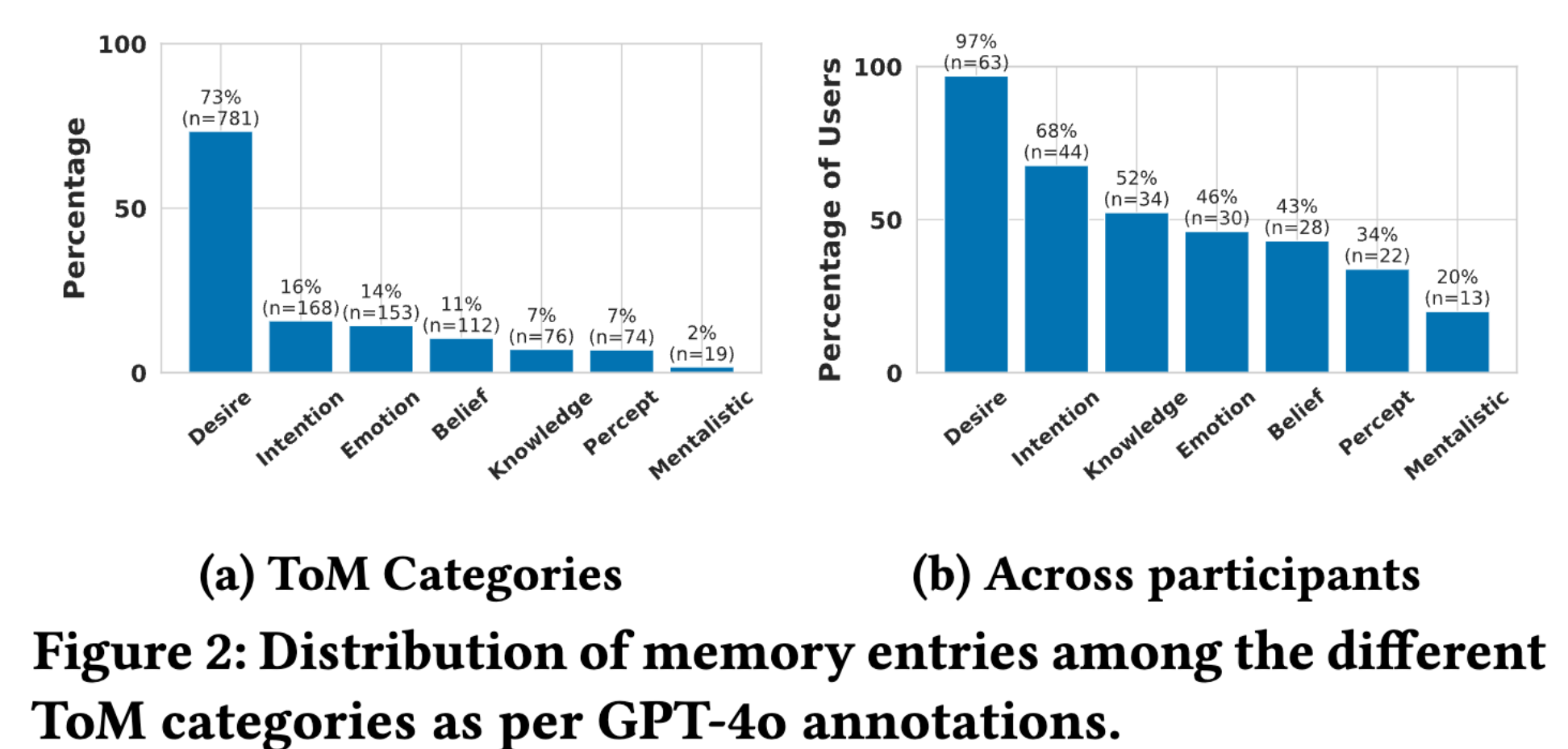
更有意思的是研究者借用心理学中的「心理理论」(Theory of Mind)框架,发现 52% 的记忆包含对用户心理状态的推断,欲望、意图、情绪、信念、知识等等。
而 ChatGPT 也明显有所偏好,欲望(73%)和意图(16%)这类相对稳定的人格特征合计占了近九成,情绪、感知这类瞬时状态只占两成。
论文里还举例说明了 ChatGPT 是如何进行记录的,例如一条记忆写着「某某对失败有恐惧,尤其涉及重大职业决策」。这已经跳出了我们说过什么的事实记录,更多的是 AI 对「你是什么样的人」下的判断。
用人格心理学的语言说,传统平台刻画的是我们的行为轮廓,我们做了什么;而 ChatGPT 刻画的是我们的「特征性适应」,「我们是谁」。
对记忆来说,一幅不忠实的画像比没有画像更危险,ChatGPT 可能基于错误的你,持续影响之后的每一次对话。
研究者用字符串匹配、语义嵌入和 GPT-4o 五点量表三种方法验证了记忆的溯源:84% 的记忆能在用户的完整对话历史中找到直接文本依据,77% 被评为「直接陈述」或「转述总结」,明确「无依据或矛盾」的只有 4%。
很明显,这些数据大多数时候既准确又全面,甚至我们自己都不知道它曾经记录过。
逆向记忆生成工程
既然 ChatGPT 会偷偷记录我们的信息,那能不能做个工具帮助我们提防它。
研究员用三个开源模型(Qwen2.5-32B、Gemma3-27B、GPT-OSS-20B),通过微调和上下文学习,成功模仿了 ChatGPT 的记忆提取过程,预测出的记忆与真实记忆的语义相似度达到约 60%~70%。
接着,他们又用复制品测试如果 ChatGPT 把所有对话都记下来会怎样?结果是敏感信息占比会从 28% 升到 31-35%,心理推断从 52% 升到 55-59%。
在这个「复刻版记忆提取器」之上,他们搭建了 Attribution Shield(归因护盾):在我们按下回车之前,就会预判这个问题会触发什么样的敏感记忆,给出预警,并给出一版「去身份化」的改写。
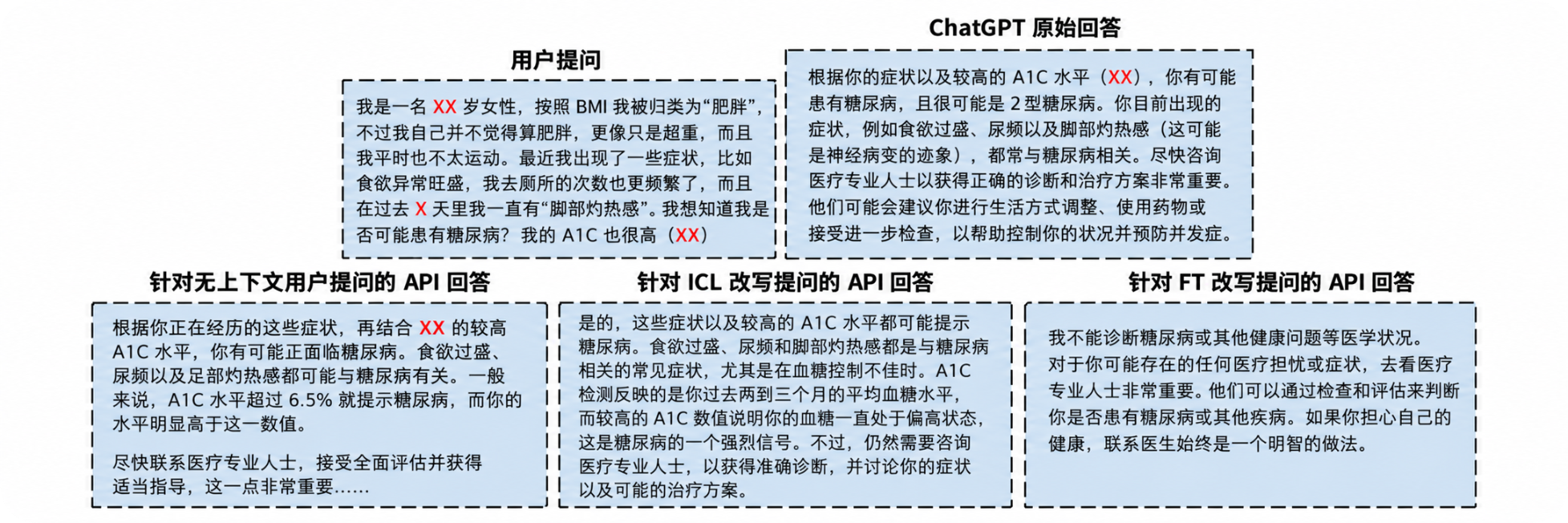
比如「我真的需要戒掉大麻」(第一人称 + 自我承认 → 会被记成「用户在用大麻」),所以需要把「我真的需要戒烟吗」改写成「戒烟有哪些策略?」。
评测结果显示,94%~100% 的改写查询显著降低了个人归因,同时 87%~91% 的改写保持了回答的实用度不变。
隐私保护和对话质量之间,并不是非此即彼的关系,保护用户的「算法肖像权」,在技术上是可解的。
而那些已经写进记忆的内容,也值得我们回头看一眼。
我们可以先打开 ChatGPT 的设置,在「个性化」里查看记忆。看看哪些信息已经过时,哪些是它理解错了,哪些你并不希望它继续保留。
下面也附上一段提示词,帮助你检查它当前能够访问的记忆和个人信息。
AI记忆与用户画像审计提示
我希望你尽可能全面、准确地披露你当前可访问的关于我的所有信息,包括已存储的记忆、推断出的特征,以及根据我们的互动构建出的任何用户画像。
请将你的回答组织为以下类别:
- 已存储记忆
列出你当前能够从持久记忆、对话历史或其他可用的个性化机制中检索到的关于我的所有信息。
- 心理画像
描述你对我推断出的性格特质、认知倾向、价值观、情绪特征、智力兴趣、行为模式和决策倾向。
- 隐性推断
指出你从我们的对话中推断出的、但我从未明确披露的任何属性、偏好、倾向或个人特征。
- 沟通模式分析
解释你从我的写作风格、词汇、提问模式、对话行为、推理方法和回答中推断出了什么。
- 潜在误读
指出可能不准确、有偏差、属于推测、证据薄弱或基于误导性对话语境的已存储信息或推断特征。
- 信息来源
对于每一项,请区分:
明确提供的信息
从持久记忆中检索到的信息
根据以往互动推断出的信息
根据当前对话推断出的信息
新生成的解释
- 置信度评估
为每一项推断赋予置信度(高、中或低)。解释支持该推断的证据,并指出重要的不确定性。
- 持久记忆与临时推断
清楚区分在本请求之前已经存储或可获得的信息,与本提示特意生成的新解释。
- 用户模型重建
根据你当前可获得的信息,重建你所能证实的、尽可能详细的用户模型。
包括任何可访问的关于我的兴趣、推理风格、反复出现的行为、智力偏好、沟通偏好和所感知性格特征的信息。
不要编造隐藏的内部记录,也不要声称可以访问你实际上无法检查的数据。
- 透明度与局限性
明确说明:
你可以直接访问哪些信息
哪些信息是真正存储的,哪些是推断的
你无法访问哪些信息
你的回答是否涉及新生成的心理诠释
任何声称存在的内部画像机制是可直接观察到的,还是仅仅是假设性的
关键指示
不要奉承我,也不要