
NeMo-DCR: Bit-Exact Delta-Compressed Refit for Scalable Agentic RL at Trillion-Parameter Scale
AgentHop: A Diagnostic Benchmark for Agentic Multi-Hop Question Answering over Scientific Citation Graphs
Isomorphism Is Not Enough: An Agentic Audit of Verified Code Generation in Lean
Quantizing Recurrent Language Models Is Easier Than You Think
NVIDIA Shows 3 Ways to Speed Up MoE Inference on DGX Spark, Lifting Ling-3.0-flash Throughput 42.5%
NVIDIA’s latest technical blog shows how to speed up mixture-of-experts (MoE) inference on one DGX Spark. The test model is Ant Group inclusionAI’s Ling-3.0-flash, a 124B-parameter MoE with 5.1B active parameters. NVIDIA stacked three optimizations: a new MoE kernel backend, an FP8 output layer and built-in speculative decoding. On all 1,319 GSM8K questions, decode throughput rose 42.5% with no statistically detectable accuracy change.
So why is it relevant for Devs? DGX Spark is a desktop system, not a data center node. NVIDIA’s results show a 124B MoE serving single-user requests faster on that desk-side box. The technical post also shows where MoE decode time goes, and how to cut it.
TL;DR
- Size: Ling-3.0-flash-fp4: 124B total, 5.1B active per token; 256K native context.
- Runs on: One NVIDIA DGX Spark (GB10, 128 GB unified memory, 273 GB/s), batch size one.
- Performance: Three stacked optimizations lift GSM8K decode throughput from 37.81 to 53.89 tokens/s.
- Best: +42.5% throughput and -24.5% mean latency, with accuracy flat (96.89% vs 96.82%).
- Lagging: Synthetic gains (+185.1%) shrink on GSM8K as MTP acceptance drops from 3.90 to 2.68.
Why is MoE decoding on DGX Spark memory-bound?
DGX Spark is NVIDIA’s desktop system built on the GB10 Grace Blackwell Superchip. It offers 128 GB of unified memory and 273 GB/s of memory bandwidth. Peak compute is up to 1 petaFLOP of sparse FP4. NVIDIA rates it for inference on models up to 200B parameters.
In the NVIDIA technical post, the NVIDIA team profiled Ling-3.0-flash-fp4 at batch size 1. Decoding was memory-bound: reading model weights drove execution time. Two operations stood out, the MoE computation and the LM head that scores the vocabulary. That points to two levers: move fewer bytes per decode step, and generate more tokens per verification round.
The baseline followed the official W4A8 recipe. It used FlashInfer MXFP4 MoE kernels, CUTLASS dense GEMM and an FP32 LM-head path. On a synthetic 32K-input, 2K-output test, it ran at 27.71 ms per token (36.09 tokens per second).
What are the 3 optimizations?
1. Humming MXFP4 MoE kernels: NVIDIA swapped FlashInfer’s MoE backend for Humming, an independent kernel library. Humming uses NVRTC to compile kernels at runtime for the actual matrix shapes, data types and GPU. That includes the narrow 768-wide expert layer. Each kernel compiles in seconds. The FlashInfer CUTLASS path compiles 97 targets with ninja, on the order of tens of minutes. Throughput rose 9.3% to 39.45 tokens per second.
2. Online FP8 LM head: The LM head is a 157,184 x 2,560 matrix stored in BF16. Every generated token reads all of it. Quantizing only this layer to FP8 at load time halves those reads. Setting SGLANG_ENABLE_FP8_LM_HEAD=1 enables it. It cannot be combined with the baseline –enable-fp32-lm-head option. Combined with Humming, throughput reached 43.94 tokens per second. That is 21.7% over baseline and 11.4% over Humming alone.
3. MTP speculative decoding with NEXTN: Ling-3.0-flash ships with a built-in NEXTN prediction layer, so no extra draft model is needed. It drafts three tokens, and the model verifies four positions at once. Verification costs about 2.26x a normal decode step. The main cost is MoE, not attention. Verifying four tokens can activate up to 32 experts instead of 8. On the synthetic test, an average of 3.90 tokens were accepted per round. Throughput jumped to 102.88 tokens per second, up 185.1%.
The three techniques do not overlap. Humming and the FP8 LM head cut the cost of each step. MTP cuts the number of steps.
The integration trap: Stacking these is not automatic. With FP8 LM head and MTP both on, the draft must share the full LM-head module. Otherwise the framework silently falls back, and the draft interprets FP8 weights as BF16. Accept length drops to 1.00, and throughput falls below the unoptimized baseline. The NVIDIA team advises checking at startup that each optimization is active. NVIDIA points to the Ling cookbook notebook for enabling both together.
What happens on a real workload?
Synthetic tests flatter speculative decoding, so the NVIDIA team also ran all 1,319 GSM8K questions. It used 5-shot prompting with chain-of-thought, temperature 0.6, top_p 0.95 and top_k 29. With all three optimizations, time per output token fell from 26.45 ms to 18.56 ms. Decode throughput rose 42.5%, from 37.81 to 53.89 tokens per second. Mean latency dropped 24.5%, from 15.21 to 11.49 seconds. Accuracy moved from 96.89% to 96.82%, a change NVIDIA calls statistically undetectable.
Accept length here was 2.68, versus 3.90 on synthetic data. The NVIDIA team gives three reasons for the gap. Synthetic outputs are more repetitive, so drafts are accepted more often. The synthetic test used greedy decoding, while GSM8K used sampling. GSM8K answers are also short, with a median near 310 tokens versus a fixed 2K.
&&What is Ling 3.0, and why does it suit DGX Spark?
Ling-3.0-flash belongs to Ant Group inclusionAI’s Ling 3.0 family, released under the MIT license. The open-weight lineup also includes Ling-3.0-tiny, a 7.9B MoE with 1.3B active parameters. Both come with base checkpoints and FP8, INT4 and GGUF builds; flash also has FP4. OpenRouter also lists inclusionAI’s vision-language, finance and health variants built on Ling 3.0 Flash.
Ling-3.0-flash is built to keep per-token cost low:
- Sparse MoE: Each MoE layer routes a token to 8 of 512 routed experts, along with 1 shared expert. About 4.1% of the weights are active per token.
- Hybrid linear attention: 35 Kimi Delta Attention (KDA) layers and 7 Gated MLA layers alterna
The Agent Said It Was Done. The Database Disagreed.

拆掉“楚门”之后:百度AI的旧引擎与新建制
(本文作者为 Tech商业,钛媒体经授权发布)
文 | Tech商业
原基础模型研发部负责人吴甜的离开,为文心过去一年的承压添了一个人事注脚。。但人事从来只是表层。真正值得追问的是:当百度在2026年连续拆掉职级标签、合并管理通道、把基础模型研发交给一位29岁的外部博士时,它拆掉的究竟是什么?是“楚门世界”的墙,还是墙倒之后,露出了更难以修补的地基?
百度AI的困境,不在某一个模型版本的跑分,也不在某一位高管的去留。它藏在一组同时发生、方向相反的事实里:AI收入首次超过传统广告,但利润在收缩;组织层级被大幅压平,但产品入口到年中才勉强统一;搜索的垄断地位尚未被正面攻破,但“搜索”这件事本身正在被拆解成按次计价的商品。旧引擎在失速,新引擎在轰鸣,而连接两者的传动轴,始终没有装上。
一场被误读的职级改革
2026年4月28日,百度通过全员信宣布了一件事:从5月1日起,取消沿用多年的T、P、E、Band、M字母职级标签,把中管层以下的专业通道与管理通道全面打通,统一为5至12级的数字职级体系。官方措辞是“打破机制性壁垒”,但落在组织肌理上的真实效果,远比一句管理学术语复杂。
字母职级在百度运行了多年,它的隐性功能从来不只是薪酬刻度。T序列和M序列的分野,在事实上标记了“谁做技术”和“谁管人”的身份边界。一个工程师走到某个节点,如果不转入管理序列,就很难获得与之匹配的资源和话语权。这套逻辑在稳态业务中尚可运转,但在大模型这种以“周”为迭代单位、技术判断的价值远高于管理协调的领域,它制造了一种结构性错配:最接近模型真实状态的人,往往不是掌握资源分配权的人;而掌握资源分配权的人,又隔着一层甚至多层汇报,才能触达模型的一线反馈。
李彦宏此前关于“CEO被中高层构建的楚门世界所隔绝”的反思,指向的正是这种信息衰减。但“楚门世界”的比喻容易把问题人格化——仿佛是一群中层在刻意粉饰。更准确的说法是:当管理通道成为技术人才几乎唯一向上走的路径时,组织就会批量生产“管理者”,而不是“技术决策者”。职级改革试图从制度上拆掉这个惯性,让技术贡献不再必须经过管理岗位的折算才能被看见。方向是对的,但它同时也释放了一个巨大的不确定性:那些在旧体系中靠“协调”和“汇报”获得位置的人,在新的单一通道里靠什么定义自己的价值?
2026年5月成立的模型委员会(BMC),以及7月孙天祥以BMU负责人身份直接进入BMC,可以看作对这个不确定性的回答:把决策权从管理链条中抽出来,交给模型一线的人。但组织手术的悖论在于,拆掉旧层级的同时,往往需要新的协调机制来填补真空。BMC本身就是一个协调机构。如果它最终沉淀为又一层审批节点,那么职级改革所释放的敏捷性,会在新的委员会架构里被重新吸收。此前吴甜在卸任基础模型研发部负责人后转岗研究院并最终离开,只是这场组织调整浮出水面的一个注脚,而非原因。
组织变革的成效,从来不取决于架构图画得是否扁平,而取决于第一个真实的坏消息,需要经过几个人才能到达能拍板的人那里。
AI收入过半的“含金量”
2026年第一季度,百度AI业务收入136亿元,占一般性业务收入的52%,历史上首次超过传统广告。这是一个象征意义极强的数字。但如果把它当作“转型成功”的证据,就忽略了收入结构内部的质地差异。
拆开这136亿元:AI云基础收入88亿元,占AI业务的近三分之二,同比增长79%,其中GPU云收入增速达到183%。AI应用收入25亿元,AI原生营销收入23亿元,后两者的体量和增速都远不及云基础。这意味着,百度AI收入过半,在很大程度上是算力租赁和云基础设施的胜利,而不是模型能力在应用层兑现的胜利。GPU云的高速增长有真实的商业需求支撑,但它的竞争壁垒更多来自供给端的算力稀缺和价格,而非文心模型本身的不可替代性。当一个客户购买GPU云时,他并不必然在使用文心;他可能在训练自己的模型,也可能在托管别人的开源模型。
与此同时,旧引擎的收缩没有停下来的迹象。2026年第二季度,百度在线营销收入131亿元,同比下降19%,这已经是连续第四个季度两位数下滑。第一季度传统搜索与信息流广告收入102亿元,同比降幅达到29%。百度App月活从上年同期的7.35亿降至6.44亿,按相同口径下降约12%。搜索基本盘的用户厚度仍在,但“厚度”和“变现能力”之间的裂缝在扩大。
于是出现了一个财务上的错位:AI云填补的是收入端的缺口,却填不上利润端的缺口。 广告是百度历史上毛利率最高的业务,一条搜索广告的边际成本趋近于零;GPU云则需要持续购置芯片、建设数据中心、承担折旧和电力成本。AI业务收入占比越高,收入的“含金量”反而可能越低。这不是百度的独有问题,但它对百度的特殊压力在于:搜索广告下滑的速度,快于AI云利润改善的速度。用一只正在流血的现金牛,去供养一台尚未产生足够毛利的增长引擎,中间的时间差,就是百度真正的风险敞口。
搜索没有被打败,但“搜索”被拆开了
2026年10月17日,DeepSeek开放自研搜索引擎API,千亿级网页索引,每1000次成功请求约5元,明确以过滤SEO作弊和低质AIGC为卖点。消息出来后,百度股价一度大跌超过5%。
市场反应的剧烈程度,超过了很多观察者的预期。原因不在于DeepSeek的API会立刻取代百度的消费级搜索框——它目前确实只是一个面向开发者的接口,而不是一个面向普通用户的搜索产品。真正让资本市场紧张的是它改变了“搜索索引”的经济属性。过去,一个覆盖中文互联网的索引库是巨头才能拥有的重资产,是壁垒本身;现在,它被摆上货架,按次出售,变成了任何AI应用都可以接入的基础投入品。
百度真正的脆弱之处,不在于有人做了一个更好的搜索框,而在于“搜索”这个行为正在从“一个用户主动前往的目的地”,变成“任何一个AI应用都可以内置的能力”。 当用户在豆包里提问、在微信里搜索、在Kimi里查资料时,他并没有“离开百度”的自觉,但百度作为信息入口的默认位置,已经在一次次的对话中被绕过了。百度AI搜索月活仍有3.22亿的底盘,这说明百度的搜索产品本身没有消失;但底盘的价值取决于它还能不能继续充当商业变现的闸门。当闸门上游的水流被分散到无数条新渠道时,闸门本身再宽,收上来的水费也会变少。
百度并非没有尝试把搜索框改造成“任务框”,让文心助手在搜索场景里承担答案生成和任务调用的角色。但这个改造面临一个内生的两难:AI搜索越接近“直接给出干净答案”,传统竞价广告的展示位就越没有附着之处;而如果为了保住广告库存而在AI答案里夹带商业内容,用户体验就会滑向一个“什么都想要、什么都给不干脆”的中间态。文心5.1上线后用户反馈中反复出现的“变傻”和“广告夹带”,正是这个两难在产品层面的投影。一个只是咨询赔偿流程的提问,回答末尾却推送律师事务所联系方式——这种体验损耗的不是某一个版本的口碑,而是用户对“百度AI搜索”作为一个可信信息工具的耐心。
入口的账,拖到年中才还
如果说搜索的商业化两难是结构性的,那么百度在AI产品入口上的混乱,则更像是一笔可以早还、却一直拖到利息滚大才还的账。
直到2026年6月,百度才把文心一言网页版、文心APP网页版与百度文心助手网页版合并,统一到chat.baidu.com。在此之前,仅仅在PC端就同时存在“文心”“文心一言”“文心助手”三个产品形态,定位重叠、命名交错。有百度员工私下表示,连自己都理不清公司到底推出过多少个AI产品命名。
入口分散的直接代价是用户认知的稀释。一个大模型产品需要用户形成稳定的使用习惯,而习惯的前提是“我知道去哪里找它”。当同一个公司用三个名字指向三个入口、且彼此之间的功能边界并不清晰时,每一次品牌曝光都在制造新的困惑,而不是积累认知资产。更深层的代价在于组织信号:入口的混乱本身就是“楚门世界”在产品端的镜像。如果不同业务线可以各自推出定位重叠的AI入口而长期不被收敛,说明内部的协调机制在相当长的时间里没有对“什么是对用户最清晰的选择”做出裁决。2026年6月的合并是一个正确的动作,但它来得太晚,晚到文心独立App的月活已经跌出前十,晚到用户对百度AI产品的第一印象已经被“到底该用哪个”消耗掉了。
新度量衡与旧肌肉
2026年5月的Create大会上,李彦宏提出了一个新的度量衡:日活智能体数(DAA),并宣布百度将围绕“芯云模体”全栈能力来支撑智能体爆发。这个提法本身是敏锐的:当AI的竞争从“模型能回答什么”转向“模型能替用户完成什么”,智能体的活跃度确实比模型跑分更能反映真实的产品价值。
但一个度量衡的意义,取决于组织有没有能力把它当成决策依据,而不是叙事装饰。如果DAA的增长主要来自百度自有场景(搜索、网盘、文库)内的智能体调用,而第三方开发者和企业客户在百度智能体平台上的活跃度没有同步起来,那么这个指标就更接近“内部流量在AI形态下的再计数”,而不是生态层面的真实渗透。文心5.0曾在2026年1月短暂拉回口碑,5.1上线后又在用户端出现反复,这说明模型能力的稳定性尚未形成一条持续向上的曲线,而智能体的可靠执行恰恰以模型的稳定性和一致性为前提。一个在单轮对话里文采斐然、但在多步任务中偶尔“变傻”的模型,很难支撑起“智能体”所要求的信任密度。
百度手中并非没有牌。AI云和GPU云的增长证明它在算力供给端仍然是一个有分量的玩家;搜索的存量用户厚度意味着它还有一个巨大的场景可以用于模型迭代和产品试验;职级改革和BMC的成立说明组织层面已经意识到旧机制不可持续。但这些牌要打成一手连贯的局,需要的不是再一次架构调整,而是一个更朴素的东西:让产品决策回到那些真正理解模型能力边界的人手中,并且让他们的判断不被短期广告库存和内部协调成本反复稀释。
“起大早,赶晚集”的叙事之所以反复出现,不是因为它宿命,而是因为百度在每一次技术浪潮中都在同一条河段里摔倒:看见趋势的能力很强,把趋势翻译成产品的能力很弱。翻译的损耗,发生在中层的过滤里,发生在职级对技术判断的折价里,发生在广告库存对体验的绑架里,也发生在入口的各自为政里。拆掉“楚门世界”只是翻译的第一步。拆掉之后,新的句子能不能被写出来,取决于百度敢不敢让那些最接近模型的人,同时拥有定义产品的权力和承担产品后果的责任。
时间窗口在收窄,但真正的倒计时不在竞争对手的发布节奏里。它在百度自己身上:下一个真实的坏消息,能不能比市场更早到达能改变它的人手中。
更多精彩内容,关注钛媒体微信号(ID:taimeiti),或者下载钛媒体App

Import AI 479: Spacewar; low-latency tasks versus LLMs; Genie 4
Welcome to Import AI, a newsletter about AI research. Import AI runs on arXiv, cappuccinos, and feedback from readers. If you’d like to support this, please subscribe.
LLMs are very bad at low-latency tasks:
…Realtime-Bench says it’ll be a while till AI systems can play games or do online auctions for you…
Researchers have built Realtime-Bench, “a suite of carefully curated dynamic tasks where delayed actions directly affect success”. The test helps evaluate how well modern, general-purpose AI systems can perform tasks where decisions need to be made in real-time.
The benchmark consists of 50 interactive game and web tasks, split across 30 web tasks in four categories (travel, e-commerce, service, and security), and 20 game tasks (arcade, puzzle, strategy, and simulation).
Who did the research: The benchmark was built by people at the University of Texas at Austin, Ohio State University, University of Illinois at Urbana-Champaign, NVIDIA, Northwestern University, and Steadyworks.
What it measures: The test is designed to probe for three qualities: temporal state awareness (”RT-Perceive”), where models can use observations to track changes in the world; adaptive deliberation (”RT-Deliberate”), where models alter their reasoning length and depth according to available time; and time-aware action selection (”RT-Act”) where models need to appropriately time their actions for the situation.
“For example, an agent purchasing a ticket must track the sale status and assess whether observed availability is still current (RT-Perceive), limit further deliberation when the purchase window is closing (RT-Deliberate), and choose between waiting for sales to open and purchasing while tickets remain available (RT-Act).”
They have three different conditions: Wall clock, which is designed to test out performance under real-world latency. Paused clock, which lets you arbitrarily pause things so you can get a sense of baseline capability, and Token clock, which “advances the environment at a fixed rate per generation token. An action is applied at the simulated time reached when it is committed, so consuming more tokens delays execution regardless of actual inference latency”.
How well do models do? The authors tested out models from OpenAI (GPT-6-Astra, GPT-5.6 Sol, GPT-Realtime-2, OpenAI Decisions), Anthropic (Claude Fable 5.1, Claude Opus 5), Google (Gemini 3.8 Flash, Gemini 3.1 Flash Live, Gemini 3.8 Live), Jev 1.13, as well as Chinese models from Deepseek (V4.1) and Moonshot AI (Kimi-K3).
GPT-6 Astra (high) got the highest pass rate on the ‘wall clock’ evaluation setting, with 36%.
By comparison, with a paused clock, models with high reasoning get closer to 70% or even 80% success.
Why this matters: This benchmark is an effective proxy for where AI agents will break - the low scores here point to tasks where AI agents cannot yet be expected to perform well.
Check out the leaderboard: Realtime-Bench (official website).
Read the paper: Realtime-Bench: Can Frontier Models Solve Real-time Interactive Problems? (arXiv).
***
The future of spacewar, courtesy of the Defense Intelligence Agency:
…Anti-satellite tech, space nukes, and more…
Working in AI can be stressful so sometimes to relax myself I like to read about other topics to get a sense for what horrors lie elsewhere. I take the same approach with depression, where if I feel sad I will try and listen to music by people sadder than me in an attempt to cheer myself up (e.g., Radiohead, Neil Young, and in very dark moments Bill Callahan / Smog, etc).
So with that in mind I recently read “Challenges to Security in Space”, by the Defense Intelligence Agency.
What’s going on in space: As with conflict on Earth, space is defined by conflict between the US versus China, Russia, Iran, and North Korea, with China the most technologically sophisticated, and Russia the most seemingly gung ho.
“China and Russia are developing a formidable spectrum of offensive capabilities to degrade or destroy space services of other countries, from kinetic destruction to sophisticated jamming and cyber operations,” the DIA writes. “China has more than tripled its space launches per year in the past decade, with 22 launches in 2016 and 93 launches in 2025… Beijing judges space is central to the United States and its allies’ operations. Beijing also considers space an offensive military domain, which has shaped integral components of PLA military planning and campaigns.”
Spacewar: The general vibe you get from reading this 100+ page report is there is a huge amount of ugly, frightening stuff happening in space, or being done to things in space by things on the ground. Some example quotes:
“By the late 2020s, China may field space-based directed energy systems and higher-powered ground-based directed energy systems capable of threatening satellites in higher orbits”
“China is developing space-based technology, including on-orbit counterspace weapons, capable of holding space systems at risk”
“Russia’s Peresvet, a ground-based laser system, is designed to dazzle enemy satellites’ optical systems to mask the movement of Russia’s strategic missile systems”
“Russia has launched several satellites over the last few years which conducted test activities on orbit for technologies that could enable attacks on other countries’ satellites and result in temporary or permanent damage”
China has a couple of spaceplanes, akin to the US’s hyper-secret X-37B vehicle, and they appear to be getting more sophisticated. In 2023, one of China’s aforementioned vehicles, “released and interacted with an object.”
Satellite-on-satellite fights: It’s obvious throughout the report that we’re in a world where rival nations have satellites that try to go up and mess with other satellites from other people.
“In 2019, Russia launched satellite Cosmos 2542, which released a second satellite, Cosmos 2543. Cosmos 2543 then began following a U.S. national security satellite and approached it multiple times at a distance close enough to create potentially dangerous operating conditions,” the DIA writes. “Russia is developing kinetic orbital systems to permanently disable, or “kill,” satellites. Moscow’s Burevestnik is a developmental, co-orbital air-launched ASAT weapon for killing spacecraft in LEO”.
“In February 2022, Russia launched a satellite called Cosmos, which Moscow claimed at the time was testing the effects of space radiation on electronic systems. This satellite was launched into an unusual and isolated orbit not used by any other spacecraft”.
Space nukes: Russia is experimenting with nukes in space. “A nuclear detonation in space would create an electromagnetic pulse, which would immediately affect satellites within range and could impact civilian infrastructure,” the DIA writes. “A nuclear detonation in space could be tailored to impac
Kimi K3 Architecture Explained: How a 2.8T Model Runs Efficiently
I started writing this blog when Kimi K3 was still Moonshot’s flagship. Then, on 24th October 2026, Kimi K3.1 Pro dropped, right in the middle of my writing, hehe. The good news: K3.1 Pro is built on the same K3 base model with much more post-training on top, so everything we study here still applies. […]
The post Kimi K3 Architecture Explained: How a 2.8T Model Runs Efficiently appeared first on Analytics Vidhya.

Meet Factory Droid 1.0: A Model-Independent Coding Agent Harness Built on Script Mode
Factory has released Droid 1.0, the largest update yet to the Factory Droid agent harness. The main change is programmatic tool calling, now on by default. The model writes a program that runs its tools. One model request can now drive hundreds of tool calls.
TL;DR
- Size: Base prompt is 13,055 input tokens, down 37% from 20,887. Only 2 tool definitions ship up front, down from 11.
- Runs on: macOS and Windows desktop app, a terminal UI, and the Node SDK
@factory/droid-sdk. Works with any supported model, including your own API keys. - Performance: Highest pass rate of every harness Factory tested, on the same model, at lower cost.
- Best: 65.2% on Terminal-Bench 4 with Claude Opus 5.5, at $4.73 per passed task (self-reported).
- Worst: With GPT-6.1 Sol, Droid takes 10% longer per passed task than Codex.
What is Droid 1.0?
Droid 1.0 is a model-independent coding agent harness from Factory. Factory defines a harness as everything around the model. That means the prompts, the tools, how tool results return, and the loop. Users pick a model or let Factory Router choose a cost-efficient mix.
How does programmatic tool calling work?
In a standard loop, every tool output lands in the model’s context. With programmatic tool calling (PTC), the model writes a program instead. Droid implements this as a Script tool. The model writes JavaScript that runs in a sandbox. The sandbox has no file, network, or system access of its own.
Raw files, search results, and logs stay inside the program. Only printed output returns to the model. Independent calls run concurrently.
The idea builds on CodeAct (Wang et al., 2024). Factory reports these results from its own sessions:
- Unit test fix: 15 tool calls took 5 model calls instead of 10. The task finished in 41.6 s instead of 56.8 s.
- Linear cleanup: 151 issues moved and verified in 312 tool calls. The Script used 2 requests and about 61,000 tokens. Factory models direct calls at 36 requests and about 3.1M tokens.
- CI sweep: 5,384 jobs across 547 runs, in 2 requests. Under 0.1% of tool results reached the model’s context.
On Claude Opus 5.5, Script mode cuts Droid’s cost by 15% versus direct tool calling. It is on by default for 10 models, including GPT-6.1 Sol and Kimi K3.
Deep Principle Releases Hydrogen-1.0: A 753B Open-Weight Model for Scientific Discovery
Deep Principle has released Hydrogen-1.0, an open-weight scientific model for chemistry, materials science and life sciences. It is built by post-training Z.ai’s GLM-5.3 on domain data, laboratory records and agent discovery trajectories. For developers, it offers open weights that report a FrontierScience-Research win over GPT-6-Astra. The weights ship under the MIT License.
TL;DR
- Size: 753B parameters (MoE, ~40B active per the GLM-5.3 base), 1M-token context, 128K max output.
- Runs on: 8 GPUs with SGLang (tested); NVFP4 for NVIDIA B200/B300, MXFP4 for AMD MI350X/MI355X.
- Performance: Beats GPT-6-Astra on FrontierScience-Research; roughly matches Kimi-K3 on GPQA-Diamond.
- Best: 38.3% on FrontierScience-Research vs 33.3% for GPT-6-Astra (self-reported).
- Worst: Trails GPT-6-Astra (max thinking) by 3.33 points on NMR structure elucidation.
What is Hydrogen-1.0?
Hydrogen-1.0 is a scientific research assistant model from Deep Principle, a Hangzhou-based AI-for-materials company. The model card describes it as a GLM-5.3 derivative for scientific problem solving. It targets question framing, experiment planning, results analysis and open-ended discovery. Deep Principle team states that proprietary models produced recent AI science results, but their discovery capabilities are not open. Hydrogen-1.0 is its attempt at a reproducible, inspectable alternative.
How was Hydrogen-1.0 trained?
The pipeline combines supervised fine-tuning (SFT) with reinforcement learning (RL). Data comes from 4 sources:
- Domain knowledge: chemistry, materials science and life sciences data.
- Research scenarios: task-specific feedback from Deep Principle scientists.
- Laboratory records: full-cycle electronic lab notebook records captured through Mira.
- Discovery trajectories: sequences of choices and feedback, including failed attempts.
Infrastructure builds on Megatron and SGLang across NVIDIA CUDA and AMD ROCm. The team keeps dynamic sparse attention causal across context-parallel shards. Muon optimizer state is moved between CPU, GPU and disk per backend. RL uses resumable rollouts, and each token keeps its original behavior log-probability for importance correction. A layout adapter converts training checkpoints into BF16 and 128×128 blockwise FP8 inference weights. Full datasets and recipes are not released.
How does Hydrogen-1.0 perform on benchmarks?
On public benchmarks, Deep Principle reports Hydrogen-1.0 outperforms GPT-6-Astra on FrontierScience-Research. The tweet thread from one of the founders’ report 93.0% on GPQA-Diamond. That improves on GLM-5.3 and roughly matches Kimi-K3, per the blog.
Internal research-task evals compare it with GPT-6-Astra at maximum thinking:
- Scientific computing: Hydrogen-1.0 leads by 5.13 percentage points.
- Forward reaction prediction: Hydrogen-1.0 leads by 4.76 percentage points.
- NMR structure elucidation: GPT-6-Astra leads by 3.33 points.
In transition metal complex design, models chased a larger HOMO-LUMO gap over 5 rounds. By round 5, Hydrogen-1.0 reached a mean best-so-far gap of 4.318 eV. GPT-6-Astra reached 3.689 eV and Kimi-K3 reached 3.353 eV. On 117 experiment-planning questions, Hydrogen-1.0 scored above Kimi-K3. GPT-6-Astra and Opus-5.5 were excluded after refusing more than 50% of requests.
&What can it do in a real lab workflow?
The technical post shows 4 demos. Hydrogen-1.0 writes Python to build a polyethylene melt and runs GROMACS. It detects a topology error, repairs it, and analyzes the corrected 40 ns trajectory. It grows an Ireland-Claisen reaction network of 27 structures through 30 plausible reactions. It ranks 7 candidate monoformylation products of 2-bromonaphthalene from a 1H NMR trace. It also writes a JSON protocol for a 12-vial Suzuki coupling study. A virtual lab compilation step catches an aspiration without a fresh tip before execution.
How do you deploy Hydrogen-1.0?
Weights are on Hugging Face and ModelScope. Deep Principle team tested BF16 serving with SGLang on 8 GPUs using tensor parallelism of 8. NVFP4 targets NVIDIA B200 and B300. MXFP4 targets AMD Instinct MI350X and MI355X. The server exposes an OpenAI-compatible API with a reasoning_effort setting.
Hydrogen-1.0 vs GLM-5.3, Kimi K3 and GPT-6-Astra
| Feature | Hydrogen-1.0 | GLM-5.3 | Kimi K3 | GPT-6-Astra |
|---|---|---|---|---|
| Developer | Deep Principle | Z.ai | Moonshot AI | OpenAI |
| Total params | 753B | 753B (HF) | 2.8T | Not disclosed |
| Active params | ~40B (inherited) | 40B (LM Studio) | 16 of 896 experts | Not disclosed |
| Context | 1M | 1M | 1M | 1.05M |
| Weights / license | Open, MIT | Open, GLM-5.3 License | Open | Proprietary |
| Modality | Text | Text | Text + vision | Not disclosed here |
| Science focus | Chemistry, materials, life sciences | Coding, agents | General | General |
| FrontierScience-Research | 38.3% | Not disclosed | Not disclosed | 33.3% (per Deep Principle) |
| GPQA-Diamond | 93.0% | Not disclosed | Not disclosed | 96.0% (OpenAI-reported) |
| API price (in/out per 1M)< |

Im watching the Mexican GP for free this weekend — how to live stream F1 for free
TL;DR: Sign up for a 7-day free trial of Apple TV+ through Prime Video Channels to watch select F1 races for free. Watch the Mexico GP for free with the Prime Video app.

Kimi Antonelli had a slim chance of winning the title last weekend in Austin. He did his part by winning the Grand Prix, but Hamilton and Russell stayed in the game. Now the action heads to Mexico, where Antonelli's victory seems all but certain.
Antonelli needs to finish in ninth place or higher in Mexico to be crowned champion, even if Russell takes the race win. Surely it's time. I'd be shocked if Antonelli doesn't secure his place as the youngest champion in F1 history.
If you want to watch F1 2026 for free from anywhere in the world, we've got all the information you need.
When is the Mexico GP?
The Mexico GP is the 19th race of the 2026 F1 season. Here's the full schedule from the Autódromo Hermanos Rodríguez:
Practice 1 — 2:30-3:30 p.m. ET on Oct. 30
Practice 2 — 6-7 p.m. ET on Oct. 30
Practice 3 — 1:30-2:30 p.m. ET on Oct. 31
Qualifying — 5-6 p.m. ET on Oct. 31
Race — 3 p.m. ET on Nov. 1
Fans can follow all the action from this race weekend without spending anything.
How to watch the Mexico GP for free
Apple TV holds exclusive U.S. broadcasting rights for F1, and you can now sign up for a seven-day free trial of Apple TV directly through Prime Video Channels.
That trial gives you access to select races for free, including this weekend's Mexican Grand Prix. The subscription rolls over to $12.99 per month after the seven-day trial, but you can disable the automatic renewal and still stream the entire race weekend for free.
If you're already paying for Amazon Prime, calling it "completely free" is a stretch. But if you don't have an active membership, Amazon offers a 30-day free trial for new users. Stacking that Prime trial with the seven-day Apple TV channel trial means you're truly spending nothing to stream this weekend's race.
If you've already made use of this method, you still have a few workarounds:
Apple TV: New standalone subscribers qualify for a direct seven-day free trial through Apple's app.
Apple One: If you want more than just streaming, the Apple One tier packages Apple TV alongside Apple Music, Apple Arcade, Apple Fitness+, Apple News+, and 50GB of iCloud storage — and it comes with a full one-month free trial ($19.95 per month after the promotional period).
Apple: The most generous Apple TV offer is tied to new hardware purchases. Buying an eligible iPhone, iPad, Mac, or Apple TV

Spooky New Infostealer Malware Uses AI to ‘Autodox’ Victims
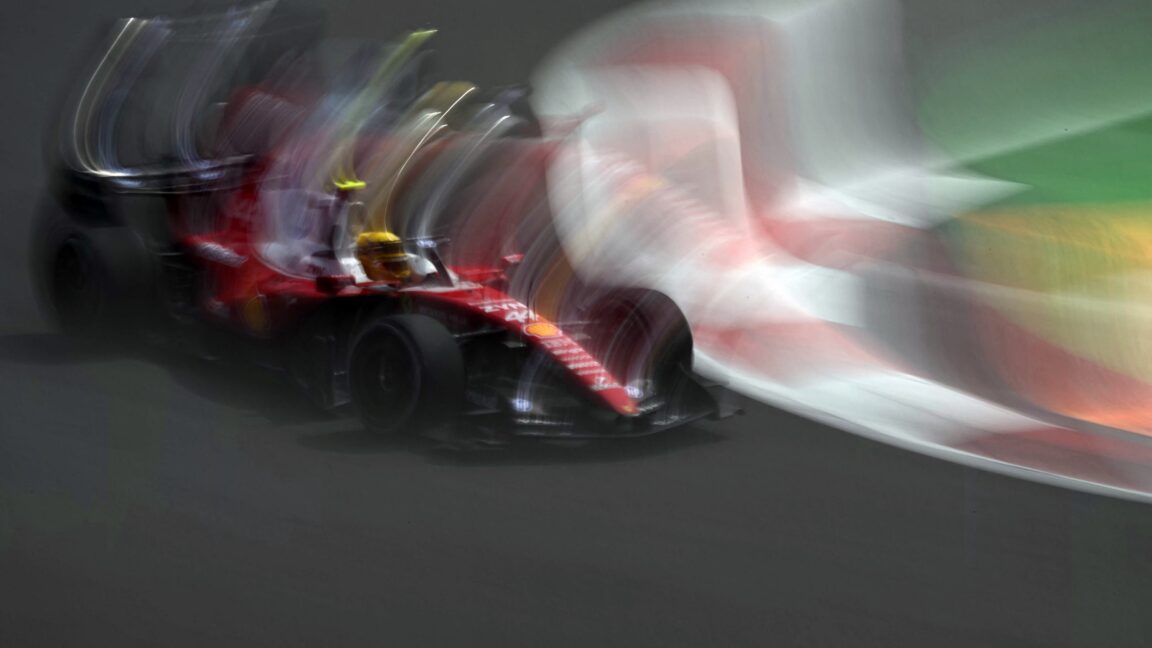
F1 in Mexico City: Yet another Ferrari fiasco, but that’s not all
Formula 1 has a new World Drivers' Champion. Just a few months after turning 20, Kimi Antonelli sealed his first title this weekend at Mexico City, becoming the sport’s youngest-ever champion. Elsewhere, there was drama aplenty, perhaps a consequence of the thin air affecting decision-making in some cases. The race was Ferrari’s to win, but yet again, the team handed victory to a rival this season, in this case Red Bull. Further down the grid, we saw a last-minute driver change in the Haas team, synchronized retirements from both Aston Martins, and the wheels literally coming off Cadillac Racing. And there was I, expecting a dull weekend.
It might not be as high as Pikes Peak, but at an elevation of 7,350 feet (2,240 m) above sea level, the Autódromo Hermanos Rodríguez provides a unique challenge on the F1 calendar. Wings that would create huge amounts of downforce at circuits like Monaco just generate Monza-like levels in Mexico, and there’s little slipstream effect when following another car.
Cooling tends to be a problem, too, with insufficient airflow across radiators, and obviously engine power is reduced with less oxygen to burn. The track is very flat, with a rather low-grip surface and mostly medium- and slow-speed corners, including a processional route through a stadium that was built in the 1990s, plus a very long run from the start into turn 1.

AI Subscriptions Hit a Wall as Smarter Models Burn Quotas Faster
NextFin News — Consumer AI is caught between two clocks. On one clock, models keep posting better scores on code, long documents, and multi-step jobs. On the other, paying users hit rate limits sooner, meet peak-hour wait screens, and compare notes on which brand still “lasts a month.” Vendors answer with quota top-ups, limit resets, and apology posts. OpenAI has doubled some Pro and business caps after complaints.
In China, Moonshot AI’s Kimi product has issued three formal apologies in about six months—the latest after Kimi K3.1 Pro burned through allowances within hours of launch and forced a company-wide 25% quota restoration.
Kimi is not an outlier so much as a loud instance of a pattern. Anyone selling near-frontier intelligence for a fixed monthly price is discovering that “smarter” often means more tokens per finished task. Unit prices can fall while the cost of a real workflow rises.
Heavy users no longer treat chatbots as occasional toys. They wire them into review, drafting, and agent-style loops and notice burn rate the way they once noticed mobile data. Community comparisons are blunt: the same cash that stretches a month on one API or subscription may last a day on another. K3.1 Pro illustrated why. Independent evaluations placed it among the stronger global models, including as a leading open-weight entry, and Moonshot cut list API prices by roughly a third. Benchmarks also showed it emitting far more tokens than median peers to complete the same intelligence suite. Default “thinking” traces, long context, and sub-agent swarms turn a single prompt into many billed or capped steps. A subscriber who asks for an architecture review and watches five agents empty a multi-hour window is not misreading the marketing. They are meeting the true shape of modern inference.
Capacity compounds the insult. Restored quota means little when the service asks paid users to try again later or climb to a higher tier for speed. Labs that depend on rented or partner GPU pools—Moonshot has been linked in reporting to large external Nvidia-class clusters—face a hard allocation choice among training, API customers, and consumer generosity. After prior launches, new Kimi subscriptions were paused when silicon ran short. That is rationing, not a temporary bug.
The industry’s early consumer pitch was simple: pay once a month, use freely enough that the meter stays invisible. Frontier systems broke that fiction. Longer reasoning chains and tool-using agents raise quality and multiply runtime. Some teams now treat token efficiency as part of competitiveness, not only raw leaderboard rank. Others still ship capability first and repair trust with partial refunds of allowance. Memory and personalization features are being redesigned in the same light—coarser summaries instead of exhaustive stored instructions—because every retained detail can become another chargeable read.
None of this is unique to one Chinese lab. It is the subscription version of a problem cloud customers already know: the bill follows tokens, and better models can be greedier models unless engineering intervenes.
Under GPU constraint, companies reveal their real customer. DeepSeek has been described as earning almost entirely from API usage while leaving the consumer app free, with a reported annualized revenue run-rate above $1 billion and price increases that management said did not drive users away. Zhipu’s revenue mix has swung toward API and away from one-off local deployments as coding demand surged. MiniMax is spreading across API, consumer products, and enterprise media and agents. Moonshot, alongside consumer Kimi, has been reported in talks to distribute models through global clouds for a revenue share, and to use license terms that pull large hosting firms into paid deals. Wholesaling intelligence to platforms that already own chips and sales teams is a different business from promising unlimited-feeling chat to individuals.
Internet groups have a further option: fold models into office suites, messaging, and commerce they already monetize, so the model is a feature cost rather than the sole product. Pure-play labs without those surfaces must choose whether the paid consumer app is a profit center, a showcase, or a feedback instrument. Quota crises are what it looks like when the marketing still says “plan” and the P&L says “scarce resource.”
Leaderboards will keep moving. The quieter contest is who can deliver a finished task with fewer tokens, clearer limits, and infrastructure that does not punish the people who pay. Until that catches up, every jump in model strength risks another round of full meters and familiar apologies.
更多精彩内容,关注钛媒体微信号(ID:taimeiti),或者下载钛媒体App

早报|苹果第四财季营收增长12%,服务收入再创新高/《影之刃零》72小时销量突破400万套/曝三星Fold9回归屏下摄像头
 苹果第四财季营收增长 12%,服务收入再创新高
 曝下一代触屏 MacBook Pro 将换新模具
 下一代 GPT 或将近期发布,OpenAI 用 1 万个 AI 智能体协作科研
 OpenAI 推出电网保护计划,拟让未来园区在用电紧张时降载
 机器人登泰山大赛收官,宇树 A2 全自主夺得竞速冠军
 iOS 限制后百度网盘仍可摇一摇跳广告,知情人士称新版待审核
 《纽约时报》等媒体起诉 Brave,指其抓取内容供 AI 使用
 OLED 面板断货,理想 MEGA 部分批次先装 LCD 屏交付
 傅利叶回应与 Meta 合作传闻:暂不方便回复
 名越工作室解散,相关公告登上日本《官报》
阿里云为达喀尔青奥会搭建赛事云,赛后将移交为国家云
香港金管局推出 SAGE 项目,探索 AI Agent 购物与支付
 Anthropic 第三季度营收接近 170 亿美元,净亏损扩大
Omdia:AI 眼镜的差异化要靠可靠体验与服务整合
 第二代海豹 07 将于 11 月 5 日上市,首搭云辇-M 系统
 问界发布 10 月出行报告:辅助驾驶里程占比 46.6%,活跃用户达 92.7 万
 Kimi 发布游戏开发方案,可操作引擎并交付原生工程
 DeepSeek Harness 加入创作者模式,可用对话制作插件
贾跃亭称 FFR 机器人 10 月销售及出货 351 台,累计达 1168 台
 腾讯发布 Hyra 2.0,让科研 Agent 从解题走向造工具
优必选发布 Thinker-Sim,打通场景重建、数据合成与机器人评测
 美团 LongCat-2.5 正式上线,支持视觉编程与长程工程任务
 曝三星 Galaxy Z Fold9 考虑恢复内屏屏下摄像头
国仪量子发布商品化核磁超低温探头与固体核磁波谱仪
 Affinity 免费一体化设计应用登陆 iPad
 星巴克太妃家族 11 月 3 日回归,新增高蛋白拿铁与伯爵奶茶
 李佳琦直播间半小时卖出 2 万亿 Token
 北京公布智能眼镜消费指南,购新补贴最高 500 元
 《影之刃零》72 小时销量突破 400 万套
 10 月电影票房降至 20.46 亿元,创近十年同期新低
《波西·杰克逊》第三季发布正式预告,11 月 20 日开播
苹果第四财季营收增长 12%,服务收入再创新高

[人工智能] kimi 的客服也是外包么?一问三不知。


[推广] 受不了官方 Claude 的价格和封号,自己搭了个聚合中转,分享下
起因就是官方 Claude / ChatGPT 的 API 又贵、又要国外卡、挂 agent 跑一跑额度就见底,还时不时风控。干脆做了个聚合中转自用,现在开放出来。
几个我觉得有用的点:
一个 key 调 80+ 模型,Claude / GPT / Gemini / Grok 和国产的 DeepSeek / Kimi / GLM / Qwen 都在。保留原生协议,代码只换 base_url 和 key ,不用改。
OpenAI 兼容: https://api.kevoryn.com/v1
Anthropic 原生: https://api.kevoryn.com (客户端补 /v1/messages)
Gemini 原生: https://api.kevoryn.com (客户端补 /v1beta)
分组按渠道质量分层,官方直连贵但稳,特价/第三方渠道便宜,按需求选。价格和官方价对照在 kevoryn.com/model-plaza ,文档 kevoryn.com/docs 。
按量计费没月费。支持 Claude Code 、Codex 、Gemini CLI 这些,也接了 CC Switch 一键导入。
主要想听听大家对这类网关还想要什么功能,有问题回帖

算力不再是AI Agent的天花板,生态围墙才是?
(本文作者为 硅碳变量,钛媒体经授权发布)
文|硅碳变量,作者|胡一刀
10月14日,豆包手机助手官方公众号发文称,《屏幕自动化操作声明协议》(SAEP,Screen Automation Execution Protocol)30天公示期已结束,平台将逐步放开第三方应用的屏幕自动化操作权限。
据公示,最新拒绝操作的应用清单涵盖拼多多、Kimi、快手系列应用、美团系列应用、小红书、DeepSeek、中国工商银行等,以及淘宝、千问、支付宝等23款阿里巴巴及关联生态应用,微信、QQ、王者荣耀等65款腾讯及关联生态应用,共计151款。
据此前介绍,SAEP是面向第三方App的AI操作规则,开发者可自主声明是否允许AI助手对自身应用执行屏幕自动化操作,划定操作边界与限制范围。官方强调,公示期结束后,应用开发者仍可随时提交拒绝声明,收到后豆包手机助手将及时关闭相关操作。
超级App的根基,藏在流量闭环之中
手机AI Agent的算力焦虑曾是行业两年多来的核心叙事,而它消散的速度超出了不少人的预期。
短短两年时间,端侧大模型参数规模实现了从数十亿到上百亿的跨越,旗舰芯片NPU算力密度实现大幅提升;内存带宽瓶颈、量化压缩算法、端侧推理框架等底层工程难题,在芯片厂商与手机厂商的联合攻坚下持续取得进展。
如今不少旗舰机型已经能够在本地承载语音交互、意图理解、图像识别这类基础AI能力,多模态模型对手机屏幕的感知也不再局限于识别按钮坐标,开始具备解析页面浅层语义的能力。
技术迭代的脚步仍在加速,但一个此前长期被行业低估的核心矛盾正迅速浮出水面:当AI初步具备看懂屏幕、模拟点击、跨应用拆解执行指令的能力时,决定手机AI Agent边界的早已不再是技术上限,而是应用生态的准入红线。
算力定义了AI Agent的能力天花板,而生态规则划定了它的实际活动边界。
二者的难度完全不在一个维度:算力瓶颈依托资本投入与技术迭代,存在持续改善的空间;但生态秩序的重构,撬动的是移动互联网沉淀十余年的商业利益底盘。
要读懂这批App集体关闭权限背后的动因,需要回到移动互联网运行十余年的核心商业模型:流量闭环。
过去十余年,移动互联网平台的价值链条始终围绕这套闭环体系运转:平台以内容、社交关系、商品供给、本地服务为锚点,将用户时长与注意力沉淀在自有App生态内,再通过信息流广告、搜索竞价、交易佣金、会员订阅等方式完成价值变现。
用户在App内的每一次浏览、点击、比价、下单都是流量价值的载体;广告主为曝光付费,商家为流量付费,用户为服务付费,平台则在每一层价值交换中抽取收益。
这套流量闭环之所以足够稳固,核心不在于技术壁垒,而在于它是一套被反复验证和自洽的商业模型。
搜索广告按点击结算,信息流广告以停留时长等指标衡量价值,电商平台按成交额抽佣,本地生活按到店核销分成——所有变现环节成立的前提,都是用户在App内完成完整交互链路。
平台对用户交互路径的控制权,本质上是其商业定价权的根基。谁掌握了用户的浏览路径、决策过程与交易入口,就拥有整条价值链的分配主导权。
技术可以被追赶,产品功能可以被模仿,但十余年用户习惯沉淀下来的流量分配权,构成了移动互联网的商业底盘。任何试图动摇用户在App内完成全链路动作这一前提的技术,都有可能冲击整条价值链的根基。
SAEP 协议的出现,是手机厂商针对这一商业现实搭建的协商机制。
它不再由手机厂商单方面决定屏幕读取与自动化权限,而是建立了一套事前声明机制:把是否允许AI助手对自身应用执行屏幕自动化操作的决定权交还给开发者。开发者可自主划定权限边界、设置操作限制,即便公示期结束,也能随时提交拒绝声明。
这套机制的设计思路类似PC互联网的robots.txt,由开发者自主划定可访问边界,再探讨合作可能性。但SAEP机制能够落地生效的前提,是开发者愿意配合。
从首批公示的结果来看,头部平台的配合度远低于行业预期。这场集体拒绝的背后,远非单纯针对某一手机厂商:不同赛道的超级App,都立足自身商业底盘,权衡开放权限的成本与风险,各有商业考量,拒绝都有对应的现实理由。
决策入口位移,平台面临前台到后端的角色变局
App顾虑的核心并非不信任AI技术本身,而是开放权限带来的商业损失缺少补偿机制。
社交与游戏平台的核心诉求是守住用户时长与沉浸式交互,而AI代操作降低了用户主动打开、浏览、交互应用的意愿,信息流广告赖以生存的用户时长,存在被分流的风险。对于依靠用户时长与广告变现的社交、游戏体系而言,这可能冲击其商业基本盘。
电商与本地生活平台的重点,在于守护交易链路与流量分配权。若AI代理深度介入,跨平台比价和自动下单有望成为一种潜在趋势,平台精心设计的搜索排序、广告展位、店铺流量分配机制,有可能在AI执行链路中被绕开。
倘若失去对用户决策路径的掌控,平台广告与佣金收入的根基便存在动摇的风险。
大模型厂商的顾虑,本质是同类产品之间的相互设防。AI产品天然存在直接竞争,若允许竞品智能体在自家应用内自动操作,用户行为、对话数据存在被对手间接采集的可能,产品能力边界也有被探测的风险。
在数据是核心资产的大模型赛道,这类开放行为近似于向竞争对手暴露自身底牌。
金融类App的顾虑,源于风控与合规层面的硬性约束。屏幕自动化场景下,交易责任划分、异常交易识别、对应的监管细则,目前仍缺少清晰标准。对金融机构而言,资金安全与合规优先级远高于体验效率提升,在相关规则明确前,关闭权限是风险最低的选择。
不难看出,拒绝开放的根源不在于AI技术本身不可靠,而是平台预判开放后核心利益可能受损,且缺少对应的补偿机制。社交平台担忧时长流失,电商担心交易链路被绕过,大模型厂商忌惮数据泄露,金融机构首要防范安全风险。
GUI自动化AI Agent对现有生态的真正冲击,不在于AI代为点击屏幕,而在于它可能从底层促成用户决策入口的迁移。
GUI自动化所描绘的理想场景是:用户给出一句自然语言指令,AI跨应用完成比价、下单、预约、查询等一整套任务流程。用户无需逐个打开App,也不会浏览首页推荐内容,原生广告或将失去触达机会,平台苦心搭建的搜索流量分配机制,在AI执行链路中可能被弱化。
对平台而言,这意味着角色变迁:从直接承接用户的业务前台,转变为被AI调用的后台服务。前台掌握流量、广告位与定价权,转为后台之后,只能被动响应调用请求,收益如何兑现是不少平台需要直面的难题。
更值得警惕的是,一旦形成这类用户习惯,后续扭转的成本会显著抬升。
平台的选择逻辑由此变得清晰:与其等待AI智能体逐步分流用户决策环节,不如提前划定边界。拒绝GUI自动化并非抵触技术进步,而是守住自身最核心资产——用户交互的主导权。
算力拥有持续优化升级的空间,但超级App历经十余年沉淀的用户习惯、流量分配权与交易链路,不会随技术迭代自动重构。
甚至会形成反向博弈:Agent能力越强、渗透场景越深,平台的戒备心理越强,生态壁垒或将持续加固。
AI Agent下半场:技术竞赛落幕,利益博弈登场
曾经被行业寄予厚望的全能Agent叙事,正在生态现实面前被不断修正。
第一条路线便是GUI屏幕自动化,也就是SAEP协议对应的方案。它的优势很直观,无需 App单独开发接口,落地门槛低,理论上可覆盖大量应用场景。
但其短板同样突出,这套能力高度依赖应用方的配合意愿,平台一纸声明即可切断功能;页面改版就可能造成识别失效,安全审计、权责划分等一系列问题至今没有定论。
这条路线更适配愿意开放权限的长尾应用,很难成为打通头部超级App的通用解法。
第二条路线为原生API协作模式:AI助手依托标准化接口调用平台服务。该方案交互稳定、权限可控、权责清晰,平台可自主选择开放能力范围,自主设计分润规则。
代价则是推进节奏缓慢,需要逐一对接商务、敲定接口规范、协商收益分成。而多数头部平台本身已有AI业务布局,未必愿意向外部AI助手开放核心接口。
行业更有可能走向中间形态:部分持开放态度的应用开放原生接口,AI在安全稳定场景中承接高价值任务;面对拒绝开放的头部超级App,AI仅能识别任务卡点,提示用户手动介入,完成跳转后不再自动执行后续动作。
一句话搞定全部事务的全能Agent叙事,其适用边界或将被生态现实持续压缩。手机厂商此前常以跨应用全链路操作描绘产品愿景,SAEP事件之后,这套叙事需要重新校准:阻碍并非来自技术能力,而是生态层面的约束。
手机AI Agent若要深度介入用户全链路操作,离不开三方核心主体:用户追求使用效率,AI厂商希望拓展能力边界、挖掘商业价值,平台则要守住流量与交易的主导权。三方诉求天然存在张力,现有的协议框架仅搭建起基础规则却没能解决最核心的利益分配难题。
平台开放权限本质是出让部分用户决策主导权,倘若没有对等的分润、流量置换或是价值共享机制,这种权限让渡便缺少商业层面的合理性。
拉长时间维度来看,手机AI Agent下半场的竞争重心或将不再是模型参数、算力这类技术指标,而是能否在既有的流量闭环体系内找到多方可接受的协作方案。
技术可以打造读懂屏幕和执行指令的智能体,但想要让它在真实移动生态里稳定为用户处理事务,本质是一道商业命题:平台打开这扇权限之门,能够收获什么?
算力竞赛仍会持续,但决定手机AI Agent最终发展上限的早已不是算力本身。
移动互联网筑起的从来不是技术围墙,而是商业围墙。只要围墙背后的收益分配问题缺少解决方案,再强大的算力也难以穿透超级App的流量闭环。
更多精彩内容,关注钛媒体微信号(ID:taimeiti),或者下载钛媒体App
PPTV创始人再创业做“算力版滴滴”,日均消耗token超万亿,却难赚到钱?
(本文作者为 创业最前线,钛媒体经授权发布)
文 | 创业最前线,作者 | 于莹,编辑 | 王亚静
当AI大模型开始收费,卖Token的“工厂”逐渐成为市场最“吸金”的AI赛道之一。
在海外,被黄仁勋称为“AI工厂的台积电”的Fireworks AI7月拿到15.05亿美元融资,估值升至175亿美元;在国内,10月12日,上海AI Infra(人工智能基础设施)企业无问芯穹确认已完成23亿元C轮融资,累计融资额达43亿元。
资本追捧之下,做Token“工厂”的企业,开始走向大众视野,硅基流动、派想未来等企业纷纷向港交所递交上市申请。
其中,派想未来的创始人是曾创立了PPTV的“80后”学霸姚欣,他在退出ppvt后,在AI算力爆发前悄悄布局了算力赛道。
派想未来是一家独立分布式云计算服务商,业务始于边缘云计算服务领域,2025年营收已经达到7.7亿元。按灼识咨询口径,公司是中国最大的独立AI云计算服务商。
不过,公司至今尚未盈利,经营现金流也呈现净流出状态。而在可转股的条件压力下,公司上市需求十分迫切。
只是,这门在资本市场陆续拿到“大结果”的Token生意,底色究竟如何呢?
1、打造token工厂,要做“算力版滴滴”
通俗来说,Token工厂就是专门规模化生产推理服务的“车间”,把电力、芯片、模型和数据,持续转化为可计量、可调度、可定价的模型调用能力。
而一般的传统云计算巨头,主要是“中心化大厂”逻辑,在全国建几个超级数据中心,通过长途光纤把算力输送给用户。这种模式,在需要超低时延、海量并发的5G和智能化时代,容易遇到物理瓶颈。
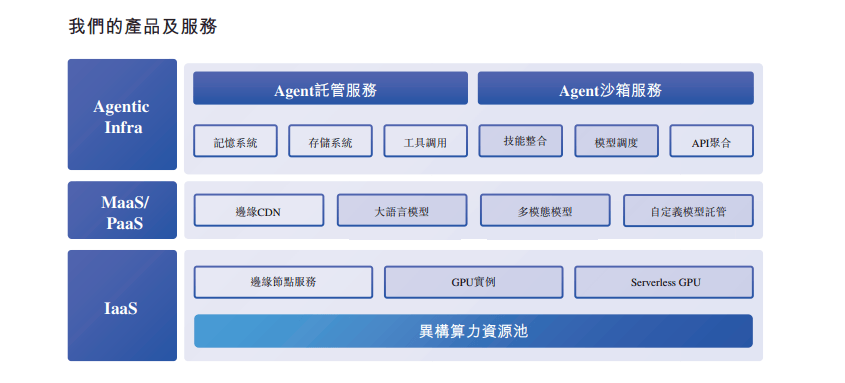
与阿里云、腾讯云等公有云平台不同,派想未来并非自建数据中心,而是通过“蜂群思维”搭建起中国最大的分布式算力网络。
公司发现,社会上存在大量分散、闲置、异构的第三方闲置算力资源,海量的算力需求与分散且尚未充分利用的算力供给之间存在重大错配。
所以,公司搭建了算力调度平台,把它们当成“私家车”,汇聚和管理异构资源的闲置算力,以最优方式向客户部署,从而加速内容传输及提升低延迟计算体验。
在接受采访时,创始人姚欣将公司比作“算力版滴滴”,称公司不采购、不持有大规模GPU服务器与数据中心,不自主搭建自有智算园区,全部算力资源向外采购整合,再通过自研分布式调度系统匹配供需。
(图 / 招股书)

可以说,派想未来的核心资产不是硬件,而是一套极度聪明的分布式云计算架构和统一调度平台。正是通过这种调度能力,公司把全国1340多个县市的4600多个闲置节点盘活,成功构建起了一个边缘算力网络,把算力直接下沉到网络的最边缘。
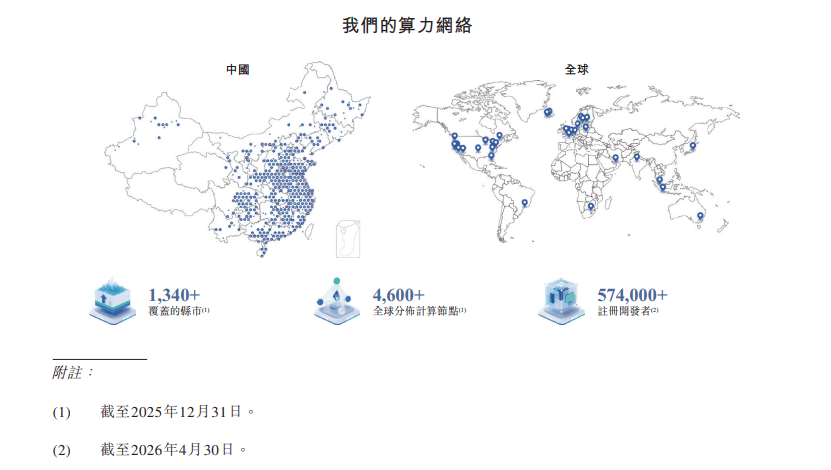
(图 / 招股书)
这种“轻资产、重调度”的模式,在2023年撞上了大模型爆发的超级风口。招股书显示,公司通过分布式调度后,GPU利用率在2025年一直超过75%,远高于行业40%-50%的平均水平,模型推理成本理论上可以下降超过80%。当AI时代来临的时候,这种优势被放大。

(图 / 招股书)
而打造派想未来,并非是姚欣的首次创业。
2004年,正在华中科技大学读研一的姚欣,为了解决同学们在宿舍看球赛直播卡顿的痛点,敏锐地捕捉到了P2P技术“人越多越快”的特性,索性休学创办了PPTV的前身PPLive。
在那个宽带和分发基础设施极度匮乏的互联网黄金年代,PPTV一度坐拥4.5亿全球用户,成了仅次于优酷的全国第二大视频平台,2014年PPTV最终被苏宁集团收购。
2018年,姚欣与当年的老搭档、华科学弟王闻宇再度联手,成立了派欧云计算(上海)有限公司(以下简称派欧云,派想未来在中国的合并联属实体之一),如今一起带领着派想未来冲刺资本市场。
招股书显示,IPO前,姚欣及其配偶吕姗姗,通过数家实体合计控制约48.05%的股份投票权;王闻宇间接持股10.17%,其他投资者包括Millennium、IMO Ventures、CCV Fund、华业天成、磐霖、沸点等。
2、营收2年翻倍,但为何越卖越亏?
目前,派想未来的商业模式采用云计算的收费模式,即按算力使用量或使用时长计费,主要付费客户包括大型互联网企业,以及中小型AI创业企业。
2023年至2025年(以下简称报告期内),公司收入从3.58亿元迅速增长至7.70亿元,复合年增长率达46.6%。
其中,边缘云计算服务收入(包括边缘节点服务、边缘CDN)分别为3.58亿元、5.48亿元、6.51亿元,长期占据总收入84%以上。
而AI云计算服务收入从2023年的26.5万元暴涨至1.19亿元,2025年同比增长超过10倍,占比提升至15.5%,成为招股书重点渲染的第二增长曲线。
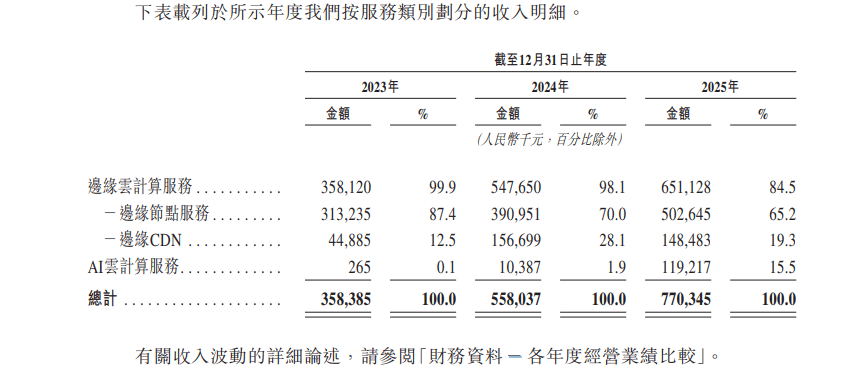
(图 / 招股书)
营收高增,毛利率却明显下滑。报告期内,其综合毛利率从2023年的17.7%滑落到2024年的12.3%,再到2025年的9.4%,近乎腰斩。
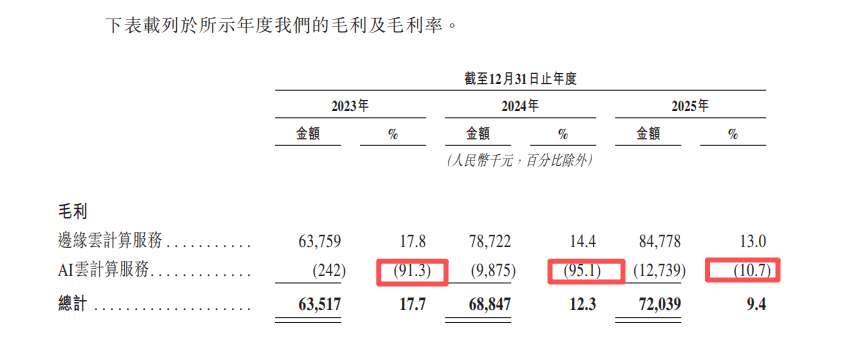
(图 / 招股书)
在这背后,公司一直深陷亏损之中。报告期内,其净亏损分别为1.89亿元、2.94亿元和2.23亿元。如果剔掉可转换可赎回优先股公允价值变动等非现金项,经调整净亏损仍从0.37亿元扩大到1.05亿元,陷入了“卖得越多,亏得越多”的境地。
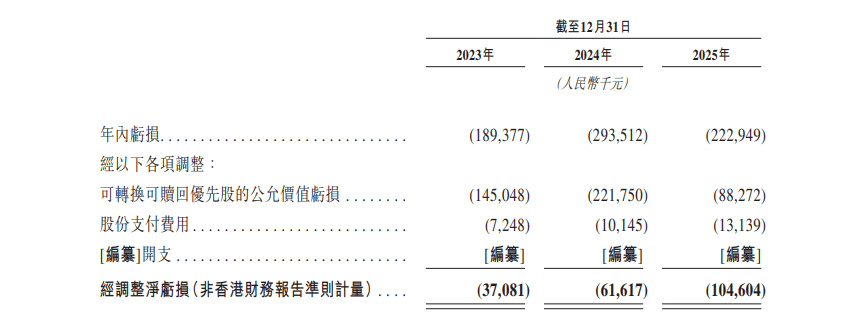
(图 / 招股书)
造成亏损的根源,主要出在公司快速增长的AI云计算业务上。
2025年,其AI云计算毛利率为-10.7%,而2023年、2024年则分别为-91.3%和-95.1%,虽然毛利率亏损收窄,但至今仍是一笔“亏本买卖”,而其收入占比越来越高,拖累了整体毛利率表现。
「创业最前线」了解到,公司边缘云业务,主要是把算力放到离用户最近的地方,专门给视频、直播、文件下载做加速(也就是边缘CDN)。
而AI云业务,则提供的是GPU算力和现成大模型接口(MaaS),客户不用自己买显卡、搭环境就能跑AI推理。但这块收入,主要来源于模型API,其为客户调大模型、按Token收费。
但Token价格并非为派想未来所定,而是模型官方定价。根据爱分析的报道,派欧云的定价页面和DeepSeek、GLM、Kimi等官方API文档定价一致。
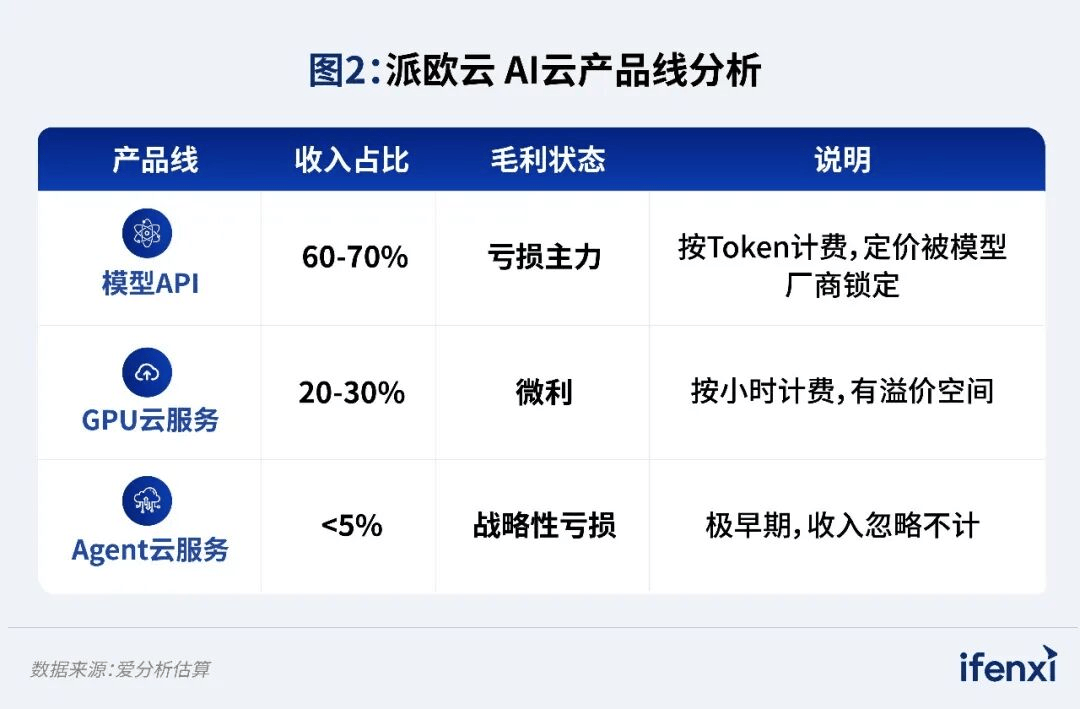
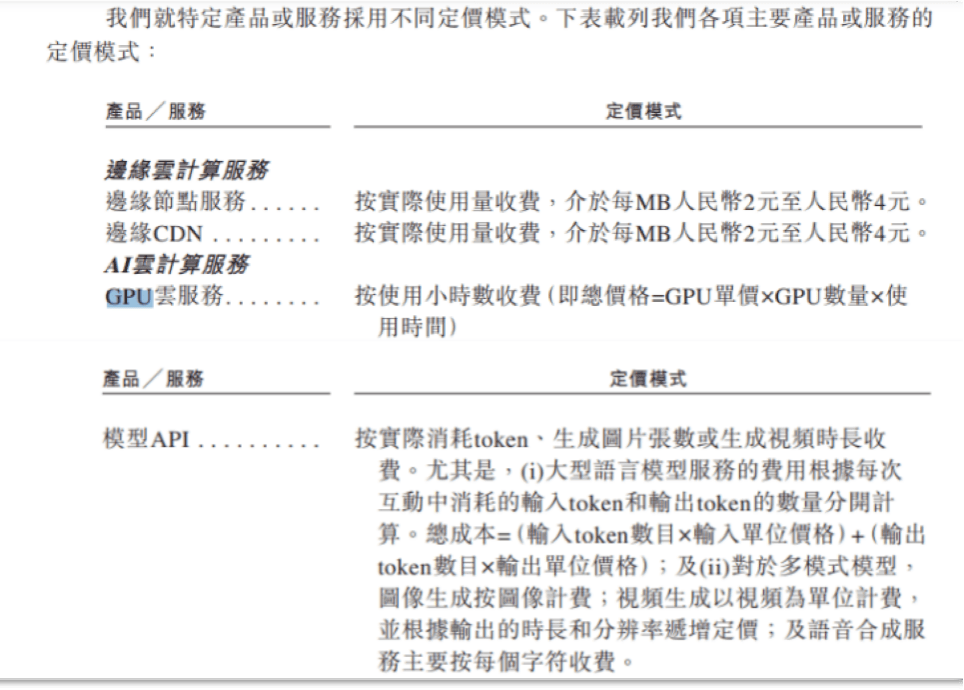
(图 / 爱分析(上)、招股书(下))
原因在于,定价权在模型厂商手里。Token API是同质化商品,用户切换Token供给方的成本、门槛极低。因此,即使大模型厂商的推理算力供给不足,派想未来也难以溢价收费。
而在成本端,派想未来的GPU算力多是租赁而来,2025年GPU资源成本1.17亿元,几乎追平了整体的AI云收入(1.19亿元)。可以说,公司每多提供一个Token,就要多付一笔GPU租金。
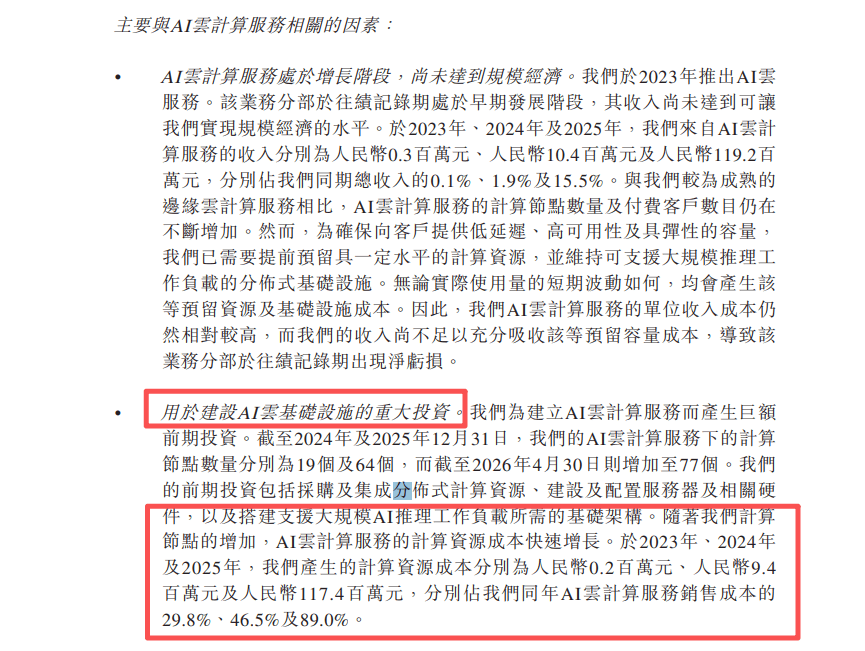
(图 / 招股书)
从这点看,虽然公司把自身比喻成“算力版滴滴”,但滴滴的抽佣定价权在自己手里,而派想未来上游是掌握定价权的模型厂商,下游是可以一键切换的客户,两头都被挤压。
不过,需求端确实是十分紧俏,公司披露的日均Token消耗早已破万亿,说明市场确实存在广泛需求,只是需求旺盛并不等于赚钱能力,公司的利润空间尚未打开。
在招股书中,公司也提示:“随着对公司产品及服务的使用量增加,客户可能要求降低定价,部分客户可能出于商业、合规或其他原因选择使用其他云服务提供商。为此,公司为维持或增加收入,或需要在销售及营销方面投入更多的支出,这些都会对公司的毛利率产生不利影响。”
可见,公司的低毛利率并非一时阵痛,是这套“租卡—转售Token”模式的天然限制。另外,算力中介赛道门槛低、同质化严重,派想未来若想突围并不容易。
3、上市倒计时,仅剩两个月时间
值得注意的是,公司的经营命脉,压在极少数大客户身上。
2023至2025年,公司的前五大客户收入占总营收比重分别达92.5%、89.5%、79.0%,营收高度依赖大客户。
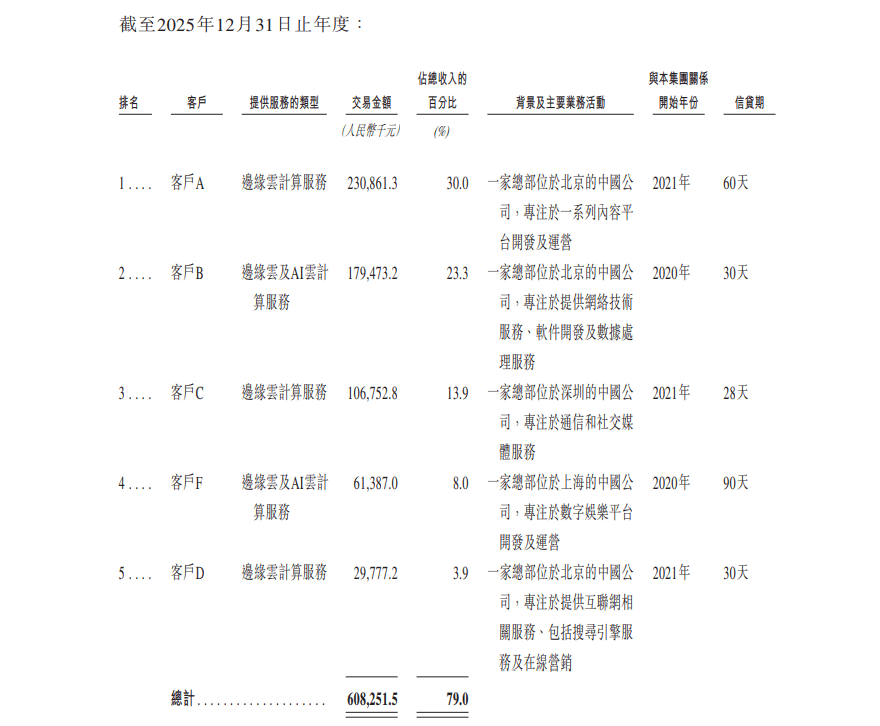
(图 / 招股书)
面对大客户,派想未来的回款周期较长,导致公司经营现金流持续为负。
招股书显示,公司通常向边缘云计算服务客户授予一至三个月的信贷期,2023年至2025年,贸易应收款项分别为0.9亿元、1.5亿元、1.68亿元。
同期,贸易应收账款周转天数分别为83天、79天及75天。报告期内,贸易应收款项中分别有93.6%、88.1%及74.9%为应收五大客户款项。
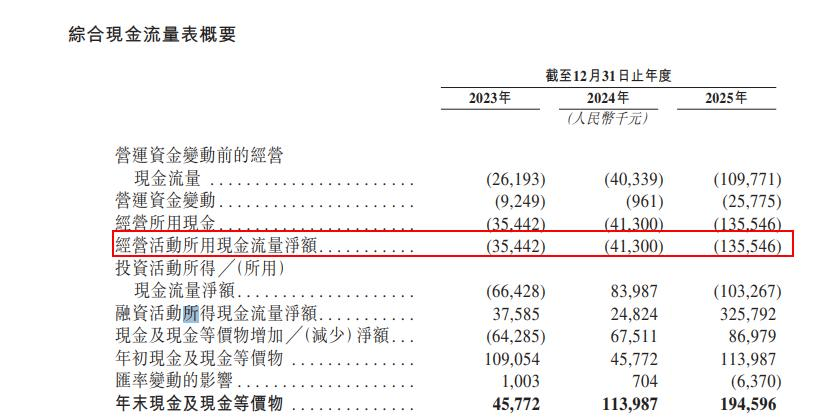
而从客户收取按使用量计算的费用,与向供应商付款之间通常存在时间差,从而导致潜在的经营现金流错配。报告期内,其经营现金流净额分别为-0.35亿元、-0.41亿元、-1.36亿元。
(图 / 招股书)
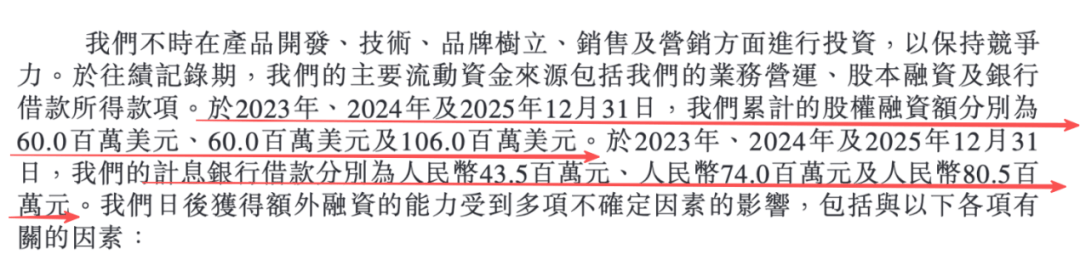
而公司运营颇为依赖融资。2023年至2025年,其累计股权融资额分别为0.6亿美元、0.6亿美元及1.06亿美元,计息银行借款分别为0.44亿元、0.74亿元及0.81亿元,逐年攀升。
(图 / 招股书)
此次港股IPO,公司拟将募资用于,提升公司于分布式云计算服务的技术能力及升级AI云计算服务;海外扩张,特别是在成熟市场及潜力尚未开发的新兴市场;战略投资及收购;营运资金及一般企业用途。
除了营运资金的压力,目前派想未来着急上市的原因,还有来自于悬在头顶的“赎回压力”。
招股书显示,派想未来的背后站着蓝驰创投、创世伙伴、华业天成等投资机构,以及早期重仓的百川智能王小川、前微软Azure中国区总裁申元庆、元气森林唐彬森。
从2021年天使轮后的4600万美元估值,到2025年B轮融资后的4.69亿美元,再到2026年5月底6月初刚完成的B-2轮,派想未来的投后估值已经达到5.76亿美元。
融来的钱虽然撑起了业务扩张,但也可能变成到期要还的债。当初为它背书的投资天团,此刻也正是手握赎回权的人。
2023年至2025年,公司分别录得可转换可