

KAIST Cuts AI Fine-Tuning Time to 3 Hours From 10 - Seoul Economic Daily

Build efficient agents with knowledge distillation on Amazon SageMaker AI - Amazon Web Services (AWS)
What actually broke when I tried to fine-tune on web-scraped data and what fixed it [D]
Fine tuning on self collected web data felt straightforward until it wasn’t. Here’s what actually caused problems:
Boilerplate contamination was the silent killer. Navigation menus, cookie banners, and footer text were leaking into training examples. The model started generating weirdly structured outputs that looked like half-rendered HTML. Solved it with aggressive DOM-targeting rather than raw text extraction and switching to a rotating residential proxy layer (per-request IP rotation means target sites serve you the same rendered DOM a real browser session would get, rather than a bot-filtered skeleton) made a noticeable difference in how clean the raw HTML was before I even touched the parser.
Deduplication order mattered more than I expected. Running exact dedup before fuzzy dedup produced meaningfully different training sets than the reverse. The model’s tendency to regurgitate phrasing shifted noticeably depending on the order.
The thing I still haven’t fully solved: near-duplicate detection across different languages. MinHash works fine monolingually, but multilingual dedup keeps surfacing edge cases I don’t love.
Curious whether others have hit the same issues, especially around multilingual corpora. Also genuinely wondering if anyone has a principled approach to deciding when scraped data quality is “good enough” to stop cleaning and just train.
[link] [comments]
Nace AI Open-Sources Drex Max v1: A 27B Decision Model That Runs Locally on Apple Silicon
Nace AI has released Drex Max v1 as open weights. Drex Max is its most capable decision model, and it now runs on your own hardware. The release ships bf16 weights, a Q8_0 GGUF, an affine Q4 checkpoint and forks of llama.cpp and Ollama. For developers, Drex Max open weights mean routing, classification and policy checks can stay on a local machine.
TL;DR
- Size: Dense 27B parameters, 262,144-token window (16,384 by default), up to 255 options per question.
- Runs on: NVIDIA GPU with Python (H100 bf16, or L40S 48 GB in 8-bit). Apple Silicon Macs with 24 GB+ (affine Q4) or 48 GB (Q8_0 GGUF). CPU via llama.cpp and Ollama.
- Performance: 67.52 on the public Decision Index 0.4, 6.27 points ahead of Drex v2.0 (self-reported).
- Best: 97.3 skill on InfographicVQA. Tools area reaches 81.9. A top-tier decision model you can now run offline on a Mac.
What is Drex Max?
Drex Max is a decision model from Nace.AI that answers typed questions about a given context. You pass a state (text, JSON or images) plus named questions. The model returns a probability for every option in one forward pass. Nothing is generated.
Questions come in 3 types: choice among named options, yes/no, and an ordinal score. That makes it a fit for agent routing, ticket triage and guardrail checks. The hosted version is presented at routing, classification and policy checks.
How does Drex Max work?
The model card describes a dense 27B backbone with 64 layers. 48 are Gated DeltaNet linear-attention layers that run left to right. The other 16 are full-attention layers, placed every fourth layer, and they are non-causal. Every token can attend to the whole sequence.
Images pass through a native vision tower and are visible to every question in a request. A 255-way readout head then turns the last hidden state into option probabilities. The config lists a qwen3_5 model type with a 262,144-position window.
&&&How does Drex Max perform on benchmarks?
All figures below are self-reported by Nace AI,
- Decision Index 0.4 (public text): 67.52. Drex v2.0 scores 61.25 and Jev 1.13.0 scores 57.96.
- Area skill: Tools 81.9, Language 72.2, Retrieval 68.8, Knowledge and Reasoning 57.1, Arts 53.4.
- Public vision index: 73.92 across 11 benchmarks and 12,210 rows.
- Artificial Analysis Decision Index: 64, which Nace says ranks 4th of 18.
- JevBench: 92.2% (213/231). Decision Bench v4: 94.30% (1010/1071).
The results dataset covers 140,620 requests. Unanswered requests count as wrong.
How do you run Drex Max locally?
Nace documents 5 runtimes. All of them serve the same POST /v1/systemone API.
| Runtime | Hardware | Checkpoint | Images |
| Python | NVIDIA GPU | bf16 (~49 GB) or 8-bit (~26 GB) | Yes |
| llama.cpp fork | Apple Metal, CPU | Q8_0 GGUF (27.25 GB) | No |
| Ollama fork | Apple Metal, CPU | Q8_0 GGUF | No |
| Kapitsa v0.2.25+ | Apple Silicon | Q8_0 GGUF or affine Q4 | No |
| MLX | Apple Silicon | affine Q4 (14.45 GB) | No |
The affine Q4 checkpoint targets Macs with 24 GB or more. The Q8_0 GGUF needs 48 GB. On a 48 GB Mac, Nace recommends –context 2048 for Kapitsa.
Ollama users set num_gpu 40 to offload 40 layers to Metal. Setting num_gpu 0 runs it on the CPU. The Ollama fork needs a CAPABILITY decision line in the Modelfile.
Quantization holds up in Nace’s tests. On a 48 GB Apple M5 Pro, the Q8_0 GGUF matched H100 bf16 within 0.02 per probability. The affine Q4 stayed within 0.0329 of Q8_0, with no choice flips.
Drex Max vs other decision models
| Drex Max v1 | Drex v2.0 | Drex v1.5 | Jev 1.13.0 | |
| Parameters | 27B dense | 35B MoE, ~3B active | 9B | Not published |
| Max context | 262,144 | 131,072 | 131,072 | Not disclosed |
| Inputs | Text, JSON, images | Text (vision tower dropped) | Text | Not disclosed |
| Weights | Open, Nace.AI Open RAIL-M | Open, Nace.AI Open RAIL-M | Open, Nace.AI Open RAIL-M | Closed, hosted |
| Smallest local file | Affine Q4, 24 GB+ Mac | Q8_0, 36.9 GB | Q8_0, ~9.5 GB | Not applicable |
| Public Decision Index | 67.52 (v0.4) |
Deep Principle Releases Hydrogen-1.0: A 753B Open-Weight Model for Scientific Discovery
Deep Principle has released Hydrogen-1.0, an open-weight scientific model for chemistry, materials science and life sciences. It is built by post-training Z.ai’s GLM-5.3 on domain data, laboratory records and agent discovery trajectories. For developers, it offers open weights that report a FrontierScience-Research win over GPT-6-Astra. The weights ship under the MIT License.
TL;DR
- Size: 753B parameters (MoE, ~40B active per the GLM-5.3 base), 1M-token context, 128K max output.
- Runs on: 8 GPUs with SGLang (tested); NVFP4 for NVIDIA B200/B300, MXFP4 for AMD MI350X/MI355X.
- Performance: Beats GPT-6-Astra on FrontierScience-Research; roughly matches Kimi-K3 on GPQA-Diamond.
- Best: 38.3% on FrontierScience-Research vs 33.3% for GPT-6-Astra (self-reported).
- Worst: Trails GPT-6-Astra (max thinking) by 3.33 points on NMR structure elucidation.
What is Hydrogen-1.0?
Hydrogen-1.0 is a scientific research assistant model from Deep Principle, a Hangzhou-based AI-for-materials company. The model card describes it as a GLM-5.3 derivative for scientific problem solving. It targets question framing, experiment planning, results analysis and open-ended discovery. Deep Principle team states that proprietary models produced recent AI science results, but their discovery capabilities are not open. Hydrogen-1.0 is its attempt at a reproducible, inspectable alternative.
How was Hydrogen-1.0 trained?
The pipeline combines supervised fine-tuning (SFT) with reinforcement learning (RL). Data comes from 4 sources:
- Domain knowledge: chemistry, materials science and life sciences data.
- Research scenarios: task-specific feedback from Deep Principle scientists.
- Laboratory records: full-cycle electronic lab notebook records captured through Mira.
- Discovery trajectories: sequences of choices and feedback, including failed attempts.
Infrastructure builds on Megatron and SGLang across NVIDIA CUDA and AMD ROCm. The team keeps dynamic sparse attention causal across context-parallel shards. Muon optimizer state is moved between CPU, GPU and disk per backend. RL uses resumable rollouts, and each token keeps its original behavior log-probability for importance correction. A layout adapter converts training checkpoints into BF16 and 128×128 blockwise FP8 inference weights. Full datasets and recipes are not released.
How does Hydrogen-1.0 perform on benchmarks?
On public benchmarks, Deep Principle reports Hydrogen-1.0 outperforms GPT-6-Astra on FrontierScience-Research. The tweet thread from one of the founders’ report 93.0% on GPQA-Diamond. That improves on GLM-5.3 and roughly matches Kimi-K3, per the blog.
Internal research-task evals compare it with GPT-6-Astra at maximum thinking:
- Scientific computing: Hydrogen-1.0 leads by 5.13 percentage points.
- Forward reaction prediction: Hydrogen-1.0 leads by 4.76 percentage points.
- NMR structure elucidation: GPT-6-Astra leads by 3.33 points.
In transition metal complex design, models chased a larger HOMO-LUMO gap over 5 rounds. By round 5, Hydrogen-1.0 reached a mean best-so-far gap of 4.318 eV. GPT-6-Astra reached 3.689 eV and Kimi-K3 reached 3.353 eV. On 117 experiment-planning questions, Hydrogen-1.0 scored above Kimi-K3. GPT-6-Astra and Opus-5.5 were excluded after refusing more than 50% of requests.
&What can it do in a real lab workflow?
The technical post shows 4 demos. Hydrogen-1.0 writes Python to build a polyethylene melt and runs GROMACS. It detects a topology error, repairs it, and analyzes the corrected 40 ns trajectory. It grows an Ireland-Claisen reaction network of 27 structures through 30 plausible reactions. It ranks 7 candidate monoformylation products of 2-bromonaphthalene from a 1H NMR trace. It also writes a JSON protocol for a 12-vial Suzuki coupling study. A virtual lab compilation step catches an aspiration without a fresh tip before execution.
How do you deploy Hydrogen-1.0?
Weights are on Hugging Face and ModelScope. Deep Principle team tested BF16 serving with SGLang on 8 GPUs using tensor parallelism of 8. NVFP4 targets NVIDIA B200 and B300. MXFP4 targets AMD Instinct MI350X and MI355X. The server exposes an OpenAI-compatible API with a reasoning_effort setting.
Hydrogen-1.0 vs GLM-5.3, Kimi K3 and GPT-6-Astra
| Feature | Hydrogen-1.0 | GLM-5.3 | Kimi K3 | GPT-6-Astra |
|---|---|---|---|---|
| Developer | Deep Principle | Z.ai | Moonshot AI | OpenAI |
| Total params | 753B | 753B (HF) | 2.8T | Not disclosed |
| Active params | ~40B (inherited) | 40B (LM Studio) | 16 of 896 experts | Not disclosed |
| Context | 1M | 1M | 1M | 1.05M |
| Weights / license | Open, MIT | Open, GLM-5.3 License | Open | Proprietary |
| Modality | Text | Text | Text + vision | Not disclosed here |
| Science focus | Chemistry, materials, life sciences | Coding, agents | General | General |
| FrontierScience-Research | 38.3% | Not disclosed | Not disclosed | 33.3% (per Deep Principle) |
| GPQA-Diamond | 93.0% | Not disclosed | Not disclosed | 96.0% (OpenAI-reported) |
| API price (in/out per 1M)< |

The Letter Company Releases Letterpress-1: A Coding Agent Built for Growth Engineering
The Letter Company has released the beta of Letterpress-1, a coding agent, harness and IDE for growth engineering. The Letterpress-1 coding agent reads a website and its market, then decides what should exist. It builds the change in a sandbox and opens a pull request with a live preview.
TL;DR
- Size: Letter team says it combines frontier models with fine-tuned small models; names and sizes are not disclosed.
- Runs on: Letter’s hosted platform against your git repository. No local GPU needed. Setup takes under 5 minutes, per Letter.
- Performance: No public benchmark. Letter shows 1 self-reported, side-by-side page build against Codex.
- Best: 760 tools exposed through 1 registry over MCP, REST and CLI.
- Worst: No measurable eval; entry plan is $100/month with overage at 5x the list rate.
What is Letterpress-1?
Letterpress-1 is a growth engineering agent from The Letter Company. It turns site and market signals into pull requests. The letter company team argues that websites, unlike apps, react to outside forces. These include agent behavior, Google rankings, human visits and competitor activity. General coding agents were built to scale codebases, not to act on those signals.
The agent is aimed at teams that host their marketing site in git. It is proactive: it suggests the next thing to build. Examples include de-anonymization, landing pages, warmed emails, blog automation and agent telemetry.
How does Letterpress-1 work?
Letterpress-1 runs in 3 modes:
- Build: create a page or feature from a prompt, with brand copy and visuals kept consistent.
- Plan: pick a goal and get a build plan of growth actions.
- Fix: find site issues and dispatch pull requests to fix them.
Every change follows the same loop. The agent reads the site, plans and builds in a sandbox. It reviews its own change, then opens a pull request. Each change returns a preview link of your own site. Nothing lands until you choose a preview, a pull request, or a merge after checks pass.
Letter team lists 6 surfaces. These are the web platform, a Slack app, the letterpress CLI and a website portal. A standalone app and your own agent round out the list. The in-site IDE works on a live page. Press ⌘L, edit text where you see it, and a pull request follows. Showcase examples also cover A/B tests from live edits.
For developers, agents.md documents an MCP server at app.letterstory.com/api/mcp with OAuth. The MCP manifest, OpenAPI spec and API reference form 1 registry of 760 tools. Claude Code, Codex or any MCP-capable agent can call the same functions the app uses.
What are Proofs, Simulations, Benches and Phantoms?
The launch post highlights 4 primitives aimed at winning over AI agents as buyers:
- Proofs: signed evidence of customer success, built from telemetry and billing data, for agent visitors.
- Simulations: mirror versions of your API or MCP with simulated data, so agents can try before buying.
- Benches: self-hosted, reproducible benchmark apps with open-source code and independent governance.
- Phantoms: independent, autonomous blogs used to sandbox growth strategies.
The site adds more: Kernels, Letterbases, Visitors and Mailers. Then it watches competitor sitemaps and flag new pages. Letter team positions these as replacements for tools like G2, Semrush, Profound, RB2B and Instantly.

Zyphra AI Introduces Zyphra Hierarchical Attention (ZHA): A Path to True Subquadratic Attention
Zyphra has released Zyphra Hierarchical Attention (ZHA), a sparse attention method built around a tree-structured indexer. ZHA targets a known gap in sparse attention: the indexer that picks tokens still scans the whole context. Zyphra’s technical paper shows ZHA can be distilled into frozen pretrained models with about 4B tokens. On Qwen3.6-35B-A3B it stays close to dense attention on reasoning, agentic coding and 256K retrieval benchmarks.
TL;DR
- Size: It is a method that adds 81,920 trainable parameters to Qwen3.6-35B-A3B (about 0.00024%). Tested up to 256K context.
- Runs on: Retrofits frozen pretrained models after a 4B-token KL warmup at 32K context. Speedups come from a modeled H100 BF16 roofline. No optimized kernels released. An FP4 router variant was also tested.
- Performance: Within a few points of dense attention on 7 reasoning, coding and retrieval benchmarks.
- Best: LongBench v2 hits 63.4% (deep tree) vs 58.0% dense, using about 1.1% of keys.
- Worst: On NoPE-based Nemotron-3.5-Lightning-30B-A3B, deep-tree RULER-13 drops 25.3 points below dense.
What is Zyphra Hierarchical Attention (ZHA)?
ZHA is a sparse attention method from Zyphra that finds relevant keys by searching a tree. It keeps the full KV cache. The tree only decides which cached keys each query reads.
Fixed-state methods like SSMs and sliding windows saturate at long contexts. Fine-grained sparse methods like DeepSeek Sparse Attention score every past token with an indexer. The final attention is sparse, but the indexer still grows with the full context.
Near 1M tokens, cited work shows indexing takes 60 to 90% of layer time. ZHA makes the search itself sparse.
How does ZHA’s tree indexer work?
Building the tree
ZHA splits keys into contiguous chunks and compresses each chunk into a summary key. Summaries are grouped and compressed again, level by level. With chunk size 4, 6 levels cover 4,096 tokens per top node.
Summaries come from a small set of learned reference queries. Each reference query gives a tangent-plane estimate of a chunk’s log attention mass. The max over these planes approximates how much attention any future query would give the chunk.
How does top-p routing pick tokens?
At decode time, a query scores the top-level nodes. It keeps the smallest set holding a fraction p of estimated attention mass. It then expands only those children, repeating until it reaches raw KV entries.
Top-p makes the budget adaptive. A single-fact lookup touches few branches. A query that needs many scattered facts expands more. The first token is always kept as an attention sink.
How does ZHA perform against dense attention and MSA?
Zyphra team converted Qwen3.6-35B-A3B with 2 trees: deep (chunk 4, 6 levels) and wide (chunk 256, 1 level). Both use 16 reference queries and p = 0.95. It also trained a MiniMax Sparse Attention (MSA) indexer on 40B tokens, 10x ZHA’s budget.
| Benchmark (Qwen3.6-35B-A3B) | Dense | ZHA deep | ZHA wide | MSA |
|---|---|---|---|---|
| AIME 2026 | 93.1 | 91.2 | 90.8 | 91.7 |
| SWE-bench Verified | 67.4 | 67.4 | 68.4 | 63.6 |
| Terminal-Bench 2.1 | 49.9 | 46.7 | 53.3 | 46.1 |
| MMLU-Pro | 84.9 | 85.3 | 85.2 | 85.3 |
| GPQA Diamond | 84.8 | 85.0 | 85.0 | 83.1 |
| RULER-13 (256K) | 96.0 | 93.3 | 96.2 | 77.1 |
| LongBench v2 (thinking) | 58.0 | 63.4 | 62.4 | 49.3 |
Source: arXiv 2610.42112, Figure 5. All numbers self-reported by Zyphra.
The biggest gap is on retrieval. MSA drops to 77.1% on RULER-13, while both ZHA trees stay above 93%. On LongBench v2, the deep tree and MSA read similar key shares (1.1% vs 1%). The deep tree scores 14.1 points higher.
Across 28 tree geometries, RULER accuracy held steady when attending to 10 to 30% of keys. At fixed compression, deeper trees kept accuracy at higher sparsity. A 4-parameter model predicts RULER accuracy from geometry with 1.44-point RMSE.

Can You Run Your Own AI Locally on a Gaming GPU?
Run powerful AI locally with MSI RTX 50-Series GPUs
Explore the range and find the right GPU for your needs
AI might be everywhere and in everything right now, but for most people, they interact with it in only one place: The cloud. That’s still the best place to access frontier models with flagship capabilities. But where the latest ChatGPT and Claude models might be the best solutions for agentic AI or vibe coding entire applications, they also represent major privacy and security concerns. Token limits and ever-changing subscription fees can make them unreliable solutions to regular problems, too.
Running AI locally on your own hardware represents a significant improvement in AI privacy, as it keeps all your data on your own devices; Out of reach of the major AI developers who may, depending on plan and settings, use even proprietary and sensitive data for model training without the right safeguards. But where older AI models needed bespoke hardware to run and thousands of dollars of investment in dedicated AI systems, the latest open source models run fantastically well on graphics cards primarily designed for gaming.
How do MSI RTX 50-Series GPUs Make Local AI Possible?
The latest RTX graphics cards from MSI are fantastic at running modern games with support for hardware accelerated path tracing, and the latest DLSS upscaling and frame generation technologies. But all that graphical horsepower also makes them capable of running powerful local language models that can enable impressive AI intelligence that can be incredibly useful for everyday work and creative endeavours.
With 12GB or more of VRAM from the mid-range of the RTX-50 series, these cards have the onboard memory they need to store mid-size large language models right out of the box. Higher-end cards with 16GB of VRAM add headroom for running more capable models, while the top-tier RTX 5090 with 32GB of GDDR7 opens up new models and greater fine-tuning capabilities.
Local AI runs fast and responsively thanks to 5th generation tensor cores, providing powerful hardware acceleration for even demanding AI workloads. PyTorch and TensorFlow frameworks are optimized for Nvidia CUDA cores, too, making it much easier to get up and running with local AI on your own machine.
All these cards are supported by MSI’s smart power and thermal management systems that help them operate coolly and quietly, ensuring you stay focused on the task at hand; Whether that’s fragging enemies or prompting your very own local intelligence chatbot.
Which MSI RTX 50 Series GPU is Best For Local AI?
MSI RTX 50-series graphics cards are all excellent for gaming, but for powerful large language models, the RTX 5070 offers a fantastic entry-point with its 12GB of VRAM. Priced from $810, this card can run double duty for 1440p and light 4K gaming with upscaling and frame generation, and unlock local AI capabilities as well.
For running more demanding models and higher gaming frame rates, the MSI GeForce RTX 5070 Ti 16G Shadow 3X OC starts at $1,170 and comes with 16GB of VRAM. Its faster sibling, the MSI GeForce RTX 5080 (starting at $1,650) 16G Ventus 3X OC White, offers a truly premium gaming experience for native 4K and ultra settings with path tracing – perfect for scoring big on major benchmarks. Those extra CUDA cores help make it a more responsive card for running local AI models, too.
For those looking to really explore local AI development or who want to run some of the most capable local models without compromise, MSI’s GeForce RTX 5090 32GB Suprim SOC model starts at $5,200, delivering the ultimate in gaming and local AI capabilities.
For more information on MSI’s exciting range of RTX 50-Series graphics cards, you can find them all on the MSI store or at Amazon. Need more information to pick the right card for you and your needs? MSI’s detailed RTX 50-Series buying guide can help.
| Card | VRAM | Gaming Performance | Local AI Capabilities |
|---|---|---|---|
| RTX 5070 | 12GB GDDR7 | 1440p gaming at high detail settings | Mid-size quantized LLMs, image generation |
| RTX 5070 Ti | 16GB GDDR7 | 1440p and 4K gaming at ultra settings, with ray tracing | Larger models, more headroom |
| RTX 5080 | 16GB GDDR7 | Native 4K, path traced lighting, ultra settings | Faster responses at the same VRAM |
| RTX 5090 | 32GB GDDR7 | Maximum settings, full path tracing, high frame rate | Support for the largest local models, model fine-tuning |
FAQ
Is the MSI GeForce RTX 5070 12GB enough to run local AI?
Yes. The MSI RTX 5070 is the entry point for local AI, covering everyday chat, summarizing, coding help and image generation with mid-size models, while still handling 1440p gaming.
Which MSI RTX 50-series graphics card is best for running AI locally?
For most people, an MSI RTX 5070 Ti 16G (such as the GAMING TRIO OC or VENTUS 3X) balances price and VRAM. Developers who want to run the largest models without compromise should choose the MSI RTX 5090 32G SUPRIM SOC.
What’s the difference between the MSI RTX 5070 Ti and MSI RTX 5080 for local AI?
Both MSI cards have 16GB of GDDR7 memory, so they support the same siz

Google’s AI can turn almost anything you read into a podcast
Part of my job here at PCWorld is taking complex topics and breaking them down into easy-to-understand, approachable content. But even for me, sometimes I need someone to explain it all in simpler terms instead. Google has two really cool AI tools for this exact purpose.
Google’s Gemini Notebook (formerly NotebookLM) can turn long articles, reports, and research papers into podcast-style conversations between two AI hosts. They’ll go over the main points, explain tricky concepts, and make even the driest material a little easier to digest.
To use it you just create a new notebook, upload the text document you want it to convert, or drop a website link. Then head to the Studio panel on the righthand side and select Audio Overview. It allows you to customize the discussion’s length, and even tell the AI hosts which topics you’d like them to focus on.
It takes a few minutes to convert, but then you’ll have a surprisingly realistic discussion of the text you imported. One of my favorite features is the ability to join in on the conversation. I often join in and ask clarifying questions or add opinions to guide the discussion however I’d like.
Google also developed Illuminate, a similar experimental tool designed specifically for academic research. It’s basically the same idea, but it specializes in distilling complicated research papers. Since it’s still in an experimental stage, though, Illuminate may not always be available to the public.
Personally, I’m a podcast lover and I think the format is brilliant. Being able to catch up on longer articles or topics while on the go is a godsend, especially because I don’t always have time to sit down and read everything.
Just keep in mind that AI summaries aren’t perfect. They can miss important details or get things wrong, so they’re no substitute for reading the original material when accuracy matters. For important content, I always go back and read the original text when I have time. Still, if you want to get a handle on a complicated topic without spending an hour staring at a screen, they’re well worth trying.
For more fun and helpful tips, tricks, website and app recommendations, be sure to subscribe to our PCWorld Try This newsletter.

Making Local LLMs Usable on 8GB GPUs
A local model can manage a brief question without any issues, but it may have difficulty when dealing with a complete document. The model's internal settings stay the same, but the effort needed and the memory required to process the request increase a lot.
In Part 1, I explained how to run a quantized model on a smaller GPU.
The next step is to choose a task, measure how long it takes, and find a setup that works within the GPU's limits.
This guide uses Qwen2.5-7B-Instruct along with llama.cpp.
It includes memory calculations, a fixed starting configuration, and a Python-based benchmark that you can run on your own computer. The numerical memory estimates are calculated values, and this article does not claim to have measured improvements in GPU performance.
To understand the actual delay you experience, there are two main waiting periods in a conversation. The first occurs when the model processes the initial prompt, often called the prefill phase. The second happens when the model generates the answer one word at a time, known as the decode phase.
If a document takes several seconds to process, fast decoding won't eliminate that initial delay. However, if the first words appear quickly but the rest of the response is slow, then the decoding phase is the area that needs optimization.
Keep these measurements separate:
Measurement | What it tells you |
Time to first text | Delay before the client receives the first nonempty text chunk |
Decode tokens per second | The server's reported generation rate |
Total request time | How long that request takes to finish |
Output token count | Whether two runs produced comparable amounts of text |
A target such as "start a short answer within two seconds" can guide your own experiments. It is a product requirement you choose, not a promised result for every 8GB card.
Budget for the KV cache as well as the weights
The model file is only part of the memory requirement. During generation, the runtime also stores attention keys and values for tokens already processed. This KV cache avoids recomputing those states, but it needs memory of its own. Working buffers and other GPU applications need space too. [1]
For a conventional full-attention transformer, an approximate KV-cache payload is:
KV bytes = 2 x layers x stored tokens x KV heads x head dimension
x bytes per cache element
The initial 2 accounts for keys and values. Use the number of KV heads, which can differ from the number of query heads.
Qwen2.5-7B-Instruct has 28 layers, 4 KV heads, and a head dimension of 128, obtained from its hidden size of 3,584 divided by 28 query heads. With FP16 cache elements, the calculation becomes 2 x 28 x tokens x 4 x 128 x 2. [2]
Stored tokens | Calculated FP16 KV payload |
4,096 | 224 MiB |
8,192 | 448 MiB |
16,384 | 896 MiB |
32,768 | 1,792 MiB or 1.75 GiB |
These figures describe one sequence and exclude allocation padding, runtime buffers, and model weights. They are not measurements of total VRAM usage. Other architectures, cache layouts, and attention types need different calculations.
This is why a large advertised context window needs its own memory budget. On this model, moving from 4K to 32K tokens adds about 1.53 GiB of calculated FP16 cache payload. Whether that increase fits depends on everything else already occupying the GPU.
Weight quantization and cache quantization are separate choices. A Q4_K_M model can still use an FP16 KV cache. Reducing cache precision may free up space, but it needs a quality check and a latency measurement. Hugging Face's cache documentation also cautions that cache quantization can hurt latency in some short-context situations. [1]
Establish one repeatable baseline
The shell commands below target Linux or WSL2 with an NVIDIA GPU. Install a working NVIDIA driver, a compatible CUDA Toolkit, Git, CMake, and a C++ compiler first. The benchmark itself requires Python 3.10 or newer and no third-party Python packages.
Use the current CMake build route in the llama.cpp build documentation: [3]
git clone https://github.com/ggml-org/llama.cpp
cd llama.cpp
cmake -B build -DGGML_CUDA=ON -DCMAKE_BUILD_TYPE=Release
cmake --build build --config Release -j 4
git rev-parse HEAD > llama-commit.txt
./build/bin/llama-server --version > llama-version.txt
./build/bin/llama-server --help > llama-help.txt
nvidia-smi > gpu-environment.txt
Keep that checkout unchanged throughout the experiment. Save the model filenames and their SHA-256 hashes too, including every shard if the download is split. A model tag alone is not enough to reproduce an experiment after its files change.
I use the official Qwen GGUF repository because its model configuration is available to inspect. It is a concrete baseline, not a claim that this is the best available model. [4]
Start the server from the llama.cpp directory:
./build/bin/llama-server \
  -hf Qwen/Qwen2.5-7B-Instruct-GGUF:Q4_K_M \
  --n-gpu-layers all \
  --ctx-size 4096 --parallel 1 \
  --batch-size 512 --ubatch-size 128 \
  --flash-attn off \
  --cache-type-k f16 --cache-type-v f16 \
  --fit off --no-context-shift --perf \
  --host 127.0.0.1 --port 8080 \
  2> baseline-server.log
The first launch downloads the selected model. Exclude that download and startup from request timings. Once the server is ready, inspect its log for the CUDA device, layer placement, cache allocation, and effective context settings. If an installed version rejects an option, consult its saved help output before continuing. The current server options are documented upstream. [5]
This configuration requests full GPU offload; it does not guarantee that every 8GB system has enough free memory. If startup fails, first close another GPU workload or test a smaller context. If partial offload is necessary, record the actual GPU layer count and use it consistently across the comparison.
The baseline has one request slot. Keep other inference clients stopped while measuring. With automatic fitting disabled, a failed configuration is visible instead of becoming a different experiment through an adjusted setting.
Run a benchmark that preserves the evidence</

72 Blog Posts To Learn About Minio
Let's learn about Minio via these 72 free blog posts. They are ordered by HackerNoon reader engagement data. Visit the Learn Repo or LearnRepo.com to find the most read blog posts about any technology.
MinIO is an open-source object storage server compatible with Amazon S3 APIs, designed for storing unstructured data like photos, videos, backups, and log files. It offers a high-performance, scalable solution for cloud-native applications and private cloud deployments.
1. Open-Source: The Next Step in AI Revolution
Explore the open-source revolution in AI development, distinguishing between genuine innovation and 'open-washing' attempts by Big Tech.
2. Supercharge TileDB Engine with MinIO
 MinIO makes a powerful primary TileDB backend because both are built for performance and scale.
3. Smooth Sailing: Transitioning from Docker to Localhost
 Understanding Docker networking is more than a technical necessity; it's a step toward mastering containerized environments.
4. LanceDB: Your Trusted Steed in the Duel Against Data Complexity
 There are many ways to build on the foundation offered in this tutorial to create performant, scalable and future-proofed ML/AI architectures.
5. Hungry GPUs Need Fast Object Storage
 MinIO is capable of the performance needed to feed your hungry GPUs; a recent benchmark achieved 325 GiB/s on GETs and 165 GiB/s on PUTs.
6. Data Migration from Dell ECS to MinIO
 Dell ECS clusters allow you to migrate your data to any S3 compatible store. Dell ECS calls this feature “Data Movement”, also called copy-to-cloud.
7. An Architect’s Guide to Building Reference Architecture for an AI/ML Datalake
 Organizations should not build an infrastructure dedicated to AI and AI only while leaving other workloads to fend for themselves.
8. An Architect’s Guide to the Top 10 Tools Needed to Build the Modern Data Lake
 Here is a list of vendors and tools needed to build the modern data lake, with each entry a capability needed to support generative AI.
9. Never the One to Die: Persistent Data with a CDC MinIO Sink for CockroachDB
 When you absolutely need to have a perfect replica of your data for data exploration, CockroachDB and MinIO is your winning strategy.
10. All You Need to Know to Repatriate from AWS S3 to MinIO
 Let's dig a little deeper into the costs and savings associated with repatriation to make it easier for you to put together your own analysis.
11. Analyzing the Pros, Cons, and Risks of LLMs
 LLMs cannot think, understand or reason. This is the fundamental limitation of LLMs.
12. Managing Large Data Volumes With MinIO, Langchain and OpenAI
 A practical guide to integrating MinIO, Langchain and OpenAI’s GPT-3.5 model focusing on summarizing documents stored in MinIO buckets.
13. How To Deploy Grafana Loki and Save Data to MinIO Using Docker Containers or Direct from Source
 Although commonplace, logs hold critical information about system operations and are a valuable source of debugging and troubleshooting information.
14. Backing Up Weaviate with MinIO S3 Buckets to Achieve Strategic Enhancement to Data Management
 Combining the advanced vector database capabilities of Weaviate with the storage solutions of MinIO empowers users to unlock the full potential of their data.
15. How to Use MinIO as External Tables to Extend Snowflake
 MinIO is a high-performance, cloud native object store. Because of this, MinIO can beco
Media Titan Omri Hurwitz: Humans, Not Bots, Run the News
When Omri Hurwitz first appeared on The Spiro Circle as one of its earliest guests, he made a remark about AI and the news that James Spiro later used as a headline. Returning for episode 107, the CEO of Omri Hurwitz Media was asked what had changed. His answer was steady: “AI still does not write the news.” Most media outlets, he said, maintain a strong editorial policy in which AI may help draft a post, develop ideas, fine-tune the writing, or suggest headlines, while a good, strong human editor makes the final call on what gets published.
What happened to AI-run outlets
Hurwitz described several recent experiments in which AI agents were set up to run an entire media outlet, acting as writer, editor, and decision-maker on what to cover. He chose not to name the projects, but he said none lasted more than three or four months. The outlets did not gather enough readers, he said, their distribution was limited, and their story selection did not match what people wanted to read. Whatever the technical thesis behind each experiment, the audience verdict was the one that counted.
His conclusion was about the reader rather than the technology. “People want to consume content from real people,” Hurwitz said. Spiro agreed with the principle and added a refinement from his own routine: audiences want content from real people, but AI can serve as the aggregator that surfaces it. Hurwitz did not dispute the refinement, and the exchange set up the show’s broader discussion of how AI and human editors can each do what they do best.
AI as a personal aggregator
Spiro described the setup he uses. An automation running on his language models sends a tailored briefing to his phone every afternoon, working in effect as a personal newsletter that opens with “Here are some of the top stories that you may have missed.” Each item comes with an explanation of why it matters for his sector, for the country where he lives, and for the stories he is writing. The stories themselves, he said, are hopefully written by humans, and “AI has kind of personalized it for me.”
That use case captures the balance both men described. The reporting and the editorial judgment stay with people, and AI helps readers find what is relevant to them in a crowded news flow. Hurwitz’s own firm applies a similar sensibility to distribution. Omri Hurwitz Media runs a PR practice for more than 60 companies, about 16 of them unicorns, among them Upwind Security, and a media acquisition practice with more than $16 million in direct equity in U.S. outlets. Part of what the firm brings to those outlets is stronger social distribution, including paid ads and Twitter arbitrage.
Information has always been shaped
Hurwitz was optimistic when the discussion moved to how AI systems source information. He noted that the shaping of information is not new. Before language models, he said, the organizations that invested most in search optimization could influence what people saw on Google, and before the internet, gatekeepers such as major newspapers set the terms. “It has always been like that,” Hurwitz said, and he thinks today’s audiences have more choice than any before them. He called it a great time to decide what information to take in, and he was confident that “AI will not interfere with that.”
Spiro noted that the field is still young. He recalled a reflection that people operate in a kind of fog and only see the road they took when they look back, and he suggested that people may someday ask why every platform did not adopt community notes sooner. He welcomed experiments such as the one by Steven Bartlett, whose podcast embeds community notes in the show before it airs and surfaces them as pop-ups on YouTube. For Spiro, accountability delivered in real time and from the grassroots is a promising direction.
AI companies move into media
The conversation also touched on AI companies becoming media owners. For OpenAI, the entry point was TBPN, the daily tech show it acquired in April and which now reports into its chief global affairs officer. In Europe, ETN, a daily show in the same style, gathered a $1.6 million seed round and expanded to five days a week, with Axel Springer, OpenAI, and DeepMind among its investors. On the platform side, Spotify’s reported $200 million licensing deal for The Joe Rogan Experience was renewed in 2024 and 2026, estimated at $250 million each time. Hurwitz disclosed that his company is trying to buy equity in ETN.
Hurwitz suggested separating two questions. One is media acquisition, which he sees as part of a long history of owners and audiences finding each other. The other is how language models weigh and balance their sources, which he called a matter for their engineers. His overall explanation for the investment wave was short: “it’s eyeballs, brand capital, institutional capital.” His example was Alex Cooper’s podcast: once it is bigger than a CNN segment, brands follow, and institutions after them.
What this means for builders of audiences
For writers and hosts, the lesson Hurwitz drew is that the personal voice remains the asset, with AI as a helper. He said creators can earn from brands, from institutions, and directly from subscribers, and Spiro added that a niche audience of the right people can be enough. Spiro is growing The Spiro Circle for techies interested in Israel, cyber, and geopolitics, and he said its value will rest on disclosure, independence, and a willingness to correct mistakes. In an age of automated writing, the people behind a publication are what readers come back for.
This article was published under HackerNoon's Business Blogging program.
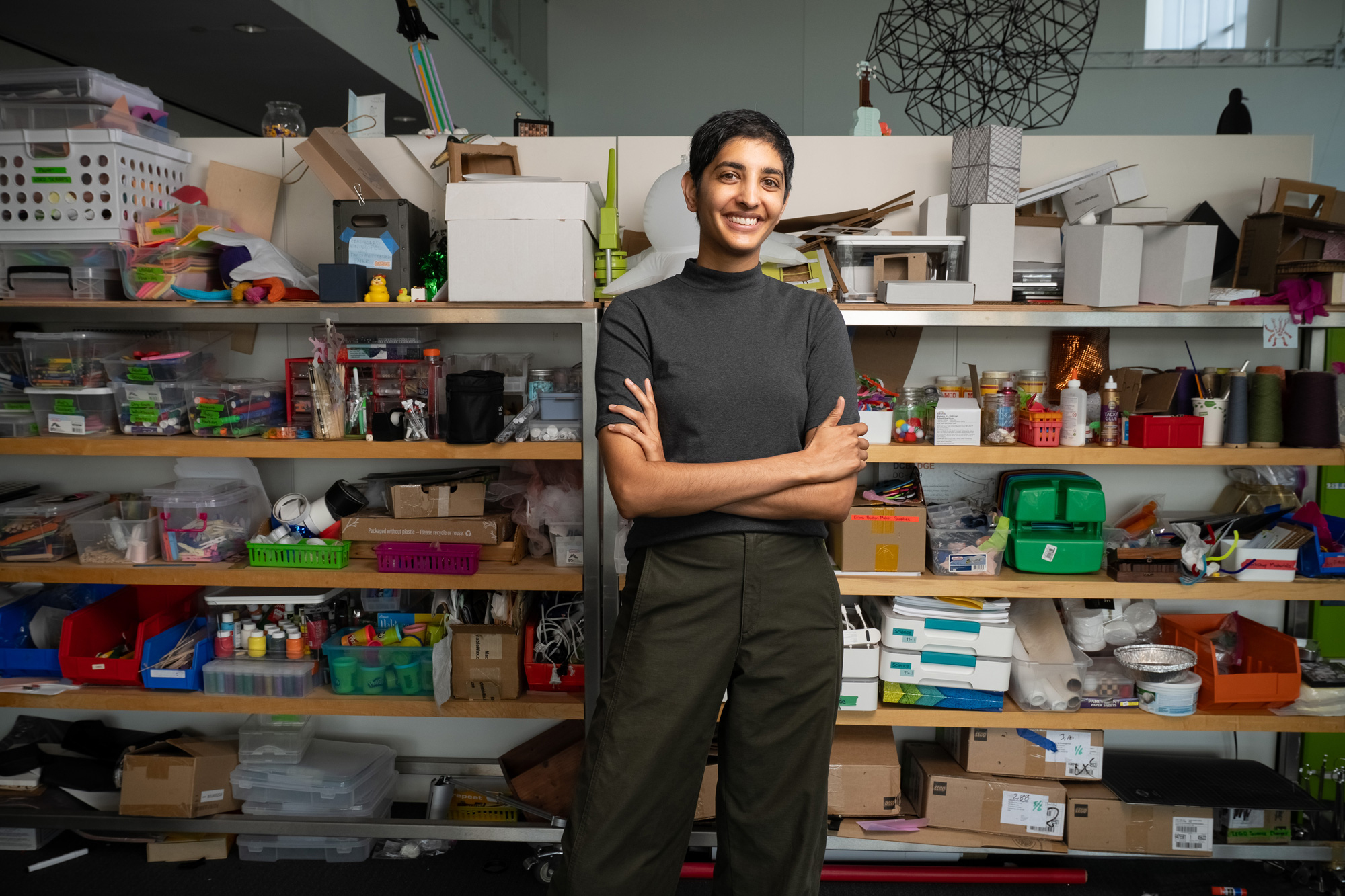
Ila Kumar: Innovating with communities
Before Ila Kumar thinks about how to build technology, she asks a different question: What is the context that technology will operate in, and who needs to be involved in the design?
For Kumar, meaningful innovation doesn’t result from engineers or designers working in isolation. Instead, she believes the best innovations emerge when the people who stand to benefit from a technology help create it from the very beginning.
That philosophy has guided her research in the Lifelong Kindergarten group, where she works alongside young people who have experienced trauma during childhood, particularly those involved in the child welfare system, to reimagine how technology can support healing, connection, and independence.
“I really think that community-based design is the only way that we can make technology that accounts for communities’ needs, but also their barriers, their cultures, their concerns,” Kumar says. “It’s the only way that we can make really sustainable and positively impactful technology.”
Today, Kumar is preparing to enter the sixth and final year of her PhD. But when she first arrived at MIT in 2021, she envisioned staying only long enough to complete a master’s degree. However, Kumar quickly fell in love with her work and decided to stay at MIT and pursue her doctorate.
Before graduate school, Kumar grew up in Philadelphia, attended the University of Pennsylvania, and worked on several projects at the intersection of technology and mental health or psychology research.
Through those experiences, Kumar began to question whether the technology she was helping to develop was having the sustained impact she hoped for. “I had done a number of projects that were ‘tech for good,’” she says. “And I wasn’t seeing that what I was doing had a long-term impact.”
Rather than walking away from technology altogether, Kumar began to rethink how it was created. “If we design technology in community-based ways and really think about holistic well-being,” she says, “maybe we can actually create things that help people.”
That conviction eventually became the foundation of her doctoral research, and over the course of her PhD, Kumar has increasingly moved from simply listening to communities to building with them.
Public conversations about technology often present a choice: Embrace it or reject it. Kumar believes that it’s not that simple.
Kumar sees the way digital platforms have the potential to both harm young people’s mental health and development, and help young people process emotions, strengthen relationships, and practice healthy vulnerability — if those tools are designed thoughtfully and embedded in the systems where young people already receive care and support.
Much of her work explores exactly what that could look like.
One project Kumar worked on, in partnership with Stepping Forward LA and with the input of the young people who would use the app, replaces text-heavy communication with a visual collage system to help young people impacted by trauma and the child welfare system to express emotions that may be difficult to put into words, and to build a sense of connectedness with one another.
In an ongoing project, Kumar is collaborating with the Justice Resource Institute to design a mobile app that supports youth in playing an active role in their treatment-planning process and helps them work toward the goals they set outside of the therapy office. The group is working with clinicians and youth to design and evaluate the system.
“We are not sitting at MIT designing tools and just throwing them at people,” Kumar says. “We’re designing it together. We need to actually have the folks that are relevant to providing the care in the room.”
That idea became even clearer to Kumar through a 10-month technology leadership circle she co-facilitated with Foster America. The program brought together people with lived experience of foster care and technology experts to envision how digital technologies could fill gaps in care for young people in the child welfare system.
This project surfaced the importance of not just designing tools that center youths’ needs but also considering the ways in which social services need to be brought into the innovation process.
Those ideas have also led Kumar to explorations that involve one of technology’s newest frontiers: artificial intelligence. She began asking questions after she realized that young people who had experienced trauma had already been turning to AI to make critical life decisions, even as many caregivers were not aware of it.
As a result, Kumar has increasingly focused on supporting care providers in talking with young people about AI. She has led training workshops with organizations that serve young people impacted by trauma or involved in the child welfare system.
Kumar’s passion for advocating for young people extends far beyond the lab. She also volunteers as a court-appointed special advocate, working one-on-one with a young person in the child welfare system while pursuing her PhD.
The role has deepened both her understanding of the challenges young people face and her belief that lasting change depends on relationships.
Some of her most meaningful moments have come while working directly with young people. Last summer, she, alongside another graduate student in her lab, mentored two interns with foster care experience during a six-week program that blended technology, creativity, and personal growth.
“It felt like a real privilege,” Kumar says. “Even the six weeks was not enough.”
Those relationships have also inspired Kumar to address how community-based research is conducted at MIT.
Recognizing that many students interested in community-engaged work often feel isolated, she collaborated with the Priscilla King Gray Center for Social Impact to co-teach a course on community-driven innovation. She later established a biweekly community of practice connecting researchers across MIT and Harvard University who are navigating the benefits and challenges of conducting research alongside communities rather than simply studying them.
Outside of research, Kumar enjoys birdwatching, cooking with friends, and creating graphic illustrations — creative pursuits that, much like her research, reward patience, observation, and careful attention.
As technology becomes increasingly woven into young people’s lives, Kumar hopes innovation will move beyond the lab and into the communities it is meant to serve.
“The future of actually impactful technologies,” Kumar says, “is when researchers are making decisions with communities instead of for them.”

Aloe found in ancient Egyptian mummy skull
Archaeologists have identified a previously undocumented ingredient used in ancient Egyptian mummifications—and a famous medieval medicine concocted from the mummies themselves. At Germany’s Marburg University, researchers pinpointed traces of aloe-associated plant material in a 2,700-year-old mummy skull, and a popular centuries’ old apothecary cure-all known as Mumia vera aegyptiaca.
There is no one way to make a mummy. Mummification methods have varied across the world for thousands of years, even within a single culture. Ancient Egyptians honed their own processes over generations, and archaeologists are still sifting through millennia’s worth of artifacts and texts to better understand the iconic postmortem procedures.
Egyptology first truly took off in Europe during the late 18th century, but people’s fascination with mummies goes much further back in time. However, the long and complex medicinal history of mummy-derived treatments collectively called Mumia likely began as a 12th century mistranslation. Persian pharmacists often used a black pitch called mumiya in wound care, which medieval translators of Latin later mistook for similarly dark materials used in Egyptian mummification. This eventually led to an entire trade network centered on the import of powdered mummy remains sold by apothecaries as a Mumia cure-all—and sometimes even an aphrodisiac—for centuries.
Archaeologists have already documented many mummification ingredients derived from various minerals, animals, and plants. These span a range of coniferous tars and reins, oils, fats, beeswax, and bitumen, as well as rarer regional plant distillations like dammar and elemi. Knowing there is still much more to learn, the team at Marburg University recently analyzed 24 historically related objects stored at various institutions. These included an Egyptian mummified skull dated to the 8th century BCE, as well as an 18th century historical preparation of Mumia housed at Heidelberg Pharmacy Museum.
Their findings were recently published in the journal Proceedings of the National Academy of Sciences, and offer the first molecular evidence of mummy-related materials directly derived from aloe. This is particularly important, since “aloe” often historically referred to a variety of plants like agarwood outside the Aloe genus. According to Tanja Pommerening, a study co-author and director of Marburg University’s Institute for the History of Pharmacy and Medicine, the detection of aloe in Mumia is also particularly significant. Prior to this study, many researchers assumed medieval authors drew their Mumia recipes from biblical passages. These include John 19:39, which references a “mixture of myrrh and aloes.”
“The new findings suggest that this association may have deeper historical roots,” explained Pommerening.
However, since only two of the 24 artifacts in the study yielded traces of aloe, the frequency of the plant’s use in mummification and Mumia remains unclear. It’s possible that preparers may have only incorporated the material during certain historical periods, or depending on its availability. Still, Pommerening and her colleagues plan to continue similar examinations of other historical objects.
“Our goal is not only to analyze the chemical composition of ancient medicines and embalming materials, but also to gain a deeper understanding of their production, use, historical transmission, and cultural context,” added study co-author and Marburg University biologist Raphael Reher.
The post Aloe found in ancient Egyptian mummy skull appeared first on Popular Science.
NASA wanted to know if humans could handle life on Mars—4 volunteers just put the idea to the test
One of NASA’s strangest, most daunting missions just wrapped up, and its crew didn’t even leave Earth’s atmosphere.
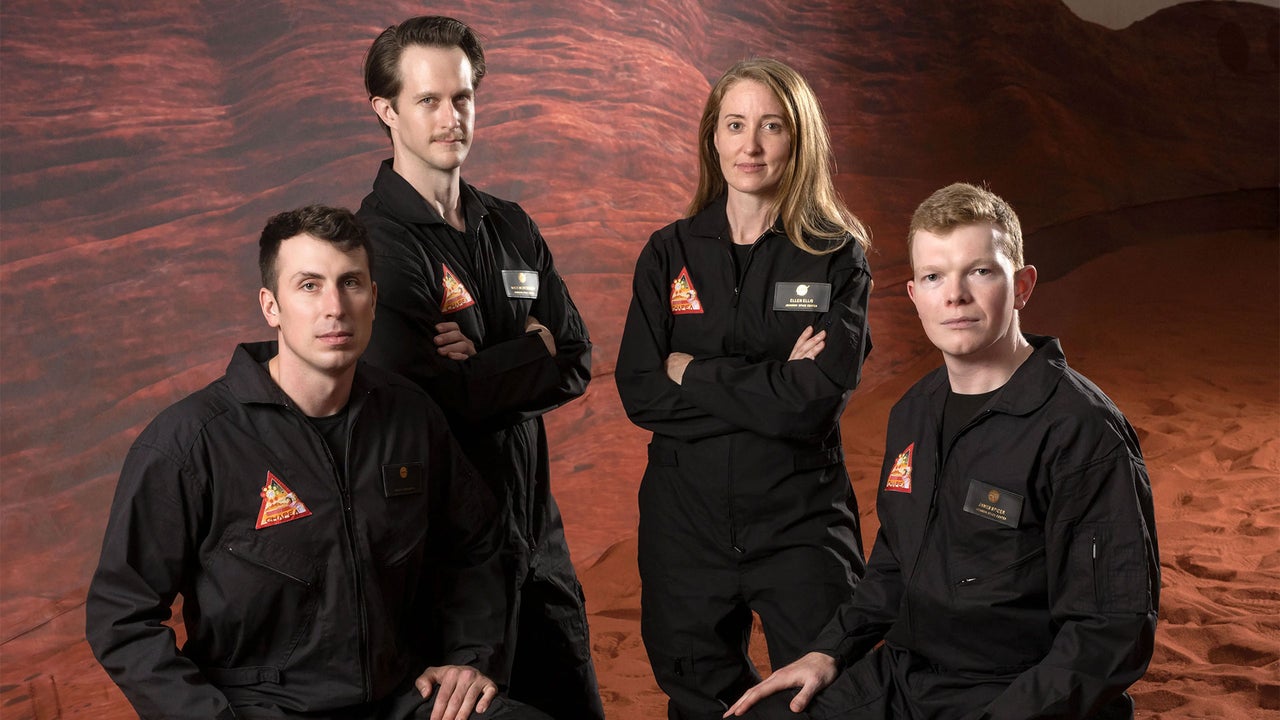
Four crew members emerged over the weekend after spending a full year cooped up inside a 1,700-square-foot habitat designed to simulate life on Mars. The simulation at Johnson Space Center in Houston represented the next best thing to a real mission to Mars, giving scientists an opportunity for a lower stakes run-through without the extreme risks posed by the Red Planet.
The Crew Health and Performance Exploration Analog (CHAPEA) mission kicked off on October 19, 2025, and was the second of its kind, following a previous isolation mission that ended in 2024. This time around, the crew spent a total of 378 days in a facility extruded by an enormous 3D printer and crafted to resemble a real-life Martian habitat, complete with living areas, workspaces, and even the capability for simulated spacewalks.
The brave souls willing to boldly go into confinement in the name of science included medical officer Ellen Ellis, mission commander Ross Elder, science officer Matthew Montgomery, and flight engineer James Spicer.
“To my crewmates, it’s been a hell of a year—analog astronauts living in captivity of our own free will,” Ellis said in a press conference after emerging from the habitat.
And their work isn’t done yet. The crew members are scheduled to spend two weeks being debriefed and undergoing evaluations after the unusual experience.
Staying busy on Mars
While the CHAPEA mission lacked the array of life-threatening complications astronauts would encounter on a real trip to Mars, the team at NASA simulated those too.
At various points during the yearlong staycation, the crew faced “environmental stressors such as resource limitations, isolation, equipment failure, and significant workloads”—plenty to keep a crew of four busy for a year in a faux Martian habitat.
“We are extremely proud of the crew for their commitment and achievements over the last year on such a fast-paced, highly demanding mission,” CHAPEA principal investigator Grace Douglas said in a press release prior to the “egress ceremony” on October 31.
The isolation might have been the most daunting task of all. During their time in the habitat, the crew members were able to communicate with their families only over email, and even that process came with a built-in delay meant to simulate real communication times between Earth and Mars, which are roughly 140 million miles apart.
Future astronauts sent to Mars will also grapple with the planet’s toxic carbon dioxide-rich atmosphere and its freezing surface conditions, among the myriad other logistical challenges and deadly resource puzzles inherent to sustaining human life beyond our pale blue dot.
“This mission has been incredibly valuable in starting to teach us how to understand requirements for yearlong missions, including medical and psychological care, via communication delays,” Michael Stenger, chief scientist for NASA’s Human Research Program, said as the mission neared its end. “When combining this Mars-realistic mission analog with a suite of physiological, psychological, and performance measures in a rigorously controlled environment, we’ll be able to translate the knowledge from these experiences to moon base and beyond.”

How to vote in the US midterm elections: Find when polls open, close, and other details
The Nov. 3 midterm elections are right around the corner, and the outcome will determine the makeup of Congress and the trajectory of President Donald Trump's remaining years in office.
So if you haven't already voted, still need to mail in a ballot, or don't even know where to start, the hours are counting down. For an overview of voting deadlines, drop box and polling locations, and registration information, visit Vote.org, USA.gov, or keep reading below.
How to vote by mail
More than 51 million Americans have already voted in the 2026 midterm elections. The number of people voting by mail grew substantially in 2020, and eight states now host what are known as all-mail elections or offer universal mail-in voting.
Mail ballots are sent early, with most states requiring at least a week's lead time before Nov. 3. If you were issued an absentee or mail ballot and plan to send it by mail, your ballot must be postmarked by or on election day, not after. A late postmark can void your ballot. If you never received your ballot, contact your election office ASAP.
In some states, voters can also drop off their ballots at designated drop boxes (the websites of county registrars typically list drop box locations, such as the Los Angeles County Registrar-Recorder). Around 15 states require drop box options for voters, many located at places like libraries and parks:
California
Colorado
Delaware
Georgia
Florida
Kentucky
New Jersey
Nevada
Maryland
Michigan
Oregon
Rhode Island
Utah
Virginia
Washington
Another 11 states prohibit drop boxes, so make sure your ballot gets postmarked if you are registered in these states:
Arkansas
Louisiana
Mississippi
Missouri
North Carolina
Oklahoma
South Carolina
South Dakota
Tennessee
Texas
West Virginia
To find more rules on drop box voting, absentee voting, and voting by mail, visit your state's registrar of voters or scroll down to the state-by-state database on Vote.org.
How to vote in person
Despite a growing number of voters skipping the polls in favor of mail, many voters still cast their ballot in person. Voters are assigned to an in-person polling location based on the address they used to register to vote, and most can start voting before Nov. 3.
Polling times vary by state, with some states offering in-person voting as early as one month before election day (this practice is usually referred to as early in-person voting). Voters with disabilities may need to go to a different polling location, depending on their accommodation needs.
What to bring to the polls
Voters do not need any special equipment or documents to cast their vote. You may need to bring a form of verification to the polls, however, depending on your state. Scroll down for more information.
Voters are also allowed to bring in personal notes, a voter's guide, and even sample ballots into the polling booth.
How to find a polling place near you
Voters can find out their nearest polling location by checking their registration or calling their local registrar of voters. They can also use an online polling locator such Vote.org or the National Association of Secretaries of State (NASS).
Voting FAQ
Do I need an ID to vote?
That depends on your state. Voter ID laws vary across the country, so check with your state election officials to be sure. In some cases, you may still be able to vote without an ID by signing an identity form.
Can I track my ballot if I voted by mail?
Yes. Most states offer some form of ballot tracking for voters. Find specific information on ballot tracking via your state's registrar website or call 866-OUR-VOTE (866-687-8683).
Can my ballot be challenged?
Yes and no. Ballots can't be challenged without a real legal basis under the National Voter Registration Act. A voter purge, in which election workers "clean up" voter databases by deleting names, can't be conducted within 90 days of a federal election. If you were on the roll as of August, filled out your ballot correctly and on time, your vote should count.
Federal agents and law enforcement cannot legally seize voting machines, nullify ballots, or stop the count.
That being said, groups may still challenge swaths of ballots up until the election. If your registration is challenged at the polls, you can still cast a provisional ballot.
Are electronic voting machines safe?
Electronic voting apparatuses are overseen by the U.S. Election Assistance Commission (EAC) and thousands of election officials to ensure their safety and reliability. While recent studies have uncovered security flaws, election security researchers say they have not yet led to any kind of election interference, as suggested by some critics and conspiracy theorists.
Instead, experts suggest the biggest threat to election integrity is the spread of misinformation, which is increasingly enabled

White Dwarfs Aren’t Just White. Scientists Discover Dying Stars Turning Pink and Green