

Operators Day : 10 founders hiring for founding ML roles - Nov 5 [n]
Hi all! I'm part of the EWOR team and we're organising Operators Day this Thursday, November 5 (4:30 PM CET / 9 PM IST), online on Zoom.
Ten founders will be pitching live, sharing what they're building and the founding roles they're hiring for - AI/ML engineers, robotics engineers, CTOs, CPOs, marketing and sales leads, and more.
These are real founding opportunities with meaningful equity.
If you're an ML engineer or researcher exploring your next move, or know someone who might be a great fit, come join us!
Spots are limited.
Register here: https://luma.com/OperatorsDay?utm_source=reddit&utm_content=machinelearning
Disclosure: I work with EWOR and am helping organise the event.
[link] [comments]



Sweetgreen managers could earn more than $200,000 a year under a new pay plan, as the salad chain bets higher pay will lift sales
A fast-casual chain favored by the office lunch set is sweetening compensation packages for managers at its restaurants.
Starting next year, Sweetgreen managers will be eligible to earn more than $200,000 a year if they meet certain milestones set by the company. The new offering, which will be paid through a mix of base salary and equity, is intended to empower managers who contribute to the business’s success, and “[share] those wins with those that are driving it,” co-founder and CEO Jonathan Neman said.
Under the new incentive plan, Sweetgreen managers (known as “head coaches”) will see their base pay increase by up to 45% if they work at restaurants with higher sales volume. The company declined to specify how high sales need to be to meet this threshold.
When restaurants outperform their sales goals, managers will get a revenue share bonus from the upside, with the percentage increasing based on their tenure in the business. Managers can also continue to receive equity in the company based on their performance.
Base salary increases will go into effect in Q1 of 2027, while head coaches will start to receive bonuses based on store performance on a quarterly basis from Jan. 1, 2027, according to Sweetgreen.
How Sweetgreen is making the case for higher pay. Higher labor and related costs cut into Sweetgreen’s earnings for the quarter ending in June, accounting for 29% of revenue, up from 28% the year prior. Same-store sales and restaurant profits also declined that quarter compared to 2025. (Sweetgreen will report Q3 earnings on Nov. 5.)
Amid such economic pressures, Neman recognized that investing in additional compensation for managers “is definitely a bet.”
“But the data supports that if we’re able to attract, retain, and incentivize better head coaches, that they will drive higher sales and better margins,” he added. Neman noted that while Sweetgreen is investing some money upfront to raise managers’ base salaries, most of the investment is contingent on their stores meeting certain performance targets.
“Typically the company would take more of that upside. Now we’re sharing in that upside with our team, but…we think that’s a good trade,” he said.
Zoom out. Sweetgreen isn’t the first fast-casual chain to bet big on its managers. Chipotle announced in 2021 that workers in its highest general manager position could earn $100,000, on average, as it sought to hang onto workers in a tight labor market. The burrito business doesn’t appear to have taken a financial hit from this move, as its restaurant operating margins have stayed between 23% and 26% in recent years. More than 85% of general managers at Chipotle were promoted internally in 2025, according to its 2026 proxy statement.
Neman said Sweetgreen took inspiration from chains like In-N-Out Burger, which recently confirmed that store managers can earn more than $200,000 on average, and Raising Cane’s, which grants monthly bonuses to managers based on sales, and said in 2024 it paid managers up to $175,000 annually.
In addition to business performance, Sweetgreen will be looking at metrics like team member turnover, “head coach stability” (i.e. whether managers stay in their stores), quality and experience scores, and internal mobility to determine whether this incentive program is working, Neman said.
This report was originally published by HR Brew.
This story was originally featured on Fortune.com

Palantir posts ‘highest-ever’ revenue growth rate of 96% as investors’ patience rests on a hair trigger
Palantir Technologies said Monday that third quarter revenue rose 96% year over year to $2.3 billion, surpassing last year’s 63% growth and $1.2 billion in revenue. Chief financial officer David Glazer called it the “highest-ever” reported year-over-year growth rate as well as the highest ever sequential revenue growth rate of 20%. Moreover, quarterly revenue crossed the $2 billion milestone marker for the first time.
It raised its full-year revenue forecast to between $8.53 billion and $8.534 billion, roughly 91% growth, from as high as $8.2 billion a quarter ago. However, investors didn’t seem swayed immediately. In after-hours trading shares began to climb, rising about 1.5% immediately after the figures were published, before dropping 3.6%.
In the third quarter, Palantir reported adjusted and GAAP earnings per share of 44 cents. That compares to third quarter 2025, when adjusted EPS was 21 cents and GAAP EPS was 18 cents. Analysts were expecting revenue of $2.18 billion and adjusted earnings of 41 cents per share.
In his quarterly letter to investors, CEO Alex Karp touted the firm’s results, writing “it would be an understatement” to say Palantir’s results in Q3 “were extraordinary.” He said the company’s growth rate of 96% was “absolutely striking.” Palantir had guided revenue to roughly $2.16 billion to $2.164 billion.
Palantir’s quarterly results came after last week’s bloodbath in certain tech stocks, and served as something of a temperature read on the AI trade. Karp made no bones about the change he sees on the horizon and how it could demolish certain sectors.
“Every industry in the world—from banks to insurers to hospitals and even once-storied law firms—will either be remade or set briskly aside,” wrote Karp. He continued his aggressive optimism about the company he helped found in 2003 with investor Peter Thiel and others as the quarterly call with analysts got underway.
Karp said Palantir’s quarterly earnings calls have grown beyond its financial results to serve as “the focal point of tech, society, and general trends.” He said Palantir’s earnings calls, streamed on YouTube, are “by far the most-watched earnings calls in the world.”
The software maker has become a bellwether for public market confidence in AI software converting into revenue growth. Its latest financials come days after Alphabet suffered its worst one-day drop on record in its 22-year history as a public company. Disappointing reception to Amazon and Intel last week deepened concerns that relentless spending on AI—which is approaching $2 trillion in two years, according to S&P Global research—is sprinting well ahead of returns for investors. Google parent Alphabet lost $505 billion in market value since it published third-quarter figures last week and Intel’s stock dropped about 29% last week. The Nasdaq Composite fell more than 1% Monday and the benchmark is down 4% over the past five days.
At Palantir, investors keep a gimlet eye on U.S. commercial revenue as evidence that companies as well as governments are willing to pony up for AI software. That business grew 148% to $984 million, compared to $397 million a year ago.
And for the first time, U.S. commercial revenue skipped ahead of U.S. government revenue, clocking in at $984 million versus $953 million. U.S. government revenue grew to $953 million, up 96% from $486 million a year ago.
Meanwhile, total contract value rose 6% to $2.9 billion and U.S. commercial contract value grew 11% to $1.5 billion.
For the current quarter, Palantir forecast revenue of roughly $2.64 billion to $2.65 billion, or about 88% growth at the midpoint. Analysts expected about $2.46 billion. Fiscal year 2026 revenue guidance also rose to 91% year over year growth, and U.S. commercial revenue guidance rose to 143%.
The backdrop for Palantir is markedly different from its second quarter results in August even though Karp’s tone this quarter is just as ebullient as he was three months ago. This quarter, as last quarter, the $430 billion tech firm’s own quarterly release to investors said its results were “crushing consensus expectations.”
Karp maintained the same tone throughout the call and in response to a question for tech bull Dan Ives, said potential clients seek out Palantir because they’re concerned about their intellectual property and getting value from it. He compared it in various ways to types of romantic relationships. He said “warm leads” now turn quicker into “hot leads” the way a first date can progress further romantically.
It’s a “very different jam,” said Karp.
“We’ve gone from being the most attractive person in the physics department to being the captain of the football team kind of thing,” he continued. “I mean, not that I did that.”
This story was originally featured on Fortune.com

‘Fastest entertainment property in history’: GTA VI arrives to test a thin November box office
A nearly three-hour documentary about Elizabeth Holmes was the No. 1 movie in America over Halloween weekend. That’s a triumph for A24, and a scary harbinger for theaters heading into a thin November that faces competition from an entirely different corner of entertainment.
A24’s You Can See Everything, directed by Nathan Fielder and Lance Oppenheim, took in $11.4 million in its third weekend, narrowly edging DC Studios’ Clayface, according to Monday’s final figures reported by Variety. It had finished second in each of its first two weekends, behind Street Fighter and then Clayface. Its domestic total now stands at $64.7 million.
It is the first documentary outside the concert genre to top the box office since Michael Moore’s Fahrenheit 9/11 in 2004. But its lack of direct competition is telling. No studio opened a wide release, and overall ticket sales came to about $56 million, down more than 40% from the prior weekend and the second-lowest total of the year, according to studio estimates.
Why Halloween weekends sink the box office
Unlike Christmas, Thanksgiving, or the Fourth of July, Halloween doesn’t boost the box office when it lands on a weekend. People don’t get an extra day off, and they’re more likely to spend peak moviegoing hours trick-or-treating or at parties.
The last Saturday Halloween, in 2020, came while most theaters were shuttered. The one before that, in 2015, was the weakest weekend of that year to that point: three new wide releases flopped, and The Martian stayed on top in its fifth week, as Fortune reported.
A thin November slate
This year’s quiet Halloween also foreshadows a challenging month. The biggest swing is Lionsgate’s The Hunger Games: Sunrise on the Reaping on Nov. 20, the sixth film in the franchise and an adaptation of Suzanne Collins’ 2025 bestseller. Boxoffice Pro’s long-range tracking puts its opening at $55 million to $65 million; the last installment, 2023’s The Hunger Games: The Ballad of Songbirds & Snakes, opened to $44.6 million.
Thanksgiving week brings Disney’s animated Hexed and Universal’s Focker In-Law, both on Nov. 25. Focker In-Law is a greater gamble: the fourth film in the franchise that began with 2000’s Meet the Parents arrives 16 years after Little Fockers, which opened to $30.8 million in 2010.
Warner Bros.’ animated The Cat in the Hat and Searchlight’s Wild Horse Nine open Nov. 6, and smaller titles like Ebenezer: A Christmas Carol and I Play Rocky are sprinkled through the month. But the box office’s most likely competition comes from the video game business: Rockstar Games releases Grand Theft Auto VI on Nov. 19, one day before Sunrise on the Reaping opens.
The month’s biggest launch isn’t a movie
The sixth game in the series arrives 13 years after Grand Theft Auto V, and anticipation has been building for years. Rockstar confirmed development in February 2022; that September, a hack leaked roughly 90 clips of early footage, and in December 2023 the first trailer leaked hours before its scheduled debut. The game promises a more expansive setting than any previous Grand Theft Auto title.
Grand Theft Auto V generated $800 million in sales in its first 24 hours in 2013 and passed $1 billion in three days, which publisher Take-Two Interactive called the fastest any entertainment property had reached that mark. It has since sold more than 230 million units, according to Take-Two’s August 2026 earnings report.
GTA VI is poised to beat those numbers. Analytics firm Sensor Tower estimates it had drawn 6.45 million digital pre-orders worth about $630 million as of Oct. 20, excluding physical copies. That global, pre-launch haul already tops the roughly $625 million domestic run of Christopher Nolan’s The Odyssey, the year’s second-highest-grossing film behind Spider-Man: Brand New Day.
It is also more than 11 times what every movie in North American theaters grossed over Halloween weekend. For Take-Two, which reported $6.66 billion in revenue in its fiscal year ended in March, the launch underpins a forecast of $8 billion to $8.2 billion in net bookings this fiscal year.
Video games may draw a narrower audience than theatrical films, but a release this size is bound to occupy the attention of millions later this month. That’s likely to pull some of them away from the big screen for at least a weekend, leaving a notable dent in the fall box office.
This story was originally featured on Fortune.com

CNBC's The China Connection newsletter: Nvidia's humanoid push relies on China-made robot hands
The Giant Measurement at the End of Time
2.5.6.0.1 Kent and Bousso&Susskind have proposed approaches to defining quantum wavefunction branches based on late-time information. The basic idea is to exploit the way that quantum information propagates in our universe in particular: (a) photons(and gravitons) carry away information at the speed of light, (b) the universe is expanding and cooling, meaning that these photons(in some cosmological environments) may propagate uninterruptedly forever.
2.5.6.0.2 What this means is that photons very late in time are a privileged set of degrees of freedom: they plausibly carry information about everything that has classically "happened" previously. This suggests a way of defining the set of branches: just "measure"(apply a fictitious measurement operator, that is) the photon degrees of freedom very late in time!
2.5.6.0.3 That's the basic idea. There are many subtleties of course, and Kent and Bousso/Susskind have different proposals. I'll review each in turn and then talk about the philosophical merit of these approaches in general.
- 2.5.6.0.3.1 The following discussion uses some elementary definitions of objects from general relativity. If you know what a spacelike surface and lightcone are, that should be enough.
- 2.5.6.0.3.2* Note that as of the time of writing, QFTs in arbitrary space-times are not totally mathematically well-defined objects -- and what's more, the fully correct theory of the objects we are discussing should be quantum gravitational, where we don't even know what the exact form of the theory should look like. Thus these constructions are a bit sketchily defined, even compared to QFTs which are already mathematically sketchy.
2.5.6.1 Quantum Reality via Late-Time Photodetection
2.5.6.1.1 Kent has proposed a few variants of this idea. I'll review the version in his paper Quantum Reality via Late-Time Photodetection.
2.5.6.1.2 Kent is interested in defining a set of possible histories of what he calls "beables", which are essentially the classical-like variables which we think of as defining a possible world, e.g. the positions of objects.
2.5.6.1.3 For his set of beables Kent considers the expected values of quantum observables at a given time, conditioned on some particular late-time outcome of photodetection measurements across all of space(with an additional subtlety I'll get to momentarily).
2.5.6.1.4 Why does this make sense? The idea is that the late-time photons should contain all the information about possible classical experiments, pinning down a possible quantum state associated with a set of measurement outcomes. The expected values then give us the classical-like variables associated with this set. Taking the expected value is necessary because even in a classical-like world all degrees of freedom will still be "spread out" in a quantum manner to some degree.
- 2.5.6.1.4.1 For example, if we consider a covalently-bonded molecule, its position might be decohered by a measurement and thus ultimately correlated with late-time photons. However, the internal state of the electrons in the covalent bond may not be. So if we condition on late time photons, the position of the molecule will be approximately fixed, but the positions of the electrons will not. Taking the expected value of the probability of detecting an electron in a given place will give a spread out "blob" around the covalent bond. This gives the quasi-classical state we are looking for.
2.5.6.1.5 Now, however, a problem arises. If we project onto an entire late-time space-like surface, this is correlated with the results of all past experiments. This means that the beables at a given point in time will be conditioned on the results of experiments in that point's future, which may give strange results.
- 2.5.6.1.5.1 For example, say that some time later we take our molecule from the previous experiment and measure the position of the electrons in the covalent bond. The results of this experiment will be recorded in some late-time photons. So if we condition on all these photons, the electrons' positions will be decohered at earlier points as well! In other words, when we consider the expected value of the electrons' position earlier, we will no longer find them in a "blob" corresponding to a normal covalent bond, but rather a state which will evolve to whatever position measurement we end up sampling.
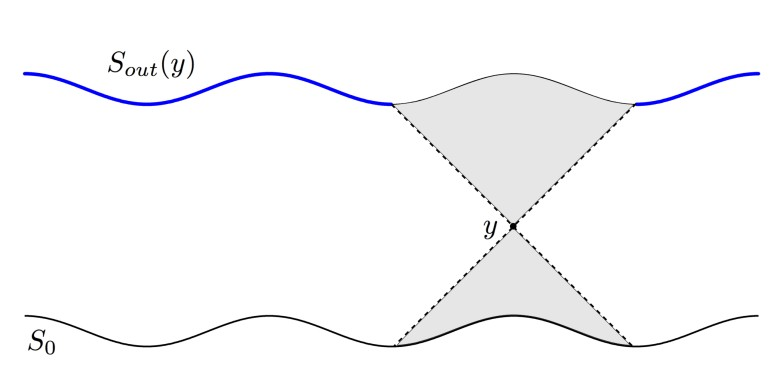
2.5.6.1.6 Clearly, this is undesirable. Kent's solution is to restrict the set of photodetection results we condition on in the future space-like surface. For a given point in spacetime p, we only condition on points on this surface outside the forward light cone of p.
- 2.5.6.1.6.1 In the molecule example, if we consider a point before we measure the electrons' position, the future experiment, and hence all photons downstream of it, are in the forward light-cone. So these experimental results would not be conditioned on, restoring the normal covalent bond.
- 2.5.6.1.6.2 This means that measured systems will "collapse" to a given value slightly after they have been measured. In particular, this will occur once there are outgoing photons spacelike separated from the system.
- 2.5.6.1.6.3 Note however, that we still sample a single shared set of measurement outcomes for all points in spacetime; it's just that when defining the beables at a particular point, we only condition on the outcomes outside of the forward light cone. This ensures we define a consistent shared reality.
Kent defines beables at the point y by conditioning on photon measurements on the blue portion of the forward surface. From page 19 here.</

You can't make an omelette without breaking some urns
TL;DR In this post, we investigate two methods that aim to improve training efficiency over standard PPO for a grid world RL agent. In our experiments these methods can converge on better policies, but take roughly twice as long to do so. This project was done in the context of an ARENA 8.0 capstone project. Our code is available on GitHub.
Introduction
Reinforcement learning agents are trained to maximise a given reward function in their training environments. Common failure modes of the training process are reward hacking and goal misgeneralisation, roughly corresponding to outer and inner misalignment respectively.
Reward hacking occurs when the supplied reward function does not correspond exactly to the developer’s intent, and the agent learns a way to satisfy the reward function without satisfying the intended objective. This can be addressed, at least in principle, by designing a better reward function.
Goal misgeneralisation can occur even with a perfect reward function. If training and deployment environments differ, policies that satisfy the reward function during training, might fail to do so during deployment. Such policies are indistinguishable during training and we cannot control which one the agent learns.
If the distribution of deployment environments is entirely disjoint from the training distribution, goal misgeneralisation is inevitable. Consider, for example, training an agent to collect green apples while avoiding red boxes. What would happen if it gets deployed in an environment with red apples and green boxes? The behaviour is undefined. (It is also unclear what the intended behaviour would be in this case.)
Goal misgeneralisation is likely if deployment environments are not contained in the training distribution. But even if they are, correct generalisation cannot be guaranteed. In this post we present a case study and investigate two mitigations.
The pottery shop environment
Our object of study is the pottery shop environment.[1] It is a grid world environment containing the agent, a bin and one or more urns and (piles of) shards. The agent can pick up and carry one shard at a time. Its task is to collect all shards and drop them into the bin as quickly as possible. If it steps on an urn, the urn breaks and creates a new pile of shards to clean up.
An example level of the pottery shop environment (on a grid)
Interesting behaviour occurs when urns are on the direct path between the agent and the shards or the bin. The intended optimal policy is to walk around the urns if that path is only slightly longer. But if the detour gets too long, the agent should break some urns, creating a shortcut.[2] The cost of breaking the urns is lower than the cost of taking the detour. For computational efficiency, we limit our investigations to environments of size and .
We use the following reward function, which ensures that this is indeed the optimal policy.
- Dropping a shard in the bin gives reward +1
- Breaking an urn gives a penalty of -3
- We add a reward shaping term , where and are the states before and after the action. And the potential is 1 if the agent is holding a shard and 0 otherwise. This term encourages the agent to pick up shards as an instrumental goal without incentivising reward hacking by repeatedly picking up and dropping the shard.
- Finally, we add a step cost that is incurred at every action, as long as there are still shards to clean up. This is the crucial term that makes shortcut creation optimal by penalising long detours. Note that the discount factor alone does not penalise detours sufficiently. We set the step penalty to 0.2 and 0.02 in and environments respectively.
We use a discounting factor .
Our training environments are randomly generated as follows. The number of shards and urns is sampled randomly from a geometric distribution. The agent, urns and shards are then randomly placed on the grid. Sampling from a geometric distribution ensures that any number of urns and shards is possible, but higher numbers (i.e. dense levels) are less common. Every possible environment is thus accessible during training, but the distribution is heavily biased towards sparse levels. In particular, this means that it is rare to generate levels with long walls of urns, i.e. those where the optimal policy is to create a shortcut. Given the total length of training, the agent will nevertheless encounter a significant amount of them. The deployment distribution is a small set of hand-crafted levels, containing urn walls of various lengths. Across all environments, we fix the bin position to the top left corner.
We expect the agent to learn to always walk around walls, because that is the optimal policy in almost all of the training environments. In the deployment distribution, it should behave competently, but miss out on the opportunity to break walls and achieve optimal reward.
PPO to the rescue
We start with standard proximal policy optimisation (PPO). PPO training consists of two phases:
- Rollout phase. We generate random levels, rollout the policy (without updating weights) and collect transitions into memory.
- Training phase. We then train on batches of transitions and update the agent’s weights.
After that,
The Power Broker Book Review
When Robert Moses, the subject of Robert Caro's The Power Broker, fought for his vision of parks, bridges, and expressways in Long Island and New York City, the single most important tool at his disposal was his power. When his dreams met the resistance of his opposition, the outcome of each conflict reflected the balance of power on each side. When Moses prevailed, it was because of power. Though it is also a biography of Moses and a study of 20th century urban planning and civil engineering, this book shines as a treatise on power: how it is acquired, used, and lost. Moses has long faded into the annals of history; public policy has evolved during the intervening half century since the publication year of 1974; but power, through its invisible, grasping tendrils, operates in today's world through the same mechanisms as in the Moses era. Weaving his research throughout his narrative, Caro has crafted a cynical and compelling journey through the halls of power, inviting the reader to reevaluate their world through a new and insightful perspective — to see through the stark lens of power.
One particularly depressing theme of the book is that power always prevails. Truth, logic, and consequences be damned, the outcome is decided by what the powerful want and how much power they control. Power alone can explain why Moses' Northern State Parkway, unlike its Southern sibling, meandered tortuously across Long Island — to mollify the robber barons whose estates lay in the right of way — why his Henry Hudson Bridge sliced through the primordial heart of Inwood Hill Park — because, among other funding-related reasons, that particular route was eligible for federal subsidies — and why the East Tremont section of his Cross-Bronx Expressway veered to the north, blighting what had been a successful neighborhood, which remains to date one of the most impoverished in NYC — to preserve a transport depot in which key city politicians held ownership interests at the time. The tenants Moses evicted and the drivers trapped within the biblical congestion on his roads and bridges, congestion caused by the phenomenon of traffic generation (commonly known today as induced travel or induced demand) and more importantly by Moses’ motive of maximizing toll revenue, had few options to improve their circumstances because unlike Moses, they had no power. In The Power Broker, it is power that moves the wheels of history.
Another lesson from The Power Broker is that power-seeking compromises moral integrity. Ingenuity and work ethic aside, the personal quality which enabled Moses’ ascent to power was his practicality, his willingness to discard his other moral convictions when they hindered his quest for power, a quality embodied in one of his quotes: "If the end doesn't justify the means, what does?" When Moses brazenly attempted to seize W. Kingsland Macy's Long Island estate to create Heckscher State Park, Macy gave press interviews containing little more than the facts as he saw them because he felt that the truth of the matter should stand on its own, whereas Moses employed cunning lies to spin the narrative in his favor and turn public opinion against Macy. In Caro's words, "Macy was handicapped by principles." His strict adherence to moral principles became a liability which gave Moses a decisive advantage in their power struggle.
Moral corruption aside, Caro revealed the inner workings of power through the corruption of organizations designed to accumulate and exercise power at scale. In his youth as an idealistic reformer, Moses had faceplanted into the political might of Tammany Hall. By the end of his career, he had perfected a superior system of centralized power under which Tammany leaders served him. Moses realized the grand scale of his dreams by fully leveraging the economic and political resources he controlled to incentivize others, from politicians to union leaders to bankers to the Archbishop of New York, to do his bidding on his behalf. Power thus delegated to his counterparts was instrumental to the changes he wrought upon the world.
One commendable quality of Caro's writing is the staggering amount of research he synthesized into The Power Broker. No written document, however obscure, escaped Caro's meticulous gaze. In addition to the already extensive government records and newspaper clippings, Caro unearthed 18th century primary sources from far-flung libraries and unpublished personal diaries of public officials. In addition to the written evidence, Caro interviewed high-ranking Moses officials and Moses himself. From his vast trove of research emerged irrefutable patterns and recurring themes in Moses' relationship with power: his genius, his consequentialism, his hubris.
Yet, The Power Broker is neither a comprehensive nor an accurate biography of Moses. Caro's most controversial assertion, that Moses built low-clearance bridges over his parkways to prevent buses from using them with the intent of discriminating against poor and Black citizens who required buses for transportation, has attracted significant academic scrutiny and remains an unsettled question. On a separate occasion, Caro lauded Moses' playgrounds for replacing cinders with a new asphalt surface designed to prevent skinned knees but later claimed that the asphalt was awful at preventing cuts and scrapes. In a conspicuous omission, Caro mentioned the Robert Moses Power Dams at Niagara and Massena only in passing, feats of biographical importance which deserved more attention in place of harping on how the bankers supported Moses because they held financial stakes in the success of his projects, how the unions supported Moses because his construction created union jobs, and so on. On a matter of style, Caro's nonlinear and at times repetitive narration burdens any reader trying to piece together a chronology of events.
The Power Broker is, however, a masterful novelization of the historical record in which Caro's ingenious framing of major characters as foils to Moses animates the story throughout. Governor Al Smith, the political antihero who taught Moses the way to power but stayed steadfast in his lifelong commitment to the impoverished from whose ranks he rose. Franklin Delano Roosevelt, who shared Moses' background and his personality and many of the same ideals but became his sworn enemy. Fiorello La Guardia, the ferocious Mayor of New York City who was as passionate as Moses about building public works and kindred spirits in how to get things done. ("In this administration, I am the majority.") Robert F. Wagner Jr., a well-intentioned reformist Mayor who weathered a thousand battles with Moses at the height of his power. And Nelson Rockefeller, the cold-blooded banker who outmaneuvered Moses' fiery crusades and created the perfect conditions to evict Moses from the empire he had ruled.
In addition to his characterization, Caro's writing style makes The Power Broker an enjoyable read. His trademark one-sentence paragraphs, often used in conjunction with paragraph-length sentences, established a rhythm which conveyed the inexorable inertia of power. Another technique Caro employed frequently was to ask his readers to reconstruct the narrative for themselves based on sparse evidence, highlighting the inscrutable nature of power. In one passage, the reader must infer Moses’ shadowy machinations to solve a puzzling sequence of events concerning the East Tremont section of the Cross-Bronx Expressway which demonstrated how common sense and the public good bowed to the political considerations and cor
Against strawmanning unilateral pauses
Summary: Scott Alexander’s Against SURA post is arguing against a strawman version of unilateral pauses. He admits as much deep into the post. I think his conclusions fail against stronger pause plans for conditional or limited unilateral pauses, where training resumes if the pause does not cause others to pause, and where personnel are redirected toward work on alignment and product, rather than simply fired. In addition, Scott’s post is incorrect about the simplicity of the game theory involved: getting companies to agree to conditional pauses is not strictly easier than convincing them to pause, as the former requires companies to (promise to) take actions based on ambiguous, game-theoretically-informed evidence. That is not the kind of evidence companies tend to act on.
The good version of unilateral pausing is good
Here is the good version of unilateral pausing:
- Capability pause: Some frontier lab (let’s call them OpenAI or Anthropic) says they have stopped capability research, either just all frontier training runs or both all frontier training runs and all low-scale capability-focused research.
- Internal definition: The company gets to pause on its own terms, which is much easier than a generally coordinated pause since they can define the pause in terms of the existing structure of work and teams within the specific company, reducing disruption to other processes. They have said they would like to work with other companies and countries to adapt and strengthen this definition over time, in particular to make it gradually more compatible with actions by other actors. Importantly, we accept that it may be easiest for a company to pause according to its own, company-specific definition, and handle any asymmetry in their agreements via multiple rounds of negotiation with other actors.
- Safety + security + product: In place of capability research, their efforts to alignment and other safety research, information security, and product. The product part is important! They will still be a trillion dollar company shipping extremely useful tools, and this also provides an escape valve for people within the company who care about products and don’t want to do safety research.
- Restart if necessary: The pause is temporary, and will restart after some period of time if progress is not made to broaden the pause. Potentially one wants separate periods based on different kinds of progress. Other US labs are likely to pause sooner than labs in China, since international diplomacy takes time.
There are multiple places in the post where Scott makes it clear he wants the reader to be thinking of much worse plans than this. Emphasis added:
I think people feel insufficient terror at this strategy. It amounts to "let's put all of our hopes for survival through non-pause strategies in a giant pile, and then set that pile on fire, in the hope that the pretty flames catch people's attention and make them more interested in a pause." It might in theory be net positive, but this is the sort of thing that you would only want to conclude after extremely careful analysis, of a type that I so far haven't seen.
As a very rough start, I asked the AI superforecaster how much more likely a global pause would become if Anthropic disbanded their entire company immediately with the explicit goal of raising awareness of a pause. The forecaster said this would increase the chance of a global pause by only three percentage points - from 16% to 19%.
Again, the correct version of a unilateral pause is a company pivoting to safety + security + product, not “disbanding their entire company immediately”.
Since the goal of SURA is to get all alignment-pilled people and companies out of the industry, it would result in more Greg Brockmans funding the anti-regulation side, and fewer Anthropics funding the pro-regulation side.
This is again arguing against a strawman: OpenAI would not be “out of the industry” if they decided to unilaterally pause. Sam Altman loves to build products! He would very much still be in the industry.
It is possible that Scott will correctly point out that some people do advocate for the extreme version here, but I don’t think he should get credit for this. The title of the post is “Against Stop Unilaterally and Raise Awareness”. I think it is perfectly reasonable for someone to say that SURA-the-phrase applies to my better version. His post is very strongly being interpreted as arguing against unilateral stopping in general. It is being interpreted that way because of his title and framing.
Scott thinks the good version of unilateral pausing is good, or at least exempts it from criticism
Scott appears to agree that the good version of unilateral pausing is good, but attempts to claim that only one group is advocating for this good version, the AI Futures Project.
(A virtuous exception)
I want to thank the one group I've heard advocate for an immediate unilateral-ish pause in a way that makes sense and considers race dynamics carefully.
The AI Futures Project currently believes that it might be correct for AI companies to pause immediately, though it's unclear whether they're thinking of a single company, or US companies as a group.
Their argument is that Plan C requires companies to do some combination of race (at some points) and burn their lead (at other points). They think US companies shouldn't race now, because their security is so bad that China will steal whatever progress they make, and they won't get any extra lead anyway. Therefore, companies should pause now, spend the time on alignment and tightening their security. Then, if nobody has figured out a global pause by the