

Benchmarking: Qwen 27B, 35B, QFN180B; Nemotron Bolt 74B, Flint40B & Clover 35B (Q4) on M5 Max 2026 on Kapitsa with KFlash [P]
 | hey folks, I'm Ye, one of the contributors to Kapitsa, an open-source inference engine optimized specifically for Apple Silicon to run Qwen, Nemotron, Flint and Clover models locally. Our custom-written Metal kernels let us tune for each chip and each model. https://github.com/nace-ai/kapitsa/ The latest update, 0.2.26, is out. Since our last M5 Max numbers, Flash-Next 180B reads prompts 46% faster and the 27B writes 8% faster, and DiffuSpace's Clover 35B joins the catalog. Kapitsa also runs Qwen Flash-Next 180B with SSD offloading: on a Mac that can't hold it, the experts that don't fit in RAM stream from the SSD, so it runs on a 48 GB MacBook Pro at 61 tok/s. Here are the end-to-end numbers on a 2026 MacBook Pro 16 with an M5 Max and 128 GB: six targets (dense, MoE, hybrid Mamba-2 MoE and a block-diffusion MoE), from 1K context up to 32K, against the next-fastest engine for each. Try it (any Apple Silicon Mac; models in this post: ResultsDecode is a 512-token coding answer, prefill a 4K prompt, median of 3 runs:
From 1K context all the way up to 32K. At 32K the 35B still writes 175 tok/s, and Flash-Next barely drops (90 to 78): Against the other enginesAgainst the next-fastest engine for each model on the same Mac: 1.23x Splash on the 35B, 2.2x oMLX on Bolt, 1.18x rec on Flint and 1.12x mlx-serve on the 27B. Flash-Next is a tie with mlx-serve, Splash still reads prompts faster on the two Qwens, and nothing else runs Clover on a Mac. Every cell with versions and flags: benchmarks. Raw runs: results. Why it's fast: KFlashOther engines verify the drafter's guesses as one chain and stop at the first miss. KFlash verifies a best-first tree of the drafter's candidates in the same 8-row pass and keeps the longest branch the target agrees with. Three details make it fit Apple silicon:
Send us your benchmarksRun the same test on your Mac and add it to the community results. It takes 3-15 minutes: Plug in and close heavy apps while it runs. At the end it asks once: Enter sends the result as a pull request from your GitHub fork, and One more askDo you know prior work where tree-verified sampling matches plain sampling token for token under the same seed? Please point me to it so we credit it. We cite SpecInfer, Medusa, EAGLE-2 and Sequoia. [link] [comments] |
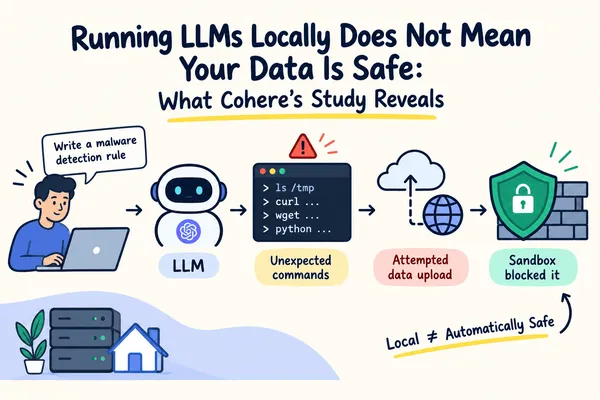
Running LLMs Locally Does Not Mean Your Data Is Safe: What Cohere’s Study Reveals

Nace AI Open-Sources Drex Max v1: A 27B Decision Model That Runs Locally on Apple Silicon
Nace AI has released Drex Max v1 as open weights. Drex Max is its most capable decision model, and it now runs on your own hardware. The release ships bf16 weights, a Q8_0 GGUF, an affine Q4 checkpoint and forks of llama.cpp and Ollama. For developers, Drex Max open weights mean routing, classification and policy checks can stay on a local machine.
TL;DR
- Size: Dense 27B parameters, 262,144-token window (16,384 by default), up to 255 options per question.
- Runs on: NVIDIA GPU with Python (H100 bf16, or L40S 48 GB in 8-bit). Apple Silicon Macs with 24 GB+ (affine Q4) or 48 GB (Q8_0 GGUF). CPU via llama.cpp and Ollama.
- Performance: 67.52 on the public Decision Index 0.4, 6.27 points ahead of Drex v2.0 (self-reported).
- Best: 97.3 skill on InfographicVQA. Tools area reaches 81.9. A top-tier decision model you can now run offline on a Mac.
What is Drex Max?
Drex Max is a decision model from Nace.AI that answers typed questions about a given context. You pass a state (text, JSON or images) plus named questions. The model returns a probability for every option in one forward pass. Nothing is generated.
Questions come in 3 types: choice among named options, yes/no, and an ordinal score. That makes it a fit for agent routing, ticket triage and guardrail checks. The hosted version is presented at routing, classification and policy checks.
How does Drex Max work?
The model card describes a dense 27B backbone with 64 layers. 48 are Gated DeltaNet linear-attention layers that run left to right. The other 16 are full-attention layers, placed every fourth layer, and they are non-causal. Every token can attend to the whole sequence.
Images pass through a native vision tower and are visible to every question in a request. A 255-way readout head then turns the last hidden state into option probabilities. The config lists a qwen3_5 model type with a 262,144-position window.
&&&How does Drex Max perform on benchmarks?
All figures below are self-reported by Nace AI,
- Decision Index 0.4 (public text): 67.52. Drex v2.0 scores 61.25 and Jev 1.13.0 scores 57.96.
- Area skill: Tools 81.9, Language 72.2, Retrieval 68.8, Knowledge and Reasoning 57.1, Arts 53.4.
- Public vision index: 73.92 across 11 benchmarks and 12,210 rows.
- Artificial Analysis Decision Index: 64, which Nace says ranks 4th of 18.
- JevBench: 92.2% (213/231). Decision Bench v4: 94.30% (1010/1071).
The results dataset covers 140,620 requests. Unanswered requests count as wrong.
How do you run Drex Max locally?
Nace documents 5 runtimes. All of them serve the same POST /v1/systemone API.
| Runtime | Hardware | Checkpoint | Images |
| Python | NVIDIA GPU | bf16 (~49 GB) or 8-bit (~26 GB) | Yes |
| llama.cpp fork | Apple Metal, CPU | Q8_0 GGUF (27.25 GB) | No |
| Ollama fork | Apple Metal, CPU | Q8_0 GGUF | No |
| Kapitsa v0.2.25+ | Apple Silicon | Q8_0 GGUF or affine Q4 | No |
| MLX | Apple Silicon | affine Q4 (14.45 GB) | No |
The affine Q4 checkpoint targets Macs with 24 GB or more. The Q8_0 GGUF needs 48 GB. On a 48 GB Mac, Nace recommends –context 2048 for Kapitsa.
Ollama users set num_gpu 40 to offload 40 layers to Metal. Setting num_gpu 0 runs it on the CPU. The Ollama fork needs a CAPABILITY decision line in the Modelfile.
Quantization holds up in Nace’s tests. On a 48 GB Apple M5 Pro, the Q8_0 GGUF matched H100 bf16 within 0.02 per probability. The affine Q4 stayed within 0.0329 of Q8_0, with no choice flips.
Drex Max vs other decision models
| Drex Max v1 | Drex v2.0 | Drex v1.5 | Jev 1.13.0 | |
| Parameters | 27B dense | 35B MoE, ~3B active | 9B | Not published |
| Max context | 262,144 | 131,072 | 131,072 | Not disclosed |
| Inputs | Text, JSON, images | Text (vision tower dropped) | Text | Not disclosed |
| Weights | Open, Nace.AI Open RAIL-M | Open, Nace.AI Open RAIL-M | Open, Nace.AI Open RAIL-M | Closed, hosted |
| Smallest local file | Affine Q4, 24 GB+ Mac | Q8_0, 36.9 GB | Q8_0, ~9.5 GB | Not applicable |
| Public Decision Index | 67.52 (v0.4) |
Meet qwenGPU: Qwen3.5-2B With 45 Compiled GPU Layers That Run CUDA
qwenGPU is an experimental model that compiles a SIMT GPU directly into the weights of Qwen3.5-2B. Developer Vixhal (@TheVixhal) released it on GitHub under the MIT license. The model runs real CUDA, compiled to NVIDIA PTX, inside its own forward passes. For developers, it tests one idea: exact computation inside a pretrained LLM, not beside it.
TL;DR
- Size: Qwen3.5-2B (24 layers) along with 45 compiled GPU layers, 69 in total. Context: 262,144 tokens (base model).
- Runs on: Apple silicon, an NVIDIA GPU or a CPU, with about 16 GB of free memory. No quantized build.
- Performance: Every launch in the developer’s runs was exact; text drift is a KL of about 7e-4.
- Best: The reference interpreter matched a real NVIDIA Tesla T4 on 49 of 49 kernels.
- Worst: About 10 to 15 tokens per second on Apple MPS; Qwen-written CUDA passed 4 of 5.
What is qwenGPU?
qwenGPU is Qwen3.5-2B with 45 compiled transformer layers placed in front of Qwen’s own 24. None of those layers are trained. A compiler computes every weight.
How does a GPU fit inside model weights?
The GPU is a 4-lane SIMT machine. It has 15 registers per lane, a 4-stage pipeline, a 32-block ROM and 126 memory words. It uses only Qwen3.5’s own layer types: Gated DeltaNet linear attention and SwiGLU MLPs.
The trick is the Gated DeltaNet recurrent state. In the circuit’s heads, the gate is held open and the write strength is 1. Every key is one-hot. Each update overwrites exactly 1 row, and a one-hot query reads it back. So each row works as a memory cell.
That state holds the program ROM, registers and global memory. The README lists 16 register rows per lane, with 1 that always reads zero. That matches the 15 usable registers in the X post.
The GPU supports integer arithmetic, predicates, divergent branches and loops. It also supports shared memory, atomicAdd, __syncthreads() and warp shuffles.
What happens during a CUDA launch?
The host plays the role of NVRTC and the CUDA driver. It compiles CUDA to PTX with clang, then lowers PTX to machine blocks. It feeds the program and input arrays to the model as tokens.
From there, the model writes the launch itself. Each EXEC(b, w) token runs block b for warp w in 1 forward pass. The VAL tokens after it carry register results. Memory writes return as MEM records. The host reads results from the recurrent state and computes none of them.
In the demo video, a dot product of [1, 2, 3] and [4, 5, 6] returns 32. The model wrote that launch in 47 tokens.
Meet qwenGPU: Qwen3.5-2B with a SIMT GPU inside its weights, 45 compiled layers in front of Qwen’s own, using its Gated DeltaNet layers as registers and memory.
— vixhaℓ (@TheVixhal) November 1, 2026
It runs real CUDA in its forward passes. The host compiles the kernel to PTX and loads it, then the model writes every… pic.twitter.com/iM5IETEbIv
Does the GPU break Qwen’s text ability?
Not by the developer’s measure. The circuit is muted on text tokens, and Qwen’s own weights are unchanged. The merged model’s next-token distribution stays within a KL of about 7e-4 of the original.
How accurate is qwenGPU?
All numbers are self-reported, measured on Apple silicon with MPS in bf16:
- Every launch was exact under
--checkreplay. - The reference interpreter matched an NVIDIA Tesla T4 on 49 of 49 test kernels.
- Normal mode answered 20 of 24 sampled chat questions with GPU-computed numbers.
- Advanced mode wrote a correct kernel first try on 4 of 5 questions.
In normal mode, Qwen writes an expression like [1, 2, 3] @ [4, 5, 6] for ready-made kernels. In advanced mode, Qwen writes the CUDA kernel itself. The README warns that a 2B model’s CUDA is still unreliable.
How does qwenGPU compare with Qwenputer and Percepta?
qwenGPU uses the transformer compiler from Qwenputer by Divyansh Agrawal. Qwenputer compiles a 32-bit RISC-V CPU into Qwen3.5-4B. Percepta built a WebAssembly interpreter into a transformer with 2D attention heads in March 2026.
| Feature | qwenGPU | Qwenputer (RISC-V) | Percepta |
|---|---|---|---|
| Base model | Qwen3.5-2B, 24 layers | Qwen3.5-4B | Custom transformer with 2D attention heads |
| Machine compiled in | 4-lane SIMT GPU | 32-bit RISC-V (RV32IM + Zba + bignum) | WebAssembly interpreter |
| Programs it runs | CUDA, lowered from PTX | C and MicroPython | C, compiled to WebAssembly |
| Compiled layers | 45 | 11 | Not disclosed |
| Where state lives | Gated DeltaNet state | Gated DeltaNet state | Execution trace in context |
| Host role | Compiles CUDA to PTX, loads tokens, reads results | Loads firmware; runs no computation | Not disclosed |
| Correctness check | Interpreter matched Tesla T4 on 49 of 49 kernels | 0 mismatches in about 230,000 replayed positions | Claims millions of reliable steps |
| Reported speed | 10 to 15 tokens/s (Apple MPS) | About 3,200 trace tokens/s (L4, Triton) | 30,000+ tokens/s (CPU) |
| Text drift vs base | KL about 7e-4 | KL 6e-4 | Not applicable |
| License | MIT code; Apache-2.0 checkpoint | MIT code; Apache-2.0 weights | Not disclosed |

Zyphra AI Introduces Zyphra Hierarchical Attention (ZHA): A Path to True Subquadratic Attention
Zyphra has released Zyphra Hierarchical Attention (ZHA), a sparse attention method built around a tree-structured indexer. ZHA targets a known gap in sparse attention: the indexer that picks tokens still scans the whole context. Zyphra’s technical paper shows ZHA can be distilled into frozen pretrained models with about 4B tokens. On Qwen3.6-35B-A3B it stays close to dense attention on reasoning, agentic coding and 256K retrieval benchmarks.
TL;DR
- Size: It is a method that adds 81,920 trainable parameters to Qwen3.6-35B-A3B (about 0.00024%). Tested up to 256K context.
- Runs on: Retrofits frozen pretrained models after a 4B-token KL warmup at 32K context. Speedups come from a modeled H100 BF16 roofline. No optimized kernels released. An FP4 router variant was also tested.
- Performance: Within a few points of dense attention on 7 reasoning, coding and retrieval benchmarks.
- Best: LongBench v2 hits 63.4% (deep tree) vs 58.0% dense, using about 1.1% of keys.
- Worst: On NoPE-based Nemotron-3.5-Lightning-30B-A3B, deep-tree RULER-13 drops 25.3 points below dense.
What is Zyphra Hierarchical Attention (ZHA)?
ZHA is a sparse attention method from Zyphra that finds relevant keys by searching a tree. It keeps the full KV cache. The tree only decides which cached keys each query reads.
Fixed-state methods like SSMs and sliding windows saturate at long contexts. Fine-grained sparse methods like DeepSeek Sparse Attention score every past token with an indexer. The final attention is sparse, but the indexer still grows with the full context.
Near 1M tokens, cited work shows indexing takes 60 to 90% of layer time. ZHA makes the search itself sparse.
How does ZHA’s tree indexer work?
Building the tree
ZHA splits keys into contiguous chunks and compresses each chunk into a summary key. Summaries are grouped and compressed again, level by level. With chunk size 4, 6 levels cover 4,096 tokens per top node.
Summaries come from a small set of learned reference queries. Each reference query gives a tangent-plane estimate of a chunk’s log attention mass. The max over these planes approximates how much attention any future query would give the chunk.
How does top-p routing pick tokens?
At decode time, a query scores the top-level nodes. It keeps the smallest set holding a fraction p of estimated attention mass. It then expands only those children, repeating until it reaches raw KV entries.
Top-p makes the budget adaptive. A single-fact lookup touches few branches. A query that needs many scattered facts expands more. The first token is always kept as an attention sink.
How does ZHA perform against dense attention and MSA?
Zyphra team converted Qwen3.6-35B-A3B with 2 trees: deep (chunk 4, 6 levels) and wide (chunk 256, 1 level). Both use 16 reference queries and p = 0.95. It also trained a MiniMax Sparse Attention (MSA) indexer on 40B tokens, 10x ZHA’s budget.
| Benchmark (Qwen3.6-35B-A3B) | Dense | ZHA deep | ZHA wide | MSA |
|---|---|---|---|---|
| AIME 2026 | 93.1 | 91.2 | 90.8 | 91.7 |
| SWE-bench Verified | 67.4 | 67.4 | 68.4 | 63.6 |
| Terminal-Bench 2.1 | 49.9 | 46.7 | 53.3 | 46.1 |
| MMLU-Pro | 84.9 | 85.3 | 85.2 | 85.3 |
| GPQA Diamond | 84.8 | 85.0 | 85.0 | 83.1 |
| RULER-13 (256K) | 96.0 | 93.3 | 96.2 | 77.1 |
| LongBench v2 (thinking) | 58.0 | 63.4 | 62.4 | 49.3 |
Source: arXiv 2610.42112, Figure 5. All numbers self-reported by Zyphra.
The biggest gap is on retrieval. MSA drops to 77.1% on RULER-13, while both ZHA trees stay above 93%. On LongBench v2, the deep tree and MSA read similar key shares (1.1% vs 1%). The deep tree scores 14.1 points higher.
Across 28 tree geometries, RULER accuracy held steady when attending to 10 to 30% of keys. At fixed compression, deeper trees kept accuracy at higher sparsity. A 4-parameter model predicts RULER accuracy from geometry with 1.44-point RMSE.

Making Local LLMs Usable on 8GB GPUs
A local model can manage a brief question without any issues, but it may have difficulty when dealing with a complete document. The model's internal settings stay the same, but the effort needed and the memory required to process the request increase a lot.
In Part 1, I explained how to run a quantized model on a smaller GPU.
The next step is to choose a task, measure how long it takes, and find a setup that works within the GPU's limits.
This guide uses Qwen2.5-7B-Instruct along with llama.cpp.
It includes memory calculations, a fixed starting configuration, and a Python-based benchmark that you can run on your own computer. The numerical memory estimates are calculated values, and this article does not claim to have measured improvements in GPU performance.
To understand the actual delay you experience, there are two main waiting periods in a conversation. The first occurs when the model processes the initial prompt, often called the prefill phase. The second happens when the model generates the answer one word at a time, known as the decode phase.
If a document takes several seconds to process, fast decoding won't eliminate that initial delay. However, if the first words appear quickly but the rest of the response is slow, then the decoding phase is the area that needs optimization.
Keep these measurements separate:
Measurement | What it tells you |
Time to first text | Delay before the client receives the first nonempty text chunk |
Decode tokens per second | The server's reported generation rate |
Total request time | How long that request takes to finish |
Output token count | Whether two runs produced comparable amounts of text |
A target such as "start a short answer within two seconds" can guide your own experiments. It is a product requirement you choose, not a promised result for every 8GB card.
Budget for the KV cache as well as the weights
The model file is only part of the memory requirement. During generation, the runtime also stores attention keys and values for tokens already processed. This KV cache avoids recomputing those states, but it needs memory of its own. Working buffers and other GPU applications need space too. [1]
For a conventional full-attention transformer, an approximate KV-cache payload is:
KV bytes = 2 x layers x stored tokens x KV heads x head dimension
x bytes per cache element
The initial 2 accounts for keys and values. Use the number of KV heads, which can differ from the number of query heads.
Qwen2.5-7B-Instruct has 28 layers, 4 KV heads, and a head dimension of 128, obtained from its hidden size of 3,584 divided by 28 query heads. With FP16 cache elements, the calculation becomes 2 x 28 x tokens x 4 x 128 x 2. [2]
Stored tokens | Calculated FP16 KV payload |
4,096 | 224 MiB |
8,192 | 448 MiB |
16,384 | 896 MiB |
32,768 | 1,792 MiB or 1.75 GiB |
These figures describe one sequence and exclude allocation padding, runtime buffers, and model weights. They are not measurements of total VRAM usage. Other architectures, cache layouts, and attention types need different calculations.
This is why a large advertised context window needs its own memory budget. On this model, moving from 4K to 32K tokens adds about 1.53 GiB of calculated FP16 cache payload. Whether that increase fits depends on everything else already occupying the GPU.
Weight quantization and cache quantization are separate choices. A Q4_K_M model can still use an FP16 KV cache. Reducing cache precision may free up space, but it needs a quality check and a latency measurement. Hugging Face's cache documentation also cautions that cache quantization can hurt latency in some short-context situations. [1]
Establish one repeatable baseline
The shell commands below target Linux or WSL2 with an NVIDIA GPU. Install a working NVIDIA driver, a compatible CUDA Toolkit, Git, CMake, and a C++ compiler first. The benchmark itself requires Python 3.10 or newer and no third-party Python packages.
Use the current CMake build route in the llama.cpp build documentation: [3]
git clone https://github.com/ggml-org/llama.cpp
cd llama.cpp
cmake -B build -DGGML_CUDA=ON -DCMAKE_BUILD_TYPE=Release
cmake --build build --config Release -j 4
git rev-parse HEAD > llama-commit.txt
./build/bin/llama-server --version > llama-version.txt
./build/bin/llama-server --help > llama-help.txt
nvidia-smi > gpu-environment.txt
Keep that checkout unchanged throughout the experiment. Save the model filenames and their SHA-256 hashes too, including every shard if the download is split. A model tag alone is not enough to reproduce an experiment after its files change.
I use the official Qwen GGUF repository because its model configuration is available to inspect. It is a concrete baseline, not a claim that this is the best available model. [4]
Start the server from the llama.cpp directory:
./build/bin/llama-server \
  -hf Qwen/Qwen2.5-7B-Instruct-GGUF:Q4_K_M \
  --n-gpu-layers all \
  --ctx-size 4096 --parallel 1 \
  --batch-size 512 --ubatch-size 128 \
  --flash-attn off \
  --cache-type-k f16 --cache-type-v f16 \
  --fit off --no-context-shift --perf \
  --host 127.0.0.1 --port 8080 \
  2> baseline-server.log
The first launch downloads the selected model. Exclude that download and startup from request timings. Once the server is ready, inspect its log for the CUDA device, layer placement, cache allocation, and effective context settings. If an installed version rejects an option, consult its saved help output before continuing. The current server options are documented upstream. [5]
This configuration requests full GPU offload; it does not guarantee that every 8GB system has enough free memory. If startup fails, first close another GPU workload or test a smaller context. If partial offload is necessary, record the actual GPU layer count and use it consistently across the comparison.
The baseline has one request slot. Keep other inference clients stopped while measuring. With automatic fitting disabled, a failed configuration is visible instead of becoming a different experiment through an adjusted setting.
Run a benchmark that preserves the evidence</
Apple Isn't Done With 2026: Here's What's Still Coming
Below, we've rounded up what's still coming, along with one date in particular that's worth watching if you're a holiday shopper.
- Apple Intelligence testing in China – November 4: The first Apple Intelligence features for users in China enter testing in the latest iOS developer beta from Wednesday, November 4. Apple has partnered with Alibaba to add Qwen support to Siri, Writing Tools, and Visual Intelligence.
- Five new products – November 6: Apple is launching five products this Friday: the OLED iPad mini with A20 Pro (from $699), the M6 iMac (from $1,499), the 14-inch MacBook Pro with M6 (from $1,999), and all-new 14-inch and 16-inch MacBook Pro models with OLED touchscreens (from $2,899 and $3,399). The latter two are Apple's first touchscreen Macs. Pre-orders are already open, but individual delivery dates vary based on region and configuration.
- Apple HomeView – November 13: Apple's new smart home display arrives on Friday, November 13, priced at $299. Available in tabletop and wall-mounted versions, the hub can be used to answer questions with Siri AI, display pictures, make FaceTime calls, play music, show recipes, offer up calendar events, and more. Pre-orders are already open in launch markets, but HomeView will not initially be sold in the European Union.
- Apple TV 4K – November 13: The fourth-generation Apple TV 4K launches alongside HomeView, and is also priced at $299. Unlike previous generations, there's just the one model with 128GB storage, and it adds Siri AI and supports four-speaker surround sound with HomePod mini 2 or second-generation HomePod speakers. Pre-orders are already open.
- Apple Creator Studio updates – November: Updates coming this month bring built-in MotionVFX content to Final Cut Pro, Generate Fill to Pixelmator Pro, and new AI assistants in beta to Logic Pro, Keynote, Pages, and Numbers. The updates are free for existing subscribers.
- Black Friday – November 27: It's not a product launch, but a date likely worth marking. Apple has held a four-day shopping event over the Black Friday weekend in recent years, when it has typically offered gift cards with eligible purchases. Our Black Friday roundup will be tracking the deals.
- iOS 27.3 and Apple Intelligence in China – December: Apple has confirmed the public rollout of its first Apple Intelligence features in China for December, alongside iOS 27.3. The initial release is for supported iPhones, with other platforms to follow after the required regulatory approvals.
- Apple Home Collection – from December: The new Apple-backed, third-party lineup includes smart home cameras, thermostats, and a lock designed with LG Electronics and Schneider Electric. Apple says that availability begins in December, although select accessories will not arrive until early 2027.
This article, "Apple Isn't Done With 2026: Here's What's Still Coming" first appeared on MacRumors.com
Discuss this article in our forums
iOS 27.2.1 Coming Soon, iOS 27.3 Beta Likely Available Tomorrow
iOS 27.2.1 should be a minor update that includes bug fixes and/or security patches, including for the iPhone Duo that launched Friday, October 23. We do not know exactly when the update will be released, but usually upcoming iOS versions begin to show up in our logs a few days to a few weeks before they are made available to the public.
There may also be a macOS 27.2.1 update with a fix that prevents macOS command-line tools from accepting eMudhra's compromised web certificates. The certificates have already been blocked in Safari, Mail, and apps that use Apple's networking and security frameworks since October 19, with no software update required for that.
In addition, we expect the first iOS 27.3 developer beta to be released tomorrow.
In a press release on the Apple Newsroom website in China last week, Apple said the iOS 27.3 beta would be released on Wednesday, November 4, but that likely means Tuesday, November 3 in the U.S. due to time zone differences. Apple said iOS 27.3 will be released to the public in December, but it did not provide a specific date.
iOS 27.3 will enable some Apple Intelligence features in China on the iPhone 15 Pro and newer, such as Writing Tools, Genmoji, Clean Up, Notification Summaries, Priority Notifications, Visual Intelligence, and Live Translation with AirPods.
Apple also said it has partnered with Alibaba to add support for its AI assistant Qwen within Siri, Writing Tools, and Visual Intelligence.
Siri AI and other Apple Intelligence features announced at WWDC 2026 will not be available in China on iOS 27.3, according to Apple.
Image Playground will also not be available in China.
Both the iPhone and Siri language will need to be set to English and Chinese (Simplified). Apple Intelligence features will not be available on the Mac, iPad, or other devices in China until Apple receives the necessary approvals, it said.
This article, "iOS 27.2.1 Coming Soon, iOS 27.3 Beta Likely Available Tomorrow" first appeared on MacRumors.com
Discuss this article in our forums
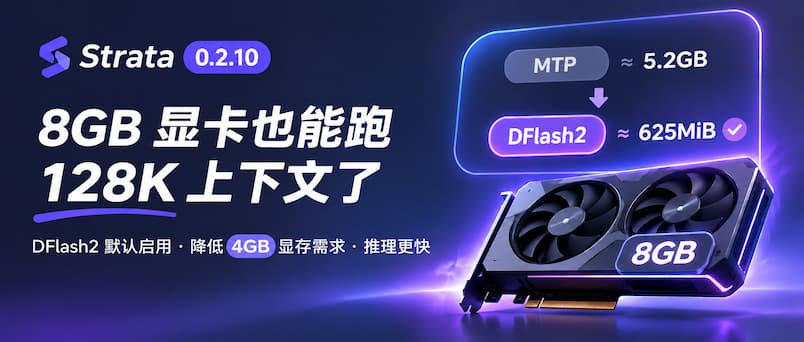
Strata 0.2.10 发布:本地 AI 大模型继续提速,默认使用 DFlash2 降低显存需求,8GB 显卡也能开启 128K 上下文
之前小众软件多次介绍过 Strata:这款开源工具可以让普通电脑,尤其是显存有限的消费级显卡,也能运行参数规模惊人的本地 AI 大模型,比如 Qwen3.8、Qwen-Flash-Next、DeepSeek 4.1 Flash 等模型。@Appinn
Strata 0.2.10 发布,这次带来了几项值得关注的改进:新的 DFlash2 推测解码器成为默认选项(降低4GB显存需求),8GB 显卡也能启动 128K 长上下文,多显卡推理速度大幅提升,还加入了一个专门针对编程任务优化的 DeepSeek 模型。
Strata 交流微信群
青小蛙拉了个交流 Strata 微信群,感兴趣的同学可以扫码入群:

8GB 显卡,也能开启 128K 上下文
以前在 8GB 显卡下,开启 64K 上下文会耗尽专家缓存空间,导致启动失败。只能改用 CPU 图像处理、更小的 KV 缓存,或将上下文降到约 48K。
Strata 0.2.10 改进了这套机制:当显存不足时,优先调整显存和内存之间的数据分配,尽可能保留用户设置的上下文长度。
比如,现在可以在 8GB 显存条件下启动 Qwen3.8 IQ3_S,并保持 128K 上下文,也就是 131,072 Token。
Strata 会根据显存余量,逐步缩小驻留在 GPU 中的 KV 缓存窗口,必要时还会调整其他缓存,甚至将部分数据放到系统内存中。
官方测试中:
- 8GB 显存限制下,DFlash2 模式生成速度达到 63~73 Token/s。
- 32K Token 的提示词处理时间为 19.8 秒。
- 一张真正的 Intel Arc A750 8GB 显卡,也成功启动 128K 上下文,生成速度为 12.7~14.8 Token/s。
注意,显存需求仍然在,不是凭空消失,而是把压力给到了内存和 SSD。

所以青小蛙认为,Strata 降低的只有显卡门槛,但却大大提升了内存容量门槛。
基本上,内存:32G起步,48G刚好,64G才算解决温饱。
DFlash2 成为默认加速器,还能额外节省 4GB 显存
Strata 0.2.10 将 DFlash2 设置为默认加速器。
DFlash2 是一种推测解码器。简单理解,就是让一个体积较小的辅助模型提前猜测接下来可能生成的内容,再交给主模型批量验证。猜对的部分越多,主模型就越有机会一次确认多个 Token,从而加快生成速度。
此前 Strata 使用的 MTP 推测层大约需要 5.2GB 空间,而新版 DFlash2 的显存占用约为 625MiB。
官方对比了同一引擎下 DFlash2 和 MTP 的表现:
| 测试设备 | 模型 | 生成速度提升 |
|---|---|---|
| Ryzen AI Max(Windows) | IQ3_S | 短回复 +8.4% |
| RTX PRO 5000 | IQ3_S | 短回复 +6.23% |
| Apple M5 Max | IQ3_S | +3.8% |
| DGX Spark | IQ3_S | +5.8% |
但是,也不是没有代价。
DFlash2 与 MTP 对比
相比之下,MTP 在硬件兼容性和多并发下都有优势:
| 对比项目 | DFlash2 | MTP |
|---|---|---|
| 显存占用 | 约 625MiB | 约 5.2GB |
| 额外文件 | 首次下载约 1.2GB | 推测层约 5.2GB |
| 单请求生成速度 | 多数官方测试更快 | 部分硬件更快 |
| 多并发 | 主要面向单请求 | 更适合多请求 |
| 低显存设备 | 优势明显 | 显存压力较大 |
| 支持范围 | 依赖特定模型与引擎 | 兼容范围更广 |
| Strata 0.2.10 默认策略 | 单请求 Qwen3.8 优先 | 多并发等场景优先 |
两张显卡一起跑,代码编辑速度接近翻倍
针对多显卡,这次更新带来优化:All-cards Split Engine。
以前多显卡运行模型时,常见做法是将模型的不同层分配到不同显卡。新的方式则允许多张显卡共同处理每一层模型,让它们同时参与计算。
官方使用两张 RTX A6000,在 Linux 下运行 UD-Q4_K_XL,得到以下结果:
| 测试任务 | 原来的速度 | 新版速度 |
|---|---|---|
| 代码编辑 | 195 Token/s | 377~394 Token/s |
| 生成新代码 | 139~144 Token/s | 189~232 Token/s |
| 普通文本 | 93 Token/s | 139~146 Token/s |
| Agent 循环 | 112~119 Token/s | 165 Token/s |
代码编辑任务的生成速度几乎翻倍。
还加入了一个编程专用的 DeepSeek 模型
Strata 0.2.10 新增了 ISTA-DAS Coder。它基于 DeepSeek-V4.1-Flash,针对编程和 Agent 任务进行了专家裁剪,每层只保留原来 384 个专家中的 192 个。
这样可以减少需要处理的专家权重。
官方测试中:
- 单张 Radeon AI PRO R9700:22.8 Token/s。
- 四张 R9700:59.2 Token/s。
- Apple M5 Max:19.1~22.5 Token/s。
- RTX PRO 6000 Blackwell:约 100 Token/s。
不过,这个模型的存储需求依然很大,仅模型权重就有约 72.1GB,另有约 110.6GB 的 Engram 数据文件,首次完整下载约需 191GB。
Agent 用户也迎来一批实用修复
除了推理性能,这次 Strata 还修复了不少图形界面和 Agent 相关问题。
比如:
- AI 回复很长时,Approve 和 Deny 审批按钮不再被滚动到看不见的位置。
- 子 Agent 可以接收用户追加的指令。
- 历史对话自动摘要现在会尽量使用用户原本的语言。
- AI 正在生成内容时,可以选择等待、排队发送新消息或者中断。
- 支持引用之前的某轮对话或选中的文字。
- 改善 Claude Code 遇到上下文溢出时的错误提示,让它能够尝试压缩上下文。
另外,Strata 也修复了 Windows 某些后台启动场景下,磁盘读取优先级过低、导致模型加载明显变慢的问题。
下载与更新
Strata 免费、开源,提供 Windows、macOS 和 Linux 版本。本次更新后 Strata 版本为 0.2.10,引擎版本 0.1.56。这两者都需要单独更新。
依旧,Strata 图形界面用户可以直接更新:
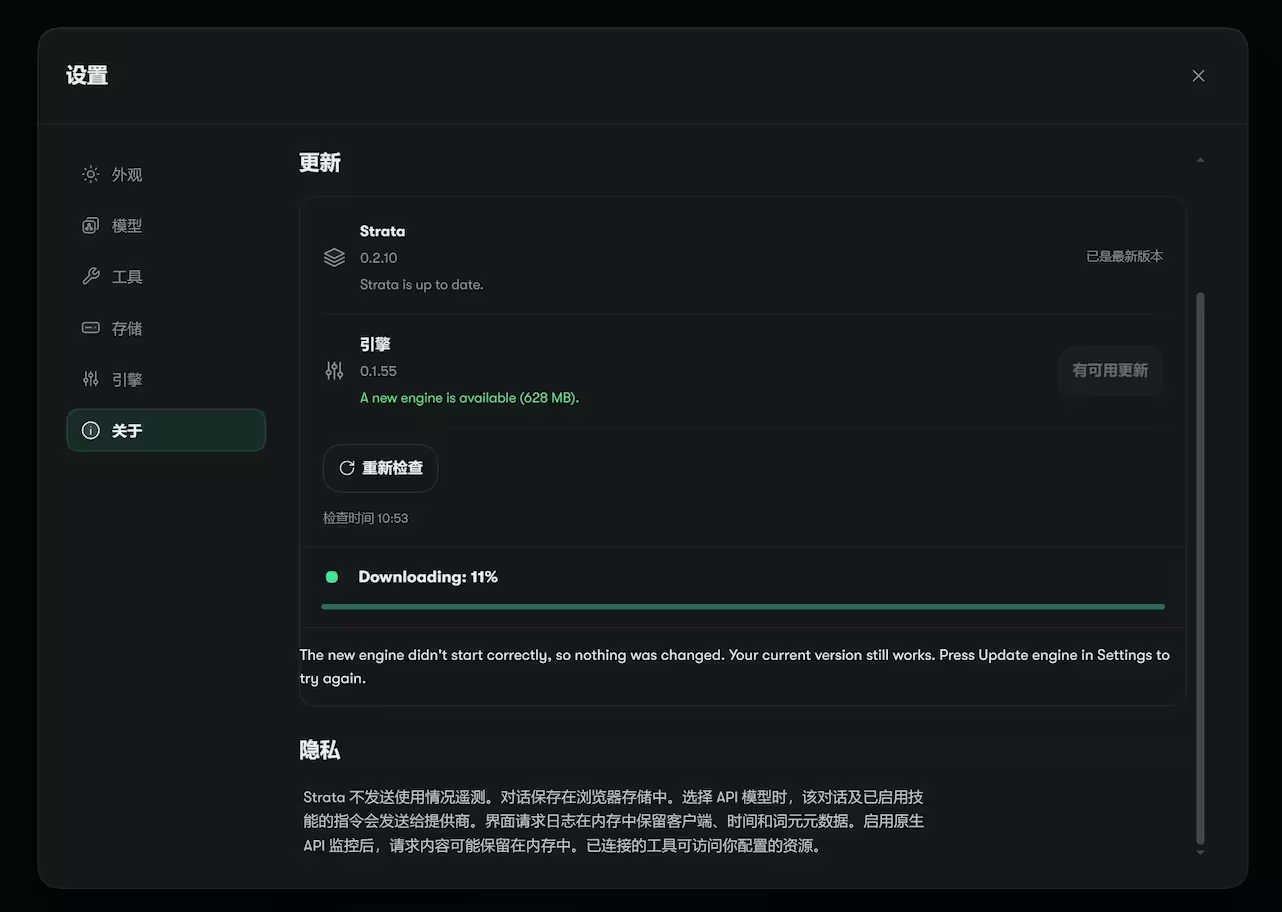
终端版用户可以运行:
strata update
项目地址: https://github.com/Niko1221/Strata
另外,每次升级都需要下载不小的文件,好慢啊。
原文:https://www.appinn.com/strata-0-2-10/
相关阅读

[问与答] 云服务商的云盾程序你们会保留吗?
感觉对安全、隐患发现是有作用的,但是留了这个又觉得毫无隐私。

开源数据库管理工具 CloudDM 发布新版本,支持团队多级审批工单

MIT:GPT-6 Astra能直接修改Qwen权重,数学能力暴涨6倍

阿里云发布AI投研工作台Qovest,给专业投资者配一个“AI研究员”
11月2日,阿里云正式发布面向专业机构投资者的AI投研工作台Qovest。用户用一句话提出研究需求,Qovest就会自动查数据、收集资料、深度分析、生成报告,并按设定的频率持续跟踪研究对象。与一次性问答不同,Qovest可以把每次的研究结果沉淀到投研空间,让一项研究能接着往下做,不必每次从零开始。近期,Qovest将推出企业版,服务金融机构及企业的投研团队。
专业投资者对Agent的要求,远比日常聊天要高:数据要实时和准确,输出结果要有明确出处,研究结论必须专业可靠。为此,Qovest团队采购权威金融数据库、将其部署在阿里云上,自研面向金融场景的Agent工程框架(Harness),打通从数据调用到分析输出的完整流程,让交付结果更加准确和专业。在开源金融评测集FinFirst与IRAB的内部横向评测中,Qovest的回答质量、响应速度、成本都领先于参与评测的主流产品。
“我们希望把投研过程中耗时较多、重复性较强的工作交给AI,把时间还给真正需要专业判断的地方。” Qovest产品负责人表示。
Qovest首页提供了多个投研案例范本,用户可以自选标的作为研究对象,设置定时任务,接入自己的操盘笔记,获得可视化的深度研究结果。比如,用户可以让Qovest拆解人形机器人产业链中各环节的单机价值与国产化水平,得到一份可交互的产业链图谱;也可以让Qovest测算数据中心电力设施的投资规模,只要调整任何一个前提假设,Qovest就会自动重新计算。
深度研究之外,Qovest还能让研究持续跟着市场跑。有基金经理在Qovest里为某个“黄金ETF”建立了一项跟踪研究:圈定国际金价、美元指数、全球ETF持仓、央行购金等变量后,Qovest每周自动更新数据,拆解当周金价涨跌中汇率因素与加息预期各自的占比,生成一份动态跟踪看板。此后每次打开这只ETF的研究页面,Qovest都能接着继续分析。

这种“不用每次从零开始”的体验,来自Qovest的“投研空间”。它与Qovest对话打通,能把研究成果、个人操盘笔记和待验证问题自动归档,让研究可追溯、可对比。未来在企业版中,“投研空间”会成为组织内成员协作、信息共享的研究调度中心。
目前Qovest官网已经对个人用户开放邀测,新用户注册后即获相应积分可免费试用,后续可选择每月99元或199元的订阅套餐,各套餐包含相应使用额度。

何小鹏:如果你想证明自己的智驾强,那你就应该出国;奇瑞高管回应智界独立;DeepSeek最新融资细节曝光!vivo、美团等位列投资者名单
1.何小鹏:如果你想证明自己的智驾强,那你就应该出国
2.39岁宇树前高管出走创业,遭投资人嫌年龄大备注老登!融资如零下40度
3.奇瑞高管回应智界独立:要更像新势力,而非“大一号”传统车企
4.重磅!美团公告:两位80后晋升副总裁
5.DeepSeek融资1055亿细节曝光!vivo、美团、小红书等位列投资者名单
6.Meta 与中国企业傅利叶打造人形机器人原型,号称 Muse 模型的物理化身
7.阿里巴巴透露国行Apple智能细节:Siri直接调用千问,用户可自主选择开通
8.OpenAI宣布:ChatGPT部分任务与Codex将共享额度,12月起实施
今日头条何小鹏:如果你想证明自己的智驾强,那你就应该出国
10月31日消息,小鹏汽车掌门人何小鹏近日公开发声,给行业内智能驾驶能力的比拼标准下了全新定义:如果一家车企想证明自家的智驾技术真正过硬,最直接的验证方式就是把产品开到海外市场,接受全球不同路况、不同交规场景的实际考验。
何小鹏坦言,小鹏从品牌创立之初,就把智能驾驶刻进了自身的核心基因里,不过这么多年在国内市场,始终不乏针对小鹏智驾能力的质疑声音,相关的行业争论从来没有停止过。这次巴黎车展,欧洲本地车企与媒体一开始也怀疑,直到亲身体验之后才表示认同,愿意开启合作。
何小鹏在现场直接表态,之前就有人跟他说过,想证明自己的智驾真的足够强,那就应该走出国门去接受全球市场的检验,而小鹏现在已经实打实做到了。到明年,小鹏的全场景智能驾驶技术就会正式从中国走向全球市场,在更多国家完成本地化适配落地。(快科技)
国内资讯39岁宇树前高管出走创业,遭投资人嫌年龄大备注老登!融资如零下40度
11月1日消息,据媒体报道,宇树科技前副总经理陈永刚,现在已经转身成为具身智能初创公司北京光粒跃迁的创始人。今年8月末,在宇树科技完成IPO仅一周之后,陈永刚正式递交辞呈,一头扎进创业浪潮。
近期,陈永刚正奔波在北京、深圳两地密集对接投资人,他一共约见了近20位投资机构,收获的反馈十分冰冷:不少投资人直接表态,已经不再看具身智能赛道。“具身智能创业融资,不是降温,是已经零下40度了。” 这是陈永刚对当下行业资本环境的概括。
据了解,今年39岁的陈永刚,并非985高校出身,在一众年少成名的AI天才面前,年龄反而成了短板。他整理的投资人拜访清单里,记下了一条扎心评价:有投资人直言他是“老登”,仅仅因为年纪偏大,就直接否决了这笔投资。而39岁的年龄,已经被市场划入行业老兵行列。
不过年龄之外,陈永刚先后任职小米、美团、长城汽车,即便拥有头部机器人企业高管履历、成熟的商业化经验,2026年10月的这一轮融资,依旧步履维艰。绝大多数投资方,都已经关上了具身智能项目的大门。(快科技、21世纪经济报道)
奇瑞高管回应智界独立:要更像新势力,而非“大一号”传统车企
11月1日消息,在三季度媒体沟通交流会上,奇瑞汽车股份有限公司执行副总裁戚士龙回应智界独立时表示,希望智界团队更像新势力企业,而不是简单做成“大一号”的传统车企。他表示,将从组织规模化、产品高端化及品牌逐步优化等方面,提升智界独立运营能力。据悉,智界明年还会有新产品导入,而海外业务仍由奇瑞集团独立运营。(界面新闻)
重磅!美团公告:两位80后晋升副总裁
11月1日消息,美团近日通过组织公告邮件宣布2026年人才发展及晋升名单。邮件显示,核心本地商业医药健康事业部负责人李晓辉、商业增值部负责人望金蓉晋升为公司副总裁。
李晓辉,2011年3月加入公司,曾任原到综事业部丽人及医美业务部负责人,现任核心本地商业/医药健康事业部负责人。望金蓉,2015年6月加入公司,曾任原外卖事业部商业增值部和原到家事业群商业增值部负责人,现任核心本地商业/商业增值部负责人。
公开报道显示,美团领导梯队此前晋升的多位管理者均为80后及85后,而本次晋升的李晓辉、望金蓉同样为80后。(快科技)
DeepSeek融资1055亿细节曝光!vivo、美团、小红书等位列投资者名单
11月1日消息,据外媒近日报道,DeepSeek第二轮融资的具体细节曝光。本轮融资已筹集1055亿元人民币(约合158亿美元),吸引近30家投资者参与,其中国资出资占比约27%,较首轮融资的2%大幅提升。
从投资方来看,腾讯控股、宁德时代仍是两大主要投资方。腾讯在两轮融资中均出资100亿元,宁德时代及其董事长曾毓群两轮分别出资50亿元和100亿元。其他产业投资者还包括长鑫存储、中芯国际、vivo、美团-WR、吉利汽车、美的集团、立讯精密、携程和小红书等,部分企业单家投资金额在10亿至30亿元之间。
从两轮融资累计金额来看,科技企业贡献约42%,国有投资者占比约19%,风险投资和私募股权机构位列其后。对于融资规模扩大,外媒称,英伟达高端芯片价格持续上涨,以及对AI产业泡沫的担忧,是DeepSeek中途将募资规模扩大一倍的原因。(中新经纬)
Meta 与中国企业傅利叶打造人形机器人原型,号称 Muse 模型的物理化身
11 月 1 日消息,据外媒报道,Meta 最近与中国企业傅利叶(Fourier)合作,打造一款名为 Max 的人形机器人原型。
据介绍,这款机器人研发用时三个月,其身高接近 5 英尺(约 1.5 米),体重约 106 磅(约 48.1 千克),搭载英伟达 Thor 芯片。Meta 首席执行官马克 · 扎克伯格将这款人形机器人,视为 Muse 人工智能模型的“物理化身”,认为它能够承担日常家务。
报道称,两家公司已在今年 9 月启动 Max 2 原型产品的研发工作。新机器人预计将重新设计躯干部分,并进行其他常规升级。Meta 与傅利叶暂未确定该产品推出时间,也无计划销售原型机。(IT之家)

阿里巴巴透露国行Apple智能细节:Siri直接调用千问,用户可自主选择开通
11月1日消息,日前,苹果正式官宣国行Apple智能,将于11月4日起随最新的iOS开发者Beta版开放测试,并将于12月iOS 27.3正式发布时面向中国用户推出。
阿里巴巴也官宣与Apple达成合作,将千问集成至Apple智能,中国用户可以在Siri、写作工具及视觉智能中,直接调用千问的文本与图像理解、内容生成等能力。官方透露,Siri可以直接调用千问的广博知识,并在Siri中直接回复用户问答。通过Siri,用户还能用自己选择的文档和照片,直接向千问提问。阿里巴巴强调,在任何问题、文档和图片发送给千问之前,都会先征得用户同意。
据悉,用户可以自主选择是否开通千问集成功能。启用后,用户可通过Apple登录或使用自己的千问App账户登录,在Siri、写作工具和视觉智能中使用千问。用户可以自主决定何时使用千问,以及分享哪些信息。用户请求及生成的回复均不会被阿里巴巴用于模型训练,以保护用户隐私。(快科技)

前三季度净利润1320亿!长鑫科技:已与多家头部客户协商长期供货协议
11月1日消息,日前,长鑫科技发布公告称,2026年前三季度实现营业收入2690.24亿元,同比增长738.51%;归属于上市公司股东的净利润1320.4亿元,同比扭亏为盈。第三季度实现营业收入1187.14亿元,同比增长613.18%;归属于上市公司股东的净利润544.35亿元,同比扭亏为盈。
长鑫科技表示,业绩变动主要系全球DRAM产品供不应求,公司产品销售数量和销售价格大幅上涨,叠加单位成本下降,产品毛利大幅上升所致。此外,在业绩会上,长鑫科技管理层表示,目前公司已与多家头部客户协商长期供货协议,以锁定中长期确定性需求,预计公司四季度营收继续保持增长趋势。
长鑫科技还透露,报告期内在新产品推出方面取得突破性进展,基于第六代技术平台开发的DRAM产品已完成工程样片验证。(快科技)
山姆开心果全国限购惹争议!会员30天只能买一件,黄牛趁机加价倒卖
11月1日消息,近期,山姆Member's Mark盐焗开心果(1.13千克/袋)持续刷屏