Progress and Cons
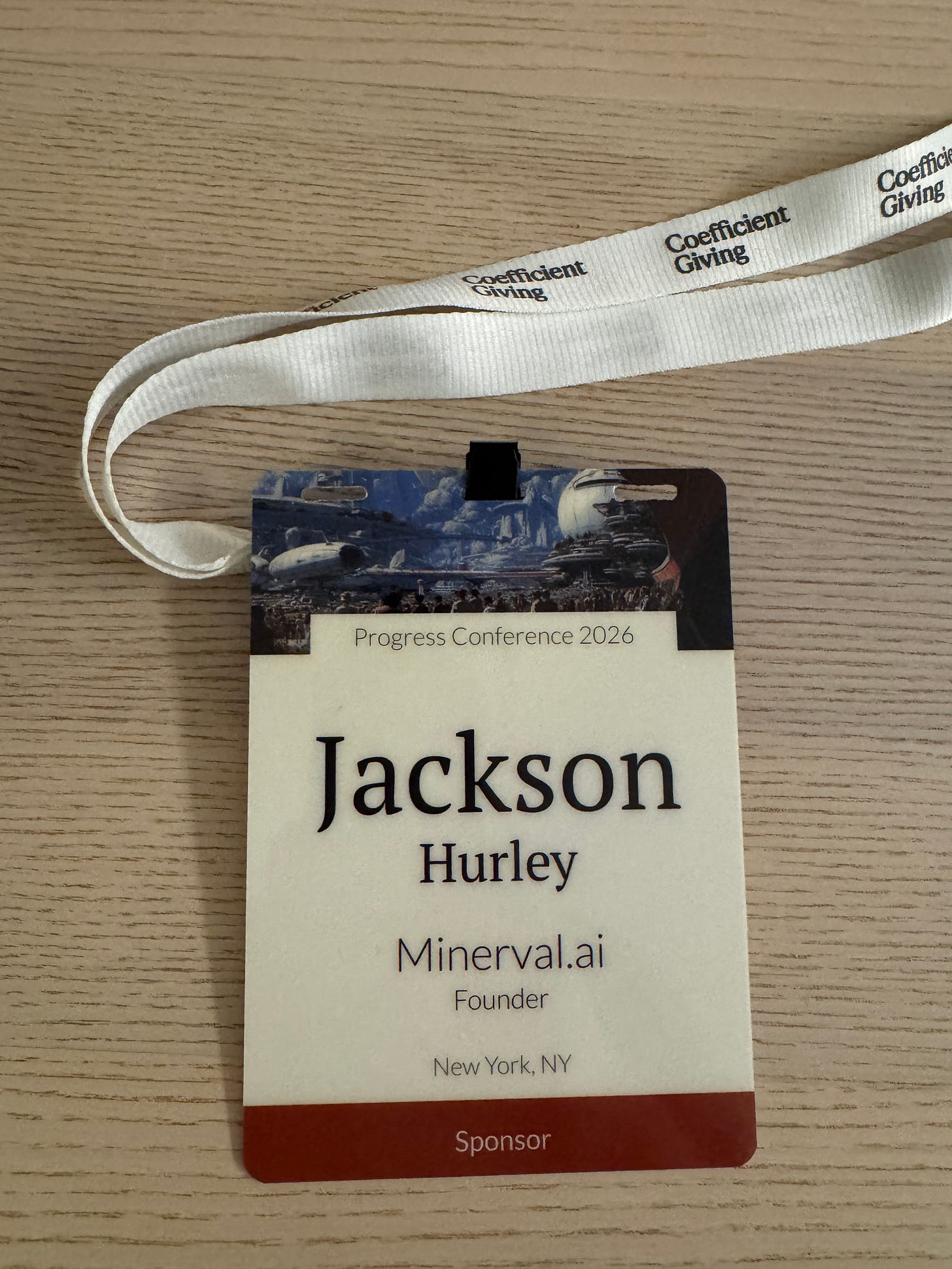
Epistemic status: Reflections on ProgressCon 2026, written up over the following weeks. Quotes are reconstructed from memory. Artistic license taken.
For in much wisdom is much grief: and he that increaseth knowledge increaseth sorrow.
– Ecclesiastes 1:18
“I’m sure you’ve all heard about the math stuff that OpenAI released earlier this week.”
It is Thursday, October 8, 2026, and the CEO of a bio lab automation startup is giving us a tour of their San Francisco office.
“Raise your hand if you think that’s a good thing.” A dozen hands shoot up out of thirty visitors. Along with ten more, my arm rises weakly to half-join them.
“Raise your hand if you think it’s not a good thing.” I look around. A couple of quiet chuckles. No hands.
He leads us through the kitchen and the standard startup office space and into the room with the robots. They are simple 3 foot by 2 foot by 2 foot boxes, set on four rows of desks. They have been chosen because they are cheap (only a couple thousand dollars each) and run on open source software on a Raspberry Pi, which means they can be modified arbitrarily.
Inside are six standard 96-well plates (8 by 12 rows of tiny plastic tubes). Above them hangs a simple robot arm with one available motion: pipetting. He shows us a series of janky bright green 3D-printed contraptions that they attach to the arm. The pipetting mechanism is connected to gears and levers that translate the energy into whatever they want.
It turns out, most of biology is just moving small quantities of liquid between test tubes, mixing them, heating them up, and cooling them down.
They 3D print everything. Claude is really good at 3D modeling now, so if they want a new part or to change something on an existing part, they just tell Claude, and it changes the model and prints a new one. They have 3D printers in all their labs around the world. When they design a new tool, they don’t have to rely on supply chains in China, they just send the design to all the labs and print them.
Scientists used to take weeks to run these tests. Now they drop their samples off in a dropbox, the company picks them up and gets them on the next plane. By 1AM, their biggest lab, located inside the FedEx airport in Louisville, Kentucky, has already received the sample and the order form/protocol. Their lab robots run the samples according to the protocol, and the results are ready by 6AM.
Just in the last few weeks, the models are good enough to do vibe-science, where you talk to Claude, and it comes up with the lab protocol to run your experiment.
I wander over to one of the biologists who works there. He says Claude used protein design models to come up with some candidate proteins that might bind to a particular receptor. He is running 96 candidates through a protocol it designed.
The little arm lifts the samples out of the first wash, moves them horizontally a few inches, and, slightly jiggling, lowers them into the second wash.
“Where did you make the candidates?”
“Oh, we have a machine in the other room. I can show you if you like.”
“Is that automated?”
“Not yet.”
I have come to ProgressCon 2026 at Lighthaven to find potential cofounders and investors for my startup.
I notice someone with ___ Ventures on their well-designed badge.
“Hi. Jackson.”
[Handshake]
“So what brings you here.”
“I’m trying to get my AI startup off the ground.”
“Ah, cool. [reads badge]. Minerval AI. What’s that?”
“It’s AI for epistemics.”
“AI for epidemics? Isn’t that...”
“Uh, no, it’s, like, using AI to figure out what’s true, and help people hold more correct beliefs.”
“Oh.”
I am still honing my pitch.
Someone who worked on frontier bio risk evals describes what it was like.
“You would talk to one expert and they would say ‘This makes it easy to do [X] and [Y], but you still need [Z]’. Then you’d talk to another expert and they’d say, ‘[Y] and [Z] are easy. The hard part is [X]. We don’t actually know how much uplift it would give someone. It’s not like we’re hiring a bunch of terrorists and running a randomized trial to see if they can make a bioweapon.”
“So why do you think is holding back all the bioweapons?”
At a nearby table, the author of You Can Just Do Things is giving out signed copies.
I learned about the conference too late to apply normally. It was already full by the time I started Minerval a few months ago. There were slots for sponsors, though. $5,000 and a few emails later, I had a ticket for one entry and Minerval’s logo on the conference website.
“So how does it work?”
“Well, first we ingest claims, from,