‘Our Risk, Their Reward’: Zohran Mamdani on AI and Data Centers
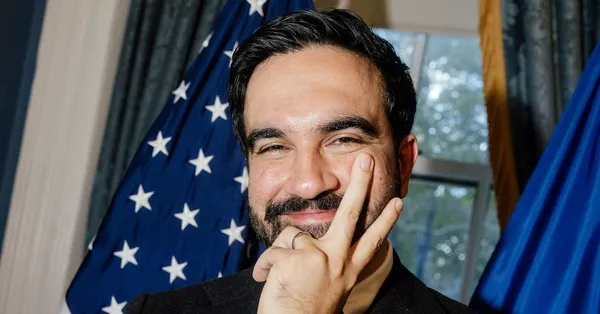
In October 2025, weeks before his historic election win, WIRED sat down with Mamdani for an interview at his campaign office. I remember, vividly, the energy that he carried into the room. This was a man, after all, who’d just pulled off a stunning political feat, rising from being an unknown to becoming the mayoral front-runner in a matter of months. In part, that was because of his message, which focused squarely on affordability and the working class. But much of Mamdani’s campaign success can be attributed to how that message was delivered, namely through a mastery of social media that made every other politician in America look like they were still figuring out how to open Instagram. Mamdani, then just about to turn 34, radiated in our first conversation with what I can best describe as a supernatural electricity. It lit up the room, and in a subsequent photo shoot on a bustling Manhattan street, drew passersby as if by magic. New Yorkers hooted and hollered at the candidate who, seemingly overnight, had made the mundanity of local politics feel like a cultural revolution. Fast-forward one year, and the Mamdani electricity is still there—it just might be a little bit more tired. The daily grind of governing, after all, doesn’t offer quite the same excitement as a rocket-ship campaign. Not to mention that Mamdani, particularly given his massive reach online, has now become a lightning rod for polarizing conversations, from Israel to the Democratic Socialists of America, as well as a beacon of political hope for millions across the country and even around the world. Mamdani’s approval rating among Big Apple voters sits at a stunning 69 percent, and he’s become among the most influential figures on the American left; he’s also been described, by his harshest critics, as a dangerous radical whose politics threaten the very city he’s been elected to lead. No pressure. During a sit-down interview at New York’s City Hall, the mayor and I spoke about what he’s learned during his 10 months on the job, how he uses social media as a tool for governance, and where he stands on some of the most pressing issues facing Americans in today’s midterm elections. Mamdani might be tired—he divulged, hoarsely, that it had been “a long day”—but the internet’s Mayor also seems newly liberated, and certainly empowered to speak his mind. Winning power and wielding it, after all, are two very different things. And right now, the power is squarely in Zohran Mamdani’s corner. KATIE DRUMMOND: It was almost exactly this time last year that I interviewed you in your campaign office. I remember that for two reasons. One, it was just before the election, but two, you were just about to have a birthday. I was remembering that this weekend, because I was in Sunset Park on Saturday. Sunset Park, for those who don't know, is the best park in Brooklyn, and actually all of New York. I'm sure you agree. While I was there, I saw you being serenaded with “Happy Birthday.” I did not join. I kept walking. I was like, “I’m gonna see this guy.” ZOHRAN MAMDANI: I was wondering, like, “Who’s that woman who’s not singing along?” Yes, the one with the really excited 9-year-old, and her mom was like, “No, we’re gonna keep going.” That was me. Good to know. Do you feel a year older? How has the last year of your life been? It’s been a pretty incredible year. It has also been probably the most transformative year that I’ve lived in my life in terms of what my life was versus what it is now. Much of that year has been having the privilege of having the greatest job in the world. To lead this city and now to be 35. 35. 35. 35. 35. How old do you feel? I think 35. It’s a funny thing because in the world of my friends, this is an age that has a lot of existential questions that come with it. In the work that I do, most people are significantly older than me, and so the meaning of the age, it doesn’t really live in a professional setting. Do you ever feel like your age is a barrier in politics? No. When I met [Brazilian President Luiz Inácio] Lula [da Silva] during the UN General Assembly, he was very excited by the fact that I was young. [Laughs] He kept coming back, “So young!” I don’t think it’s a barrier. It’s been one that has also illuminated both the promises and the betrayals of politics. To be 35 means you grew up through the housing crisis. You grew up through the Iraq War. You grew up through so much of what has shaped our country’s politics over the last few decades. These have been formative moments in my and so many other people’s lives. That too often politics is shaped by those for whom these are issues that just affect other people, not ones that have been all-consuming. We spent quite a bit of time last year talking about social media and your campaign’s use of it. WIRED declared you the internet’s Mayor. That was before you even won the election. It was a gamble. We felt pretty good about your odds … Not sponsored by Kalshi. No, absolutely not, and never. You told us that you wanted your campaign to not just do social media better than other candidates; you wanted to “own the medium.” You’re still at it. How are you thinking about social media as a tool now for governance versus a tool for campaigning? I think the similarity is that you have to continue to recognize the fact that for many New Yorkers, this is how they engage with the world. It is yet another medium that has to be treated with the same legitimacy and respect as traditional mediums. I say that because if your goal is to reach as many New Yorkers as possible to tell them about a policy that you are unveiling that they could stand to benefit from, your responsibility is then to communicate through every conceivable measure. Social media means that we can make a video that could reach, that will reach, more than a million people. That’s just on one specific medium. Also, it means that you have to continue to work your way backwards from How are New Yorkers consuming media? It’s not that we have the right answer, it’s just that we’re listening. For example, we heard from a number of Spanish-speaking New Yorkers that if you really want to communicate with a specific constituency that you’re not reaching right now, you need to make a WhatsApp channel. So we made a WhatsApp channel, El Chisme Oficial de NYC, and on that channel we will share directly with Spanish-speaking New Yorkers information that we’re putting out, and you will hear voice notes of me speaking in incredibly halting Spanish about what that policy is. I think for too long there’s been a sense of “pat myself on the back” in government where it’s like, “I put out the paper press release. People should just know. I put this in one obscure place that people could find if they were looking for it.” We have to make politics and political decisions something that reach people wherever they already are, as opposed to the condescension that comes with, “If you’re not reading this, then it’s not meant for you.” You also talked last year about your time campaigning and feeling like you needed to put yourself out there on social media in different ways, “Many of which are embarrassing.” What does it look like to be less embarrassing on social media now that you’re the mayor? You’re asking the wrong guy. Have you tried to clean up your act a little bit? I feel like I’m equally embarrassing. I think there’s a part of social media which is all about the presentation of cool and mystery. I don’t think that’s what you’re doing. That’s not where I live. We’re not living in mystery. I live in a world where you will know everything about me, and I have to utilize that to try and share the message of what we’re doing and why we’re doing it. I think in some ways that means abandoning any fear of embarrassment or what it means for perception. If the way that you can learn about the Rent Guidelines Board is me jumping into freezing cold water, then so be it. That’s what it was when I was running for office, and I think today we’re still taking the same approach of: How can we communicate with as many people as possible? How can we not veer into a place of complacency? That “Oh, now that I’m the mayor, it means everything has to conform to a traditional outreach.” Part of the reason why so many people feel so ambivalent, at best, about politics is that there’s a sense of irrelevance. And some of that irrelevance comes from the focus of politics, but some of it also comes from the methods of politics. If politics continues to present itself in a way that it did 20 years ago, that is ignoring the fact that we are living in a very different world today. That’s the world that we should be speaking to, and that’s the world whose concerns we should be reflecting. I would just say that in the year since we sat down together, there’s been a lot of focus on our use of the medium, as if that is more important than the message. I think it’s important to focus on the use of medium, the respect for the medium, and also to understand that putting tired, old ideas into a short-form version in a vertical video does not answer the critical issue with politics today. It’s not just the presentation, it’s also the substance. The New York Times published a story in September about your office’s work with creators. Your administration works with lots of creators, some of whom receive talking points around initiatives. They’re invited to cover events, sometimes where traditional journalists, people like myself, would not be present. Among the concerns raised in that piece is the idea of this distinction between journalist and creator. I understand wanting to leverage social media to reach people in new ways. I think that’s really laudable. But how do you think about that distinction between, quote unquote, “professional journalism” and content creation? Because I think for the average person, and people are very smart, that line has become incredibly blurry. I would push you a little bit. Push away. Talking points are essentially the basis of a press release, right? When we announce a new policy, in the press release there’ll be quotes from myself and other relevant agency heads and other relevant politicians, and then there’ll also be a description as to what the policy is. To me, that is so critical because we’re looking to demystify politics, and some policies are pretty self-explanatory, and other policies are ones that, frankly, if I didn’t have talking points, then I wouldn’t even be able to formulate what that is. Earlier this week, we announced that we were going to deliver on an innovative solution to flooding in Central Park. We were going to be able to lower the water levels in three key water bodies to ensure that we would do so in advance of a storm, and then prevent the typical storm water runoff. You need to be able to explain that before you have a conversation about it. So that’s where I would push a little bit on the idea of what talking points are and what they serve. To your question, you have to be able to treat all of these different mediums with respect and understand the differences between them. If we were an administration that exclusively engaged with digital-first creators, then that would be an issue. But what I see as important is we have to speak to journalists for whom their medium is television, newspaper, radio, digital, magazine, as well as those for whom their only medium might be TikTok or Instagram or Twitter or Bluesky, whatever it may be. It cannot be a choice any longer, because I think, as you’ve said, for many New Yorkers, there is a sense that all of this is media. I think we have to have respect for that, as opposed to what has long been a political condescension about which media is legitimate and which media is illegitimate. How do you separate audiences in your mind when you think about what you would say on TikTok or Instagram, what you would say to a journalist, what you would say behind a podium? Do you think about those distinctions? Not so much. I think if you try to calibrate yourself for every single constituency, you are losing sight of why people will want to listen. It starts to veer into an imitation as opposed to a presentation of the facts, and I think there’s a difference in that we’ll sit down for 48 minutes. But if I put out a video on Instagram that’s 48 minutes, is it gonna do well? No. But if I’m thinking that I should speak like this over there, and then I should speak like this over here, you’re gonna end up kind of twisting and turning yourself into knots. I want to move to the midterms, but last year we spent some well-earned time talking about Eric Adams’ social media campaign. He did incredible things on those platforms. Remarkable. Michael Bay. His life has been changed by that one video. Phenomenal. Who is the Eric Adams of the midterms on social? The social media that I am still confused by … Sure. … is that of the departing Congressman Shri Thanedar. I don’t know about this one. I just never fully understand what I’m looking at. What are you looking at? What’s happening in the videos? Sometimes it’s even just still images. Are we in carousel mode? Is it just a single photo? Typically solo style. I would invite others to take a look, and I would say that I’m very excited as well about the incoming congressman. I will take a look. [Laughs] There is some remarkable AI-generated social media content from some candidates, some of which includes AI-generated versions of you talking about, I think it was a delusion pill. I have not seen that one. You and Governor Hochul, you’re talking about taking the delusion pill … What? … where you think that having higher taxes and less money is a good thing. You should check this out. Was this from [Republican gubernatorial candidate] Bruce Blakeman? Yes! I’m sure it was. It's incredible stuff. Mr. AI. It looks just like you. [Laughs] Yeah … You are not on the ballot for the midterms this November, but this is a big one. In the last year, you have become one of the most influential people in politics. Whether you agree with me saying that or not, you’ve been described repeatedly as something of a power broker within the Democratic Party. An endorsement from you matters. I’m curious about your decision to endorse and campaign for Governor Hochul. She's seeking reelection. You were critical of her before taking office. Can you talk us through that calculus and what changed? I think the key thing that my endorsement is a reflection of is just how productive our working relationship has been. And frankly, it is a stark contrast to that of the typical working relationship between the mayor of New York City and the governor of New York state. You look through the years, frankly, and you will find mayor and governor after mayor and governor who are seemingly forever at loggerheads. What I've found in working with Governor Hochul is that we can deliver on material wins for working-class New Yorkers. And to me, the single most exciting one of those is Universal 2K. On the eighth day of our administration, she agreed to deliver $1.2 billion to make universal childcare a reality for 2-year-olds in this city. The two of us spent a morning, maybe about a week or two ago, with a family whose child was enrolled in 2K, and they told us that before that, they had to send their child to a different state, that his grandmother had to drive him at 4:00 am for him to get to a childcare that they could afford, and they were still paying $2,300 a month. That partnership delivered this family more than $20,000 of savings that they can now put towards a house. That, to me, is what politics has to be. It has to mean something for working people. You don’t have to translate to them what $2,300 a month means. They feel it, they know it. That’s what I'm excited to build on. To me, it’s her track record. It’s her commitment to this city, one that continued in the bu